Making the Book of Kells: When art was a labor of love and bookmaking no simple task
A Cork art dealer selling licensed prints in New York talked us through how monks on Iona and at Kells made the most famous Gospel book in Ireland.
As printed in the Celtic Mirror, September 1995
They painted with pine martens and goose quills, using paper they had prepared years in advance. They worked by the light of the sun and the flickering flames of candles. Day in and day out. Season after season. For years.
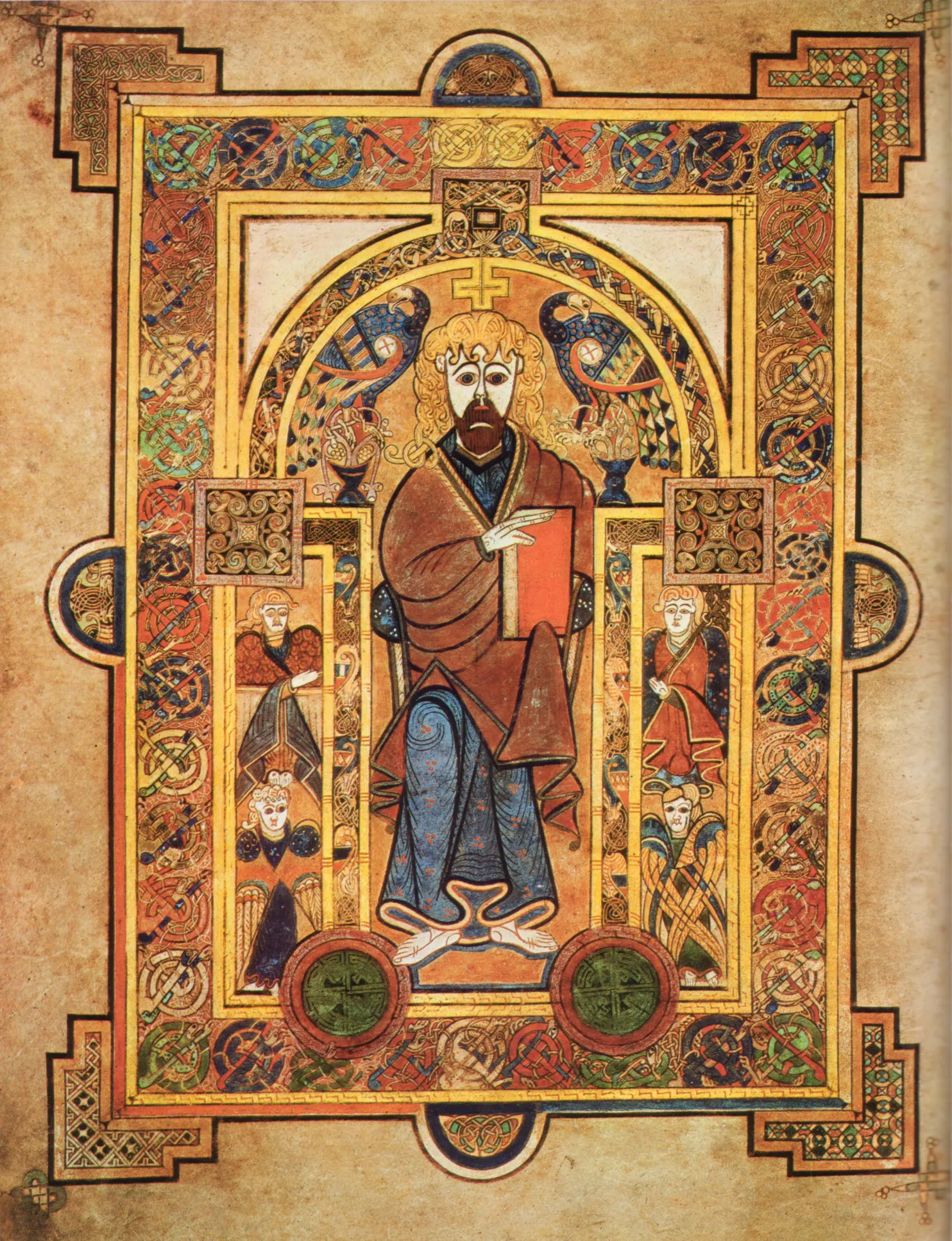
The blue used to color the picture story of St. John was probably acquired via trade with seafaring merchants who had brought it to Iona from Afghanistan. The reds in the ancient painting came from the belly of pregnant Mediterranean insects.
Such was the art of bookmaking in the eighth century, when monks at Iona began to draw and to paint the Book of Kells.
Back then, there were no arts supply shops in which to buy sable brushes, paints and specialty papers. Computer-assisted design was eons away from even being thought about - though the Celtic monks who created the book did have an interesting, albeit primitive, system for doing process color.
Arts experts, who have made careers of studying the decorated manuscript, cannot, with certainty, say how the Christian monks produced this illuminated story of the four gospels.
Nor is it known how long it took them to complete the manuscript.
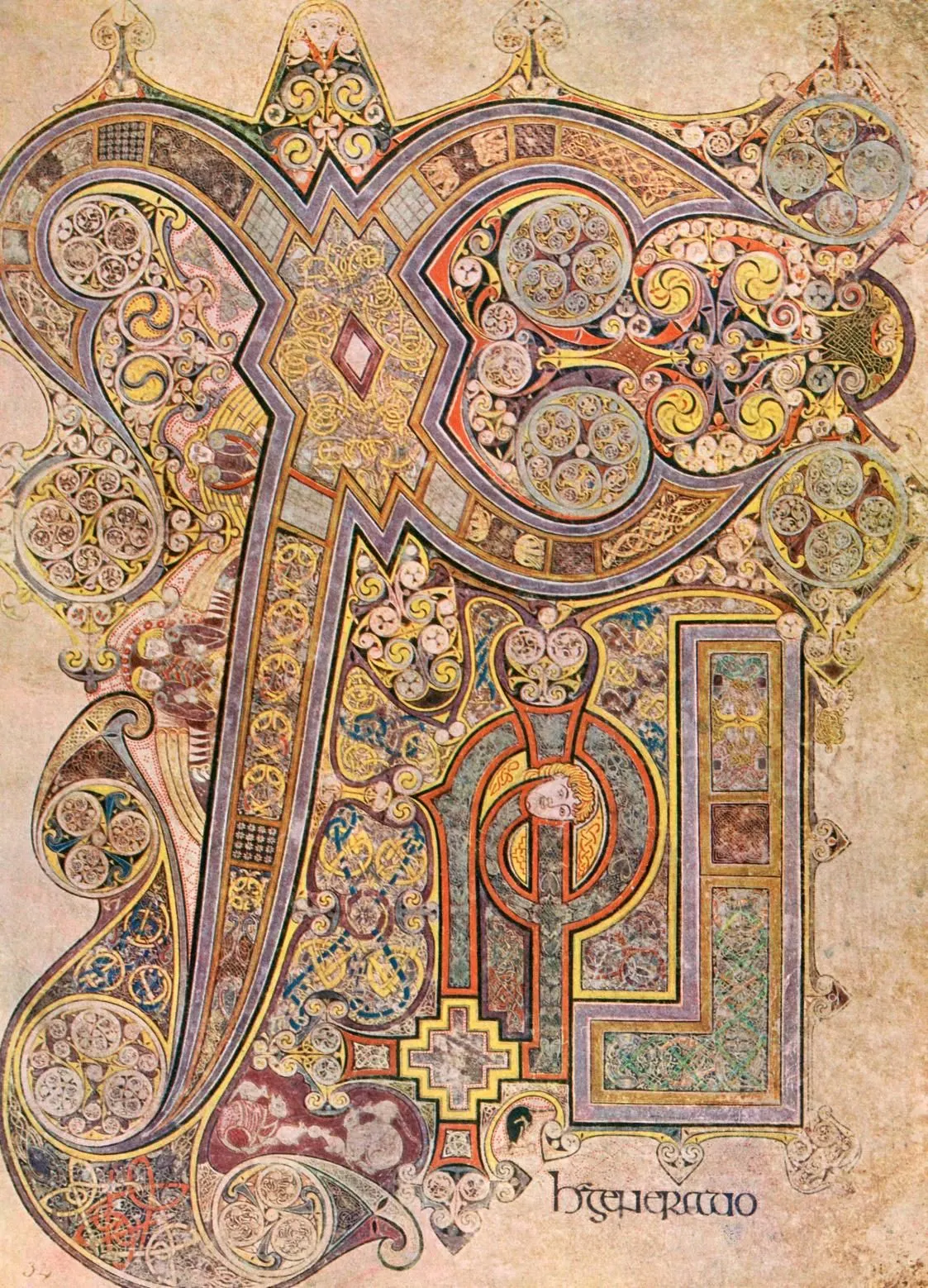
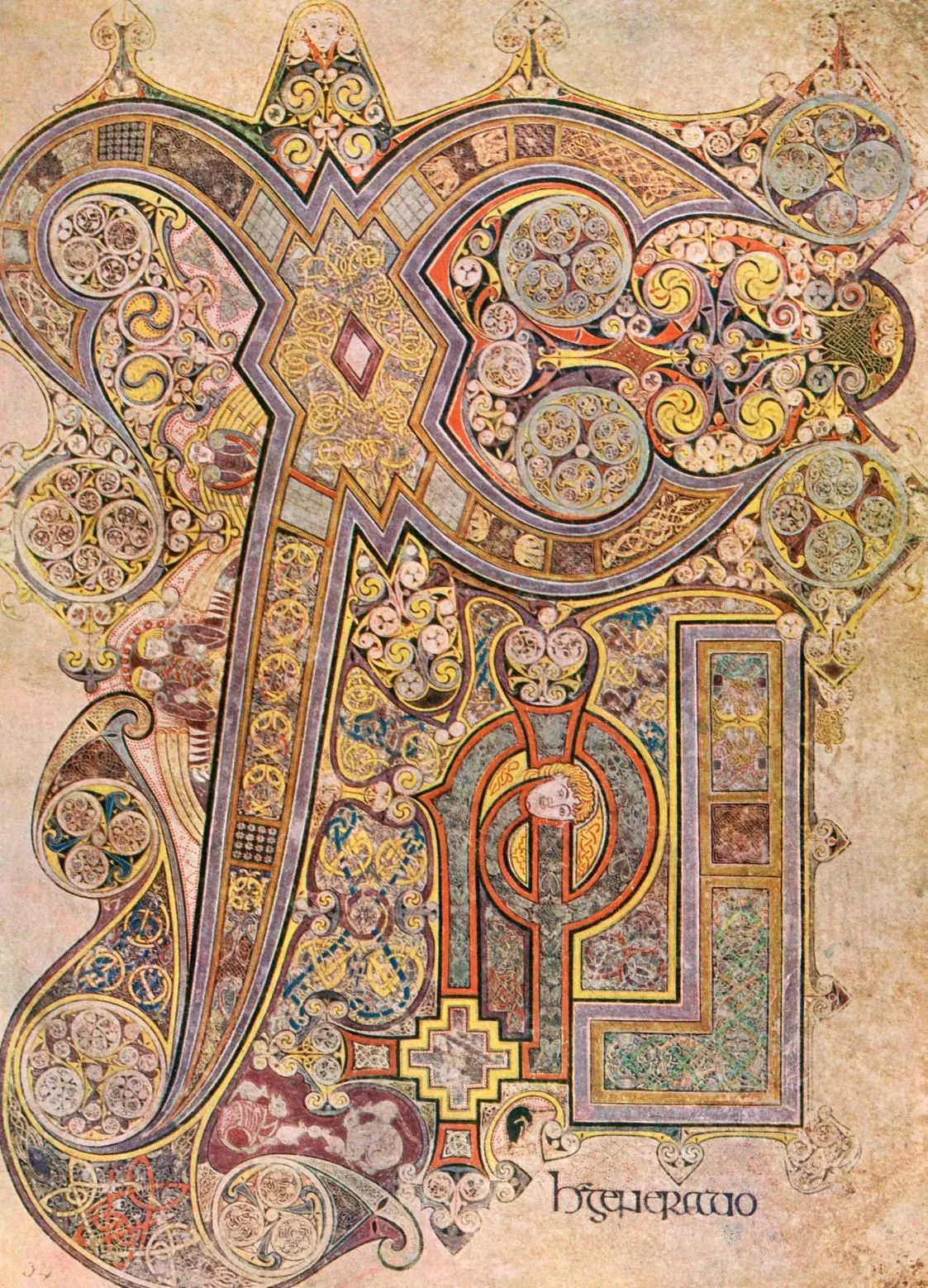
“(Scholars) say there are three major influences, three major artists working on it because of styling and changes in color, too. Different pigments were mixed differently. If you look at something like the Chi-Rho page, the most important color-graphic piece of work in the world really, and imagine the book being about 13 by 10 1/2, the actual detail and intricacy is absolutely fantastic. Almost unbelievable,” said Luis Porretta of County Cork.
A businessman dealing in fine arts and antiques, Porretta spent a week in mid-August, in New York City, talking up the availability of limited edition prints that his company, Heritage Resources Development Co. Ltd. in County Cork, and Trinity College, the keeper of the Book of Kells, are selling.
Porretta is one of the many people who believe that Colm Cille, the founder of many monasteries as well as the man who became St. Columba, originated the idea of the manuscript.
“It became their (the monks') lifelong work. No one really knows how they were able to do it. They've conjectured that maybe they had some sort of rudimentary magnifying glasses from scraped glass, but a lot of scholars say that is an impossibility.
“Sitting in their little rock huts there in Kells - and as you know, the weather is not always brilliant in Ireland, especially through the winter months - how they could have produced in the grayness and gloom something so glorious by candlelight and by natural light, we'll never know,” Porretta said. “It's a book of mystery. And, that's the great attraction to it.
“In today's world, where we know everything about everything, we go back 1,200 years, and there's hardly anything we know about the thing that has been so influential in people's lives.”
Weather notwithstanding, the holy artists had more worrisome things with which to deal - the Vikings.
Imagine being an artist who faced unannounced interruptions from weapon-wielding visitors.
For the artist of the 1990s, it would erase memories of anger at having been taken from one's work by a visit from the door-to-door salesman. Would it not?
“What happened is the monks were working on the book and the Vikings attacked a couple of times and pillaged the place, and the last time they attacked, they killed 68 monks. So, (they) hotfooted it back to Ireland and finished the book in the village of Kells just north of Dublin,” Porretta said.
“Now we know it was finished in Kells, or at least evidence is supported that it was finished in Kells, because some of the yellow pigments in the actual paintings came from pigments (of the earth) in the Kells area.
“Probably if the Vikings hadn't attacked, they would have called it ‘The Book of Iona.’”
It is not known how many monks worked on the manuscript because some of its most important pages are missing. The book did not totally survive the invasions of the Vikings.
“We reckon there is about 30-odd pages missing. Some of them being the decorated pages. We know there are three of the back pages missing. And, the last three pages contain the names of the people who did all the work,” Porretta said.
The manuscript, which is now encased in shatter-proof glass in a room at Trinity College, had also lost its cover, which historians have described as having been a masterful work of art.
“Hammered gold with rubies across it,” Porretta said. “I don't know, maybe it's buried under the ground in Scandinavia or maybe even melted down by some barbaric Viking.”
Some of the illuminated pages had not been painted, which is evidence that the work of the monks was interrupted.
For a time, the book was displayed in a church in Kells for the townsfolk to see. Around 1654, during the Cromwellian days, it was taken to Dublin for safe keeping. Henry Jones, bishop of Meath, presented it to the college in 1661.
“It was generously guarded from the ravages of time and any other commercialism, I might add,” Porretta said. “This is the first time we've entered into a commercial enterprise like this.”
While the Book of Kells is replete with Christian intonations, its main contemporary value is the art that fills each page.
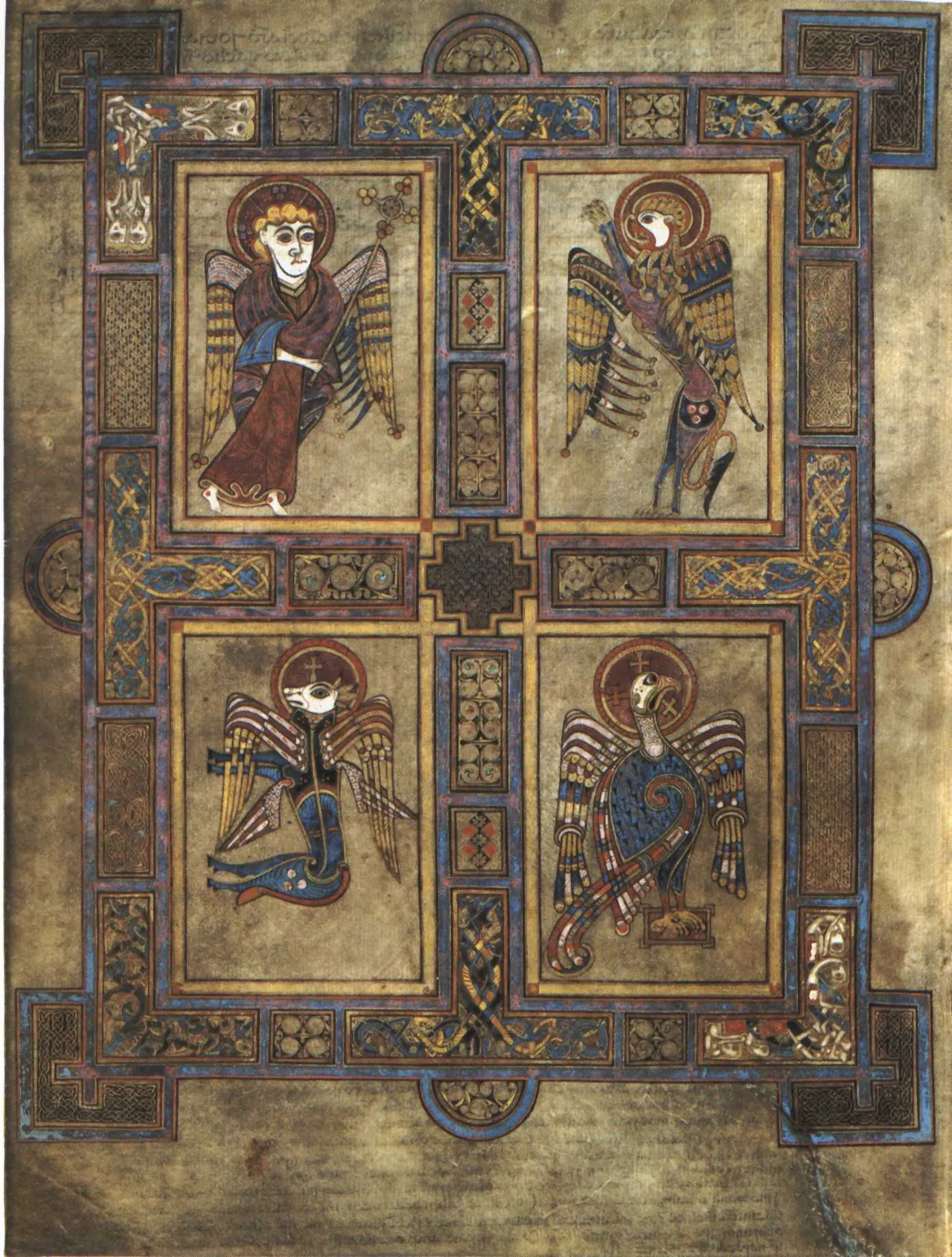
About 200 of its 600 pages are full-page paintings. The Christian monks preached to their followers through the Celtic art on these illuminated folios.
“In medieval times, it was only nobility, like Colm Cille who would have been able to read and write,” Porretta said.
“The majority of people read by pictures. So, these have all got stories in them, lost to us now in great measure. But, in medieval times, people looked at these and memorized them.
“While they were working in the fields, they brought these pictures into their minds and learned their lessons from that.”
The book was used in the way the clergy use the Bible at church.
Though, as Porretta pointed out, the Gospels in The Book of Kells - handwritten in the Latin language - do not translate as contemporary Bibles read.
“The Christian monks were Celts. So, they had come from Ireland, and so they had a tradition of Celtic art,” Porretta said.
“They used Celtic art to express their Christianity basically. There are the remains of Celtic art all over Germany, France and other places in Europe. Some of these can be found in metal work of the contemporary age in Germany,” Porretta said.
“So, there's something that isn't known - the Celtic influence spread over the whole of Europe. You see, Ireland was a major force for Christian expression through the whole of the western world.”
The Celts painted Christ as an amber-haired man with blue eyes. Moreover, it was interesting that they painted him at all.
Back then, Porretta said, people were afraid to put a face on the Lord.
Typically, with a project of such magnitude, a master scribe would have had apprentices working under his tutelage.
“If you follow the tradition of all the other decorative manuscripts of the time, somebody did the draftsmanship and a number of people did all the coloring,” Porretta said.
Among the things that the master scribe would have taught his students was artistic discipline.
“The intricacy in the work shows there was obviously tremendous amounts of discipline. It shows that they knew what they were doing.
“In fact, that's one of the reasons that we'd encourage any young artist, who wants to be an artist or is an artist, to really go back and look at these classical illustrations and see the discipline that's there, which arguably is missing in a lot of today's art.
“The Chi-Rho page probably took two years to complete.
“Now that's discipline,” Porretta said. “It was a lot more sophisticated, the actual finishing, than people might think, because the discipline involved showed a tremendous amount of sophistication in mixing the paints and inscribing the thing.
“It was a long-term process. So, when they woke up in the morning, and who knows what they did in the way of worship, they would then get to work. No doubt, they took their work home with them in the evenings.”
What the scholars say now
Porretta told the story the way it was usually told in 1995, and much of it holds. Some of it has been revised, and the paint box most of all.
The blue from Afghanistan and the Mediterranean purple were long treated as proof of how much money and trade went into the book. Modern examination of the pigments found no lapis lazuli and no murex shell purple. The palette is red and yellow ochre, a green copper pigment, orcein, and woad. Woad and lichen dyes for the blues and purples now count as strong evidence that the painting began in what is today Scotland, which fits the Iona story rather well. There is no gold or silver leaf in it at all.
The link to Colm Cille himself has gone. Columba died in 597, and the manuscript is now dated to around 800, two centuries later. The book is still often called the Book of Columba, but no scholar thinks he planned it. The Viking story stands broadly as told: the community moved from Iona to Kells, where the new abbey was built between 807 and 814, and Kells was raided many times in the following decades.
The lost cover is a matter of record. The Annals of Ulster report that in 1007 the great Gospel of Columba was stolen at night from the stone church at Kells for the sake of its shrine. It turned up a few months later under a sod, with the jewelled cover gone. The tearing may explain some of the missing leaves at the front and back.
Porretta's 600 pages are, by today's count, 340 vellum folios, or 680 pages. Since a 1953 rebinding by Roger Powell the book sits in four volumes. Two pages are on show in the Old Library at Trinity at any one time, turned every 12 weeks, and the whole manuscript can be read online through Trinity's Digital Collections. The book itself rarely travels. When the Gospel of Mark volume went to Canberra in 2000, only the fourth trip abroad in its history, it came back with minor pigment damage, blamed on vibration in flight.
Questions readers ask
Where was the Book of Kells made?
The Book of Kells was most likely begun at the Columban monastery on Iona, in what is now Scotland, and finished or kept at Kells, County Meath, after the community moved there; the new abbey at Kells was built between 807 and 814. Woad and lichen-based blues and purples in the paint support a Scottish start to the work.
Did the Book of Kells use lapis lazuli?
For years writers said the blue came from Afghan lapis lazuli and the purple from Mediterranean murex shells. Modern pigment analysis found neither. The colours come from red and yellow ochre, a green copper pigment, orcein and woad, and the manuscript uses no gold or silver leaf at all.
How many pages are in the Book of Kells?
The surviving manuscript has 340 vellum folios, which make 680 pages. Some leaves are lost from the beginning and end, probably torn away when thieves ripped off its jewelled cover in 1007. Since a 1953 rebinding by Roger Powell it has been kept in four separate volumes at Trinity College Dublin.
Can you see the Book of Kells online?
Trinity College Dublin publishes high-resolution images of every page through its Digital Collections portal, based on photography made for the 1990 Faksimile-Verlag facsimile. In the Old Library itself, two pages are displayed at a time and the opening is changed every 12 weeks, so a return visit usually shows a different spread of the manuscript.
When did the Book of Kells come to Trinity College?
The book stayed in Kells until 1654, when Cromwell's cavalry were quartered in the town and the governor sent it to Dublin for safekeeping. Henry Jones, then Bishop of Clogher and vice-chancellor of the University of Dublin, presented it to Trinity College in 1661, and it has been there ever since.