Conference links women from around the world
Ireland's equality minister told the 1995 Beijing women's conference his government would make equality real in law and in fact. What Dublin delivered.
As printed in the Celtic Mirror, September 1995
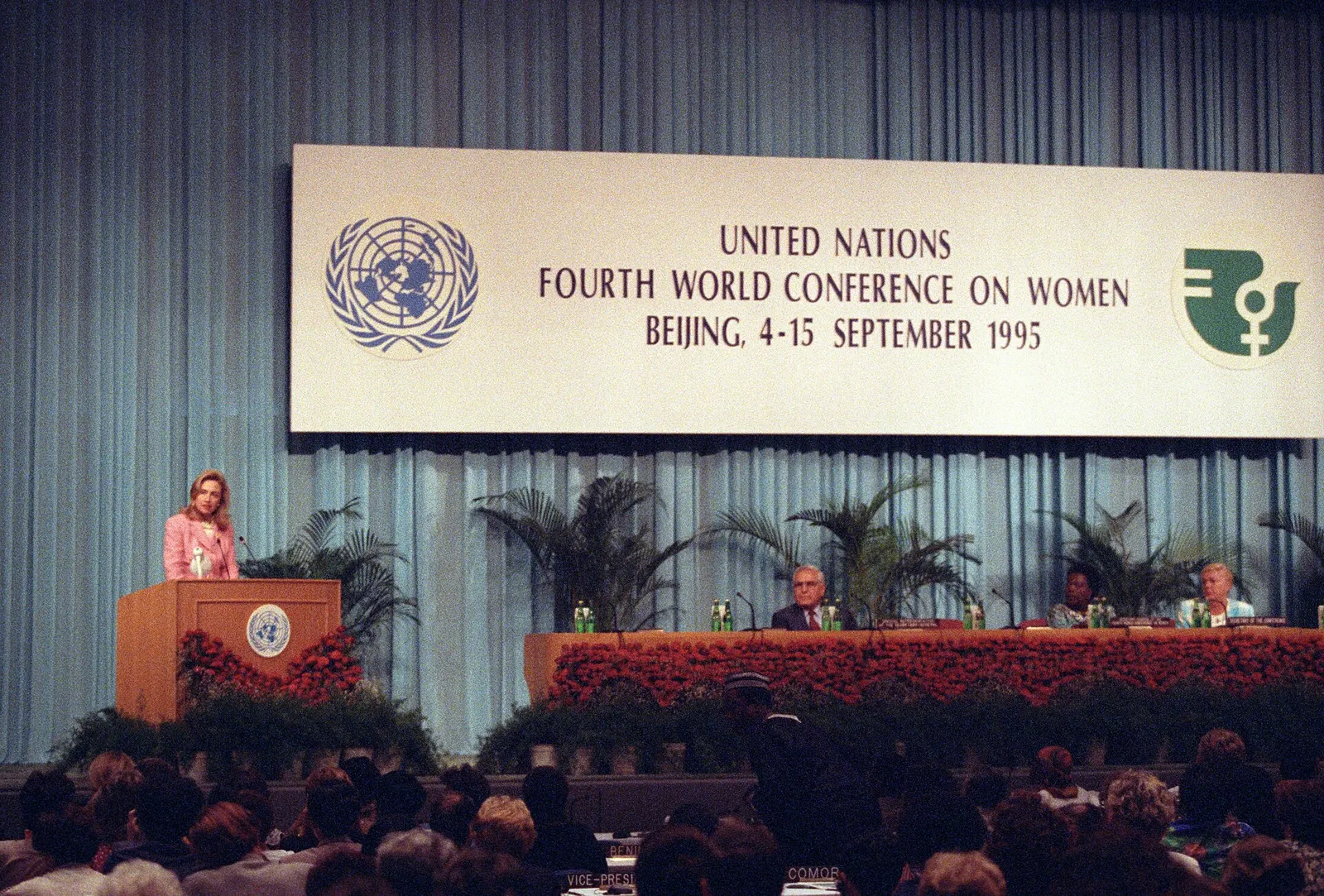
Mervyn Taylor, minister for Equality and Law Reform of Ireland, was one of the leaders who spoke at the Fourth World Conference on Women last week in Beijing.
Taylor joined women peers representing many and diverse countries of the world to talk about sociological, economic and political issues of concern to women, including equality in the workplace and domestic violence.
The purpose of the conference was to define the goals for women's status for the next decade.
The conference was particularly memorable for American women because it was held in the year in which women in the United States are marking the 75th anniversary of women's suffrage. Additionally, there is a strong effort among Congressional Republicans to eradicate affirmative action policies that give certain preferences to American businesswomen who compete for government contracts.
That movement is trickling down to state levels, where affirmative action laws are also in place and in danger of being removed.
In his statement about what Ireland is doing to advance the standing of women, Taylor said: “The Irish government plans to make equality a reality in Irish society, both in law and in fact. The platform for action should be built on previously agreed standards and all obstacles to women's full participation in public life must be removed.
“Ireland attaches importance to equal participation of women in decision-making roles and aims to ensure that women account for at least 40 percent of the membership of State Boards.”
Taylor also said that strategies to promote increased involvement of women in the workplace must include “family-friendly conditions of employment,” increased sharing of family responsibilities and access to quality child care.
“There are plans to introduce legislation to outlaw discrimination in nonemployment areas also on grounds of gender, marital and parental status, and sexual orientation. Ireland supports an examination of international legal mechanisms to promote equality of women and men. Women's health, including sexual and reproductive health and rights, is vital to achieving the aims of the Conference,” Taylor told colleagues.
Taylor concluded by saying the government of Ireland is implementing a policy to develop a comprehensive family planning service within the public health system. The service will include education, counseling and advice on all methods of contraception.
“Steps have been taken to ensure a wide range of family planning services free of charge to the poorest in the community,” Taylor said.
Meanwhile, United Nations Development Program Administrator James Gustave Speth told conference participants that if women's labor was paid or given a proper market value, they would emerge as the major breadwinners in most societies.
Despite rapid strides in women's health and education, the doors to economic and political power were barely open, Speth said, citing figures from UNDP's 1995 Human Development report.
Policy makers must recognize women's contributions to the economy and ensure their equal access to resources and opportunities. Development planners and international agencies must incorporate gender issues and concerns into policies and programs, he said.
From Beijing to the ballot box
A note on the restoration first. The 1995 page spelled the minister's name “Taylog” throughout and, in places, referred to him as “she.” He was Mervyn Taylor, a Labour TD for Dublin South-West, born to a Jewish family in Dublin in 1931 and a solicitor by trade. We have corrected both.
The conference he addressed ran from 4 to 15 September 1995. It drew representatives of 189 governments and some 17,000 participants, with another 30,000 activists at a parallel forum. Its lasting product was the Beijing Platform for Action, the plan Taylor said should be built on agreed standards. The line most people remember from those two weeks came from an American, not an Irishman: Hillary Clinton's speech of 5 September, “Women's Rights Are Human Rights.”
Taylor went home to a harder fight. In 1995 he was the minister in charge of removing the constitutional ban on divorce. He steered the bills through both houses, and the referendum of 24 November 1995 passed by about half of one per cent. The anti-discrimination laws he promised in Beijing ran into trouble: the Supreme Court struck down his Employment Equality Bill and Equal Status Bill. Revised versions were approved in the last months of his term and enacted by the next government, the first of them as the Employment Equality Act 1998. That Act also renamed the old Employment Equality Agency, set up in 1977, as the Equality Authority, which was merged into the new Irish Human Rights and Equality Commission on 1 November 2014.
The reproductive health language in his speech took far longer to reach the constitution. The Eighth Amendment, which had banned abortion except where a woman's life was at risk, was repealed by referendum on 25 May 2018 with 66.4 percent voting yes.
Taylor left office in June 1997 and died on 23 September 2021, aged 89. President Michael D. Higgins led the tributes.
Questions readers ask
When was the Beijing women's conference?
The Fourth World Conference on Women was held in Beijing from 4 to 15 September 1995. Representatives of 189 governments attended, with about 17,000 participants and roughly 30,000 more activists at a parallel NGO forum. The conference adopted the Beijing Declaration and Platform for Action, a plan for legal equality agreed by governments from around the world.
What did Hillary Clinton say in Beijing in 1995?
On 5 September 1995 Hillary Clinton, then First Lady of the United States, delivered the speech known as Women's Rights Are Human Rights to the Fourth World Conference on Women. It is regarded as one of the most influential speeches of the period, and in 2013 she led a review of what had changed since.
Who was Ireland's Minister for Equality and Law Reform?
Mervyn Taylor of the Labour Party held the post from January 1993 to 1997, apart from a short break in 1994. He steered the 1995 divorce referendum, which passed by about 0.5 percent, and drafted the employment equality and equal status bills later enacted by the next government. He died in September 2021.
When did Ireland legalise divorce?
Irish voters removed the constitutional ban on divorce in a referendum held on 24 November 1995, approving the Fifteenth Amendment by a margin of about half of one per cent. The government campaign was led by Mervyn Taylor, the Minister for Equality and Law Reform who had spoken at the Beijing women's conference two months earlier.