Irish Great Famine taught alongside Jewish Holocaust: New Jersey law used as model for nation
Irish-American activists in Nutley wanted the Famine in every state's genocide curriculum. New Jersey said yes a year later, and the argument began.
As printed in the Celtic Mirror, September 1995
NUTLEY, N.J. - The Irish Action Coalition is engaged in recruiting activists to appeal to state representatives to introduce and pass a Holocaust Education Law, mandating the teaching in public school of the Genocide of the Irish people during the Great Irish Famine alongside the teaching of the Jews' Holocaust.
Currently, New Jersey is the only state that has passed this law.
New Jersey Gov. Christie Whitman signed a bill into law last April that expanded the state's Holocaust Commission's mission to prepare school materials “of a wide range of genocides.”
The coalition, along with members of the Ancient Order of Hibernians and the American Irish Political Action Committee, have formed an ad hoc committee of teachers, scholars and authors, to put together a curriculum on the Irish Famine to be presented to the Holocaust Commission for implementation in public schools in 1996.
“We would like to see every school, in every state in the union, teaching this curriculum,” said Helen McClafferty, co-chairwoman of the IAC.
To this end, McClafferty has mailed literature to thousands of Irish Americans across the country, urging them to contact their state representatives to pass legislation that would result in the “Irish Holocaust” being taught in the states' public schools.
The IAC is willing to help any group or activist who wants to undertake this project in their state.
Write or call James Mullin, 757 Paddock Path, Moorestown, NJ 08057, (609) 727-4255 or Helen McClafferty, 3B River Road, Nutley, NJ 07110, (201) 667-1875.
What New Jersey taught
The ad hoc committee in this item finished its work on schedule. On 10 September 1996 the New Jersey Commission on Holocaust Education approved a unit on the Great Irish Famine for its Holocaust and Genocide Curriculum at secondary level. A revised version was submitted in November 1998. The main drafter was the man whose phone number ends the story: James Mullin of Moorestown, a librarian, who later wrote up the whole effort as The New Jersey Famine Curriculum: a report, published in the journal Éire-Ireland in 2002.
The curriculum did what the coalition wanted and drew the reaction its framing invited. The word in the headline, genocide, was the sticking point. After criticism, the Holocaust Commission asked for statements from two academics on whether the Famine met that definition. They came from two law professors, Charles E. Rice and Francis Boyle, neither of them known for work on Irish history. Their opinion held that between 1845 and 1850 the British government had knowingly pursued a policy of mass starvation that amounted to genocide under Article II of the 1948 Genocide Convention, applied retrospectively.
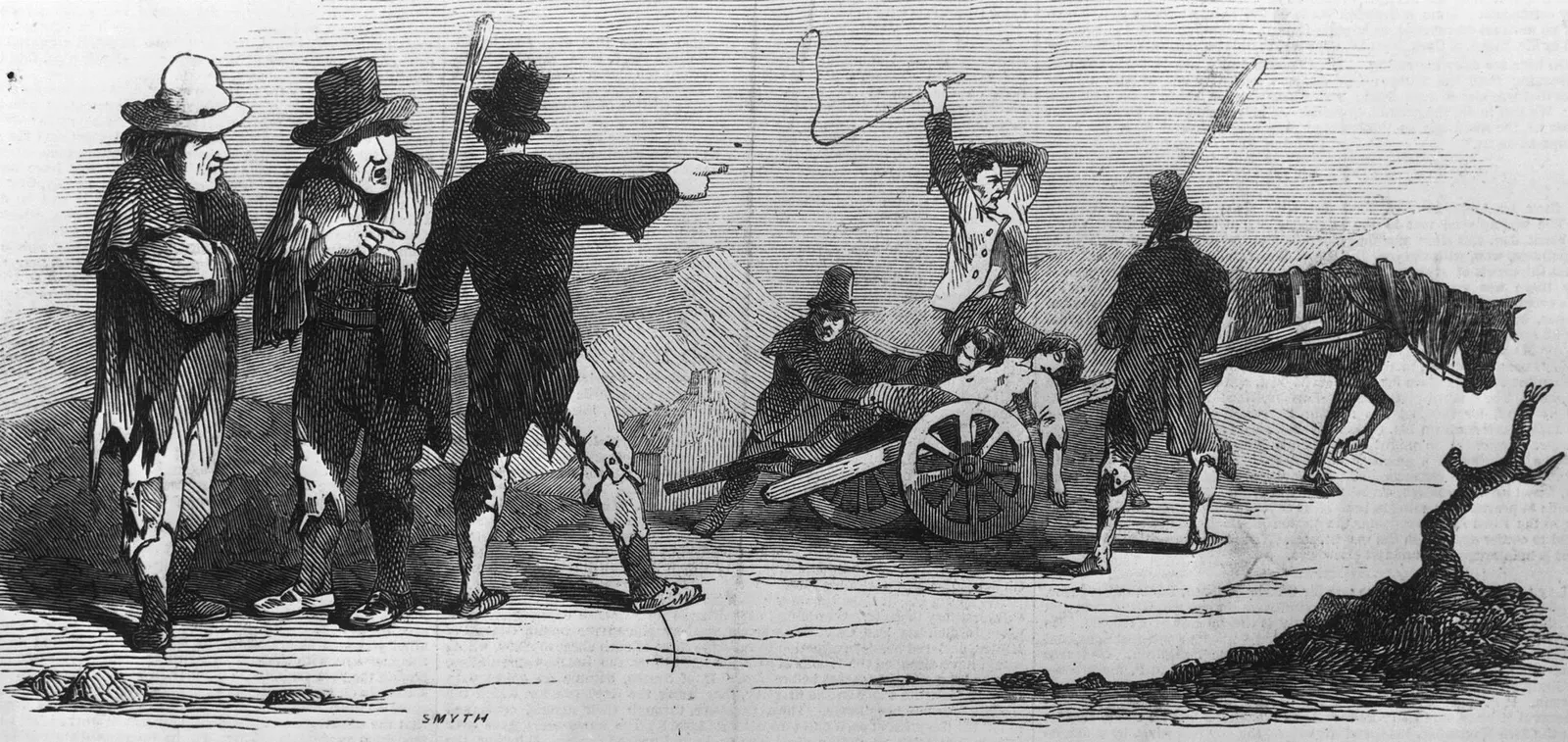
The teaching text itself had a longer life than the quarrel. The Irish Famine Curriculum Committee published it in 1998 as The Great Irish Famine, and it is still cited by general reference works, for instance on the way Irish ports were closed to food exports during the shortages of 1782 and 1783, when local prices promptly dropped. The contrast is the point. In the 1840s large quantities of food were still exported from Ireland, and London's refusal to bar those exports, as it had on earlier occasions, has been a source of anger ever since.
Historians of Ireland have mostly not followed them. The Irish historian Cormac Ó Gráda has said that no academic historian continues to take the genocide claim seriously, because genocide requires murderous intent and not even the most bigoted commentators of the day sought the extermination of the Irish. Others put it more carefully: few historians in Ireland would call it genocide, but that does not mean British policy, in what it did and in what it refused to do, had no effect on who starved and who emigrated. That middle position is roughly where the scholarship rests in 2026.
The numbers themselves are not in dispute. About one million people died between 1845 and 1852, and at least 2.1 million left Ireland between 1845 and 1855. On the eve of the Famine the island had about 8.5 million people. Its population fell by 20 to 25 percent between 1841 and 1871.
Outside the classroom, the Irish-American push produced memorials more than laws. New York dedicated its Irish Hunger Memorial in Battery Park City on 16 July 2002, a half-acre site built around a 19th-century cottage from Attymass, County Mayo. In Ireland, the state has held a National Famine Commemoration Day since 2008, usually on a Sunday in May.
Christine Todd Whitman, who signed the expanded commission law in 1995, left the governor's office in January 2001 to run the federal Environmental Protection Agency.
Questions readers ask
Is the Irish famine taught in New Jersey schools?
On 10 September 1996 the New Jersey Commission on Holocaust Education approved a Great Irish Famine unit for its Holocaust and Genocide Curriculum at secondary level, with a revision submitted in November 1998. It was drafted largely by the librarian James Mullin after lobbying by Irish-American groups including the Irish Action Coalition.
Do historians consider the Irish famine a genocide?
Most academic historians of Ireland reject the genocide label because it requires intent to destroy a people. Cormac Ó Gráda has said no academic historian takes the claim seriously. Many still argue that British policy between 1845 and 1852 worsened mortality and emigration, and the debate continues in public discussion.
Who said the Irish famine was genocide under international law?
At the request of the New Jersey Holocaust Commission, law professors Charles E. Rice and Francis Boyle provided an opinion that the British government's policy between 1845 and 1850 met Article II of the 1948 Genocide Convention, applied retrospectively. Neither man was previously known as a historian of Ireland, which critics noted.
How many people died in the Great Famine?
Around one million people died in Ireland between 1845 and 1852, and at least 2.1 million emigrated between 1845 and 1855, many to the United States. The population, about 8.5 million before the blight struck, fell by 20 to 25 percent between 1841 and 1871.