Divulging Gaelic football's fine points: Game enjoys popularity on both sides of Atlantic
A 1995 primer for American readers on the rules of Gaelic football, written days before Dublin met Tyrone in the All-Ireland final at Croke Park.
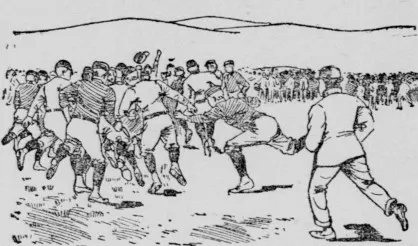
As printed in the Celtic Mirror, September 1995
Gaelic football is a game that has been played for more than 100 years, since the Gaelic Athletic Association was founded in 1884, to promote Irish language and culture.
The game of Gaelic football is very similar to Australian Rules Football and it is almost certain that the Australian game has its roots in Gaelic Football.
The game is played by two opposing teams, each with 15 players.
There is a goalkeeper, six defenders, two midfielders and six forwards.
The game is played on grass and the official minimum measurements are 130m long by 80m wide. There are two H-shaped goal posts at each end of the field.
The object of the game is to place the ball (round) between the posts for a score.
Points are scored when a player either fists or kicks the ball over the crossbar (1 point) or kicks it underneath the crossbar for 3 points.
A player is allowed to handle the ball (unlike soccer) and run with it provided he doesn't take more than four steps without either hopping the ball or kicking it back to himself.
A player may kick the ball to a team member or he may fist the ball. Throwing the ball is not allowed. An opposing player may not drag or pull at his opponent.
The player in possession may be dispossessed by knocking the ball loose with an open hand.
Games are of 70 minutes duration, each made up of two 35-minute halves.
The most prestigious award to be won in Gaelic football is an All-Ireland football title with the ultimate game played on the third Sunday of September every year.
The championship starts at the beginning of May and every county in the country is represented. There are four provinces in Ireland and the championship starts off with the provincial championships.
The four provinces are Munster (South); Leinster (East); Connacht (West); and Ulster (North). The winners of the respective provincial titles go on to compete in the All-Ireland semi-finals.
For example this year, Cork (Munster champions) played Dublin (Leinster champions) in one semi-final, while Galway (Connacht champions) played Tyrone (Ulster champions) in the other semifinal. The two winners, Dublin and Tyrone, will now meet in the All-Ireland final on Sept. 17 in Croke Park.
The All-Ireland final is always played in Croke Park (named after Archbishop Croke from Thurles, who was one of the founders of the GAA) and every year, emigrants from Ireland always find their way back to Ireland if their native county is involved in the final.
This year will be no exception and it is expected that thousands of people will travel from the four corners of the earth to see their beloved counties do battle for the ultimate prize in Gaelic football.
For those people not fortunate enough to make the trip, the game is broadcast worldwide and here in the United States, there are many centers where the game can be viewed live.
For the people who have left Ireland, Gaelic football is also played here in the United States.
All the major cities have leagues where players can continue to play the game and provide entertainment both for themselves and for the spectators who prefer to just watch the game.
Teams are usually called after counties in Ireland and this adds a certain amount of pride to the player and the spectator who can now once again play for and support their native county.
County teams represented in the Philadelphia area are Donegal, Derry, Mayo, Cavan, Tyrone and Galway.
The season in Philadelphia usually kicks off in May and goes right through to the end of August when the winners from the various cities take part in the All-American playoffs, which is held in a different city in the United States every Labor Day weekend.
Well-known players from Ireland also play here in the United States, especially when their team has been eliminated from the championship at home.
This gives them the opportunity to remain active throughout the summer months and also increases the interest level here when a star player is playing for a particular team.
Full time, and after
The final this primer was building up to went Dublin's way. On 17 September 1995, in front of 58,684 people at Croke Park, Dublin beat Tyrone by 1-10 to 0-12. Peter Canavan scored eleven of Tyrone's twelve points and missed a late free that would have drawn the game. The day is remembered for Charlie Redmond, who scored Dublin's goal, was sent off and did not leave the field, an episode that led the GAA to bring in red and yellow cards. Tyrone had to wait until 2003 for a first All-Ireland, and added titles in 2005, 2008 and 2021.
Much of the rest of the guide is now history too. The straight provincial knockout described here was loosened in 2001, when the All-Ireland Qualifiers gave beaten teams a second route, and Galway won that year's title through the back door. The Super 8s group stage followed in 2018. The championship no longer runs to the third Sunday in September: the current rules say the final must be played by the 35th Sunday of the year, and the 2026 final was on 26 July, when Mayo beat Kerry 1-20 to 1-17.
The scoring has changed as well. After a special congress in November 2024 adopted proposals from a Football Review Committee led by the Dublin footballer and manager Jim Gavin, the game took on a 40-metre scoring arc in 2025. A point kicked from outside it is now worth two. Teams must keep at least three players in each half at all times, and kick-outs must travel beyond the arc.
One claim in the 1995 piece needs softening. The two codes are close cousins, close enough that Ireland and Australia played International Rules test series from 1984 to 2017. But professional historians who began studying the Australian game's origins in the late 1970s have challenged the idea that it grew out of Gaelic football; several have argued that rugby and other English public-school games were the main influence. Irish football was certainly played in South Australia by the 1840s and 1850s, so the debate is about influence, not about whether the Irish were there.
The American game the writer described goes back further than he suggests. A photograph of the Emmets playing the Sarsfields in Golden Gate Park, San Francisco, survives from July 1892.
Questions readers ask
How many points is a goal in Gaelic football?
A goal, scored by putting the ball under the crossbar into the net, is worth three points. A ball sent over the crossbar is worth one point, or two points since 2025 if it is kicked from outside the new 40-metre arc. Scores are written as goals and points, so 1-10 means 13 points.
What is the two-point arc in Gaelic football?
The two-point arc is a D-shaped line 40 metres from goal introduced in 2025 after a GAA special congress in November 2024 accepted proposals from the Football Review Committee chaired by Jim Gavin. A kicked point from outside the arc is worth two, and umpires signal it with an orange flag.
Who won the 1995 All-Ireland football final?
Dublin won the 1995 All-Ireland Senior Football Championship final, beating Tyrone 1-10 to 0-12 at Croke Park on 17 September 1995 before 58,684 spectators. Charlie Redmond scored Dublin's goal and was later sent off, while Tyrone's Peter Canavan scored eleven of his side's twelve points.
When is the All-Ireland football final played now?
For decades the final was played in September, usually on the third or fourth Sunday. Under current rules it must be played by the 35th Sunday of the year at Croke Park, and the 2026 final took place on 26 July, when Mayo beat Kerry 1-20 to 1-17.
How many steps can you take in Gaelic football?
The 1995 guide gave the rule that still applies: a player carrying the ball may take up to four steps before bouncing it or soloing it, which means dropping it onto the foot and kicking it back into the hands. Throwing is not allowed, so passes are made by kicking or by striking the ball with the hand, and illegal pick-ups are penalised.