Great Famine mural reflects Ireland's troubles: NI youths make statement during cultural festival
In August 1995 young people in North Belfast's New Lodge painted the Great Hunger on a gable wall and tied it to the poverty outside their doors.
As printed in the Celtic Mirror, September 1995
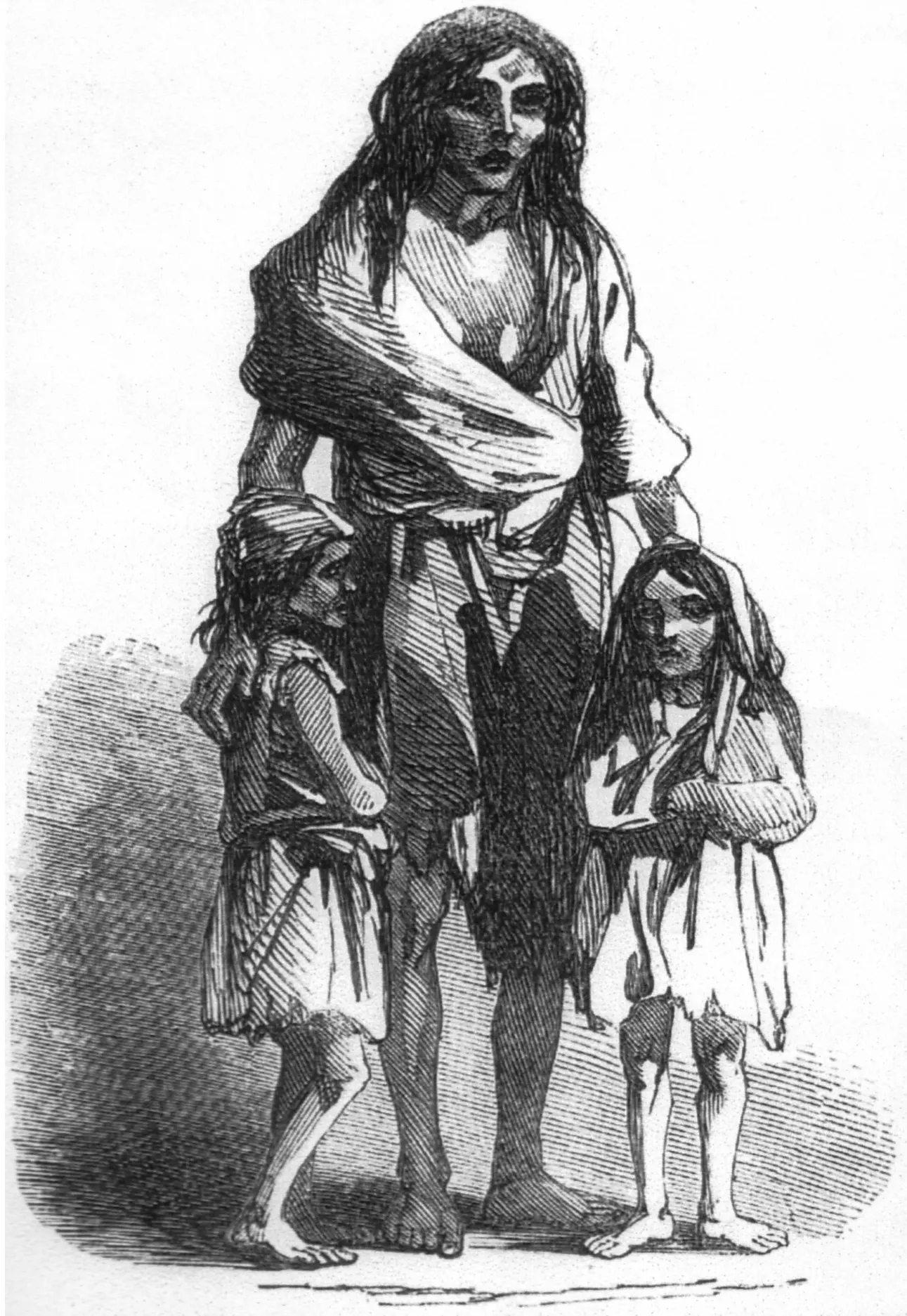
BELFAST - Go down to the New Lodge Road in North Belfast, and you'll see two women and a child foraging for potatoes. You'll see the shack they live in just behind them. In the distance, a ship waits to take the unfortunate woman's neighbors far away to a better life, if their starving bodies endure the trip.
This is a picture of the destitute lifestyle of many Irish people during the famine years of the 1840s.
A scarcity of potatoes, the staple food for most of the population, caused the starvation and exile of millions of Irish people. The virus that caused the potato blight was inadvertently imported from America.
This is a picture painted on a gable wall in a nationalist ghetto in Belfast that has endured more than its share of the "Troubles" over the past 27 years.
Local youths painted the mural to coincide with the New Lodge's cultural festival that was held in August.
"The festival is a celebration of our culture and the right to celebrate our culture," said Michael Rogan, who heads the New Lodge Cultural Society.
"This is the first major festival in the New Lodge," he said. "Last year, we had a bonfire, but this year, we are celebrating our culture in a more positive way."
Part of the cultural celebration has involved a study of the historical problems that have led to today's troubles in Northern Ireland.
Rogan and his colleagues see a relationship between the causes of the famine and the causes of the political unrest in Ireland today.
Rogan said the Great Famine, "An Gorta Mor" in Irish, marked the "onslaught by the British government 150 years ago against our people. The poverty that exists in nationalist areas today is not here by chance. An Gorta Mor was the beginning of an economic war against the Irish people."
The failure of the potato crops and the landlords' exporting of other Irish foodstuffs caused an influx of rural dwellers into Belfast.
"The Famine marks the first generation of large-scale Catholic male unemployment," Rogan said.
The mural is part of the New Lodge Cultural Society's efforts to start debates on the impact of the Famine on areas like the nationalist New Lodge.
"Britain chose to let us starve," Rogan said.
"The mural has almost caused a number of motor accidents," Rogan said. "People are curious, so they slow down to get a look at the mural."
He said the mural has not been "marked" by vandals.
"It's a tribute to the people of the area. They understand its significance. Everybody respects it," Rogan said.
The lack of jobs in North Belfast links the Famine destitution depicted in the mural with the New Lodge's current economic underdevelopment, according to Rogan.
"It's no accident that you walk two minutes out of the New Lodge, or any other Catholic part of the city, and there are loads of shops. But there is no industry in our areas, no economic infrastructure at all," Rogan said.
The painting of the mural in the New Lodge coincides with the beginning of the three-year Great Hunger Arts Project in West Belfast.
Other New Lodge residents say they see the mural as a way to bring dignity to their neighborhood.
"The mural reminds what our people came through - it's OK to remember," said Sinead Crossen, an area teen-ager.
"It was the Famine then; it's Castlereagh now," said Donncha O'Hara, a life-long resident of the area.
Castlereagh is an interrogation center in Belfast recently criticized by the United Nations as the site of human rights abuses of suspects by the police.
"The mural reminds us of what we survived, that we can survive," O'Hara said.
The wall and the record since
One line in this 1995 report needs a correction, and it is not Rogan's. The potato blight was not a virus. The organism was Phytophthora infestans, an oomycete, a water mould more closely related to brown algae than to fungi. Researchers have traced it to the Toluca Valley in Mexico; it moved through North America and probably reached Europe in 1844. Irish reports of blight began in September 1845. The famine ran until 1852, killed roughly one million people, and drove at least 2.1 million to leave Ireland between 1845 and 1855.
The festival Rogan described took root. The New Lodge Festival was set up as an alternative to the Internment Night bonfire, which had a habit of ending in trouble, and that is the swap he hints at when he says "last year, we had a bonfire."
The economic argument on the wall has been harder to shift. The New Lodge remains one of the most deprived wards in Northern Ireland: fifth of 581 on the official measures, second for income deprivation. About 70.8 percent of pupils at local schools qualify for free meals, and fewer than a quarter of households own their homes. The 2001 census counted 5,224 residents, 97.3 percent from a Catholic background. Since 2004 newcomers from Poland, Latvia and Lithuania have added to the mix, and in 2024 the documentary The Flats let residents of the tower blocks tell their own Troubles stories on screen.
Memory of the Famine has also become official. In 2008 the Irish government began a National Famine Commemoration, with a committee set up that July by Minister Éamon Ó Cuív. The main ceremony rotates around the four provinces, and Northern Ireland has hosted it once, at Newry in September 2015.
We could not confirm whether the 1995 gable mural itself survives. Belfast walls get repainted often, and New Lodge Road has carried many murals since. If a reader has a photograph of it, the archive desk would be glad to see one.
Questions readers ask
What caused the Irish potato famine?
The immediate cause was potato blight, Phytophthora infestans, an oomycete or water mould rather than a virus or true fungus. It has been traced to the Toluca Valley in Mexico and probably reached Europe in 1844. Irish reports of diseased crops began in September 1845, and with most of the poor relying on the potato, failures across several seasons turned into mass hunger.
How many people died in the Great Famine in Ireland?
Roughly one million people died between 1845 and 1852, with 1847, known as Black '47, the worst year. At least 2.1 million people left Ireland between 1845 and 1855, and the island's population fell by about 20 to 25 percent between 1841 and 1871. The Irish name for the famine is An Gorta Mór, the Great Hunger.
Where is the New Lodge in Belfast?
The New Lodge is a working-class Catholic district immediately north of Belfast city centre, bounded by Duncairn Gardens, the Antrim Road, Clifton Street and North Queen Street or York Street. It is known for its tower blocks and for the murals along New Lodge Road. It ranks fifth most deprived of Northern Ireland's 581 wards.
When is the National Famine Commemoration in Ireland?
The Irish government has organised an official commemoration since 2008, the year Minister Éamon Ó Cuív set up the National Famine Commemoration Committee. The date and venue change each year, rotating through the four provinces: Skibbereen in 2009, Strokestown in 2014 and Newry in 2015, the only time a Northern Ireland town has hosted the main event.