Gerry Adams: Perdurable peacemaker
Written in West Belfast in 1996 and reprinted after the Good Friday Agreement, a sympathetic American portrait of the Sinn Féin president on the eve of all-party talks.
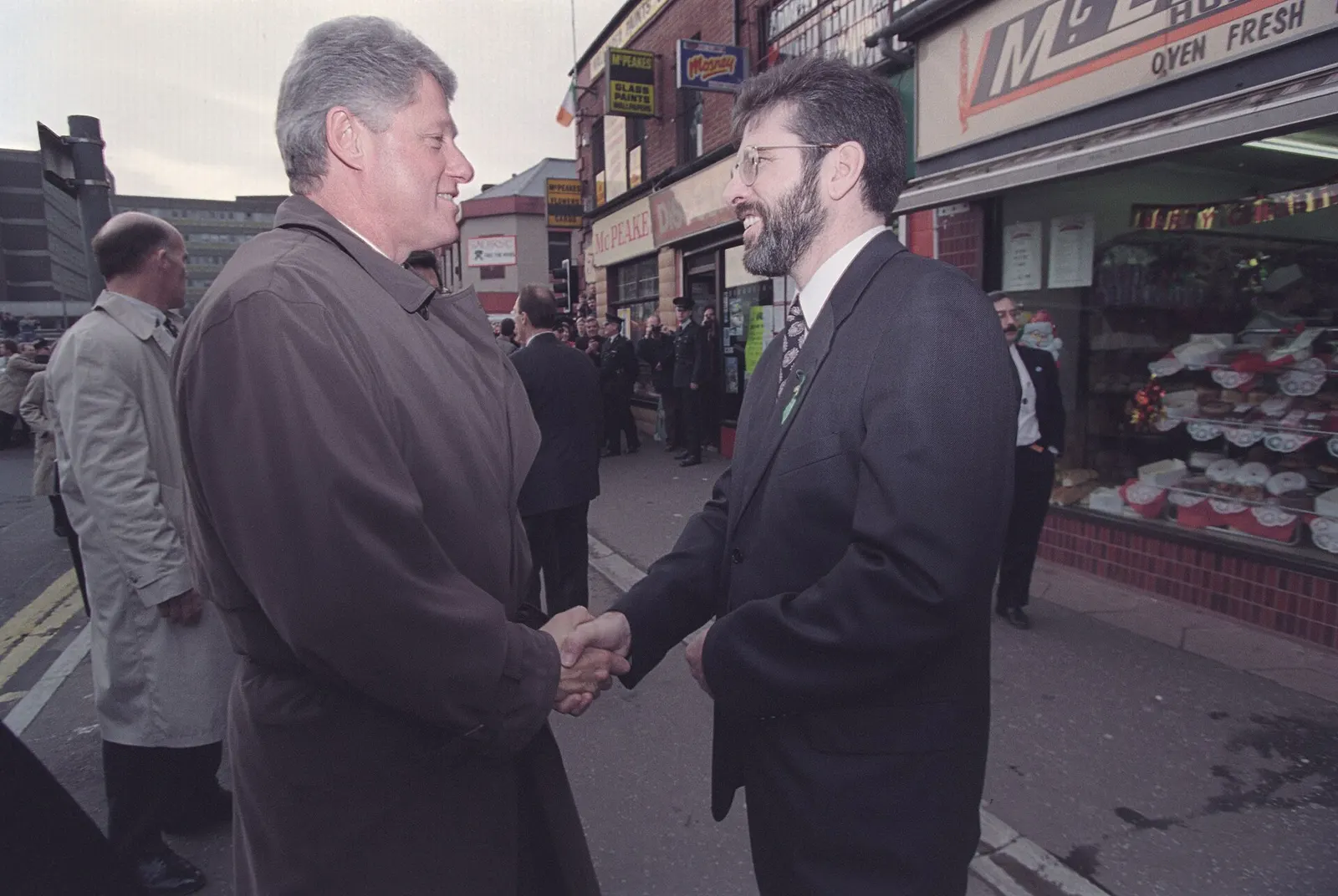
As printed in the Celtic Mirror, June 1998
Editor's note: This profile of Gerry Adams appeared in the July 1996 issue of an Scathan. In light of the recent arrival at a way station heretofore seemingly unattainable in the march toward peace in Northern Ireland, and of Adams' position in the vanguard, it seemed an eminently appropriate piece to reprint in this issue.
An adage tells us, "Freedom is not free."
After spending time in West Belfast interviewing members of Sinn Fein, and speaking with some citizens of that city, I would most certainly concur. And as our Independence Day approaches, I will most assuredly appreciate the meaning of the word "freedom" more than I have in the past. It is easy to take freedom for granted if you have not had to make any sacrifices to attain or preserve it, as most in my generation have not.
When it's time to break out the sparklers and hoist my children up on my shoulders one at a time for a better look at the fireworks cascading in the night sky, I will reflect on my short stay in Belfast and the people I met there, a people who know all too well that freedom, and the struggle to attain it, comes with a high price tag.
Gerry Adams defines freedom quite succinctly: "Freedom is much more than the right to vote, though it is important. It is the right to fulfillment, the right to equality, the right to meaningful employment, the right not to be forced to emigrate, the right not to be poor."
I am allowed to have my say in the determination of the political future of my country. Neither I nor my family will be harassed, let alone imprisoned or murdered, because of my political party affiliation.
But this is a right denied to many in Northern Ireland.
Adams, in his quest to unite Ireland and ensure equal treatment for all people there, has endured many injustices. These injustices are well documented: internment without trial, which included severe beatings; the wounding or killing of family members by the British Army; a loyalist bomb attack on his home; and being seriously wounded in an attack carried out by a loyalist death squad.
Then there is the battery of half-truths, misinformation and lies that have assailed Adams' name, promulgated by what may be the most efficient propaganda machine of all time, the British government. If one were to view Adams as described by his enemies, one would see a radical zealot who will stop at nothing to achieve his aims. Former British Prime Minister John Major once remarked that "his stomach would turn rather than talk to Adams."
So it is easy to see that Adams has been demonized by many in the mainstream media, as have most influential republicans, due to the strokes of pens dipped in the ink of British propaganda.
Recently, Bryant Gumbel tried to take Adams to task on national television by asking if he and Sinn Fein "really" want peace in Northern Ireland. This kind of ignorance about Adams still prevails even though he and Social Democratic Labour Party leader John Hume were the instrumental figures in orchestrating the framework document for peace that paved the way for the IRA's historic cease-fire.
Despite the insurmountable odds against him, Adams has not only survived, but also moved the Sinn Fein message to the forefront of people's awareness when Northern Ireland is discussed. And Adams' staying power has proved extraordinary, as he has been president of Sinn Fein since 1983, a remarkable period of time for any one person to lead a political party.
Despite British attempts to marginalize the party, Sinn Fein has remained a viable player in the search for a peaceful resolution to the conflict. From the outset, there have been preconditions that were obviously intended to deny Sinn Fein entry into peace negotiations.
First, there was the stalling tactic on the part of the British in calling for disarmament of the IRA prior to the "all-party" peace talks. Then the call for elections. When the IRA ended the cease-fire after 17 months of inactivity, the British set a June 10 date for peace negotiations, with yet another precondition: No cease-fire, no Sinn Fein at the talks.
Yet many realize that negotiations without Sinn Fein are worthless, and Adams said that the legality of denying entry to a political party that has an electoral mandate needs to be questioned. "We are exploring that option and all of our options," he said. "We have secured a political mandate. We have the right to involvement in talks."
Regardless, Adams states, "We will attend the talks on June 10. Whether or not we will be denied entrance remains to be seen." Adams adds that Sinn Fein has always stated that his party will sit down and discuss peace with anyone, any time, anywhere.
In the context of waging a battle with the British in the court of public opinion, Adams has also seen marked success. Until 1994, Section 31 of the British Broadcasting Act forbade the media to air the words of Sinn Fein members. The act was not renewed in 1994, and since then Adams has made considerable inroads in expressing his message not only at home, but also across the Atlantic.
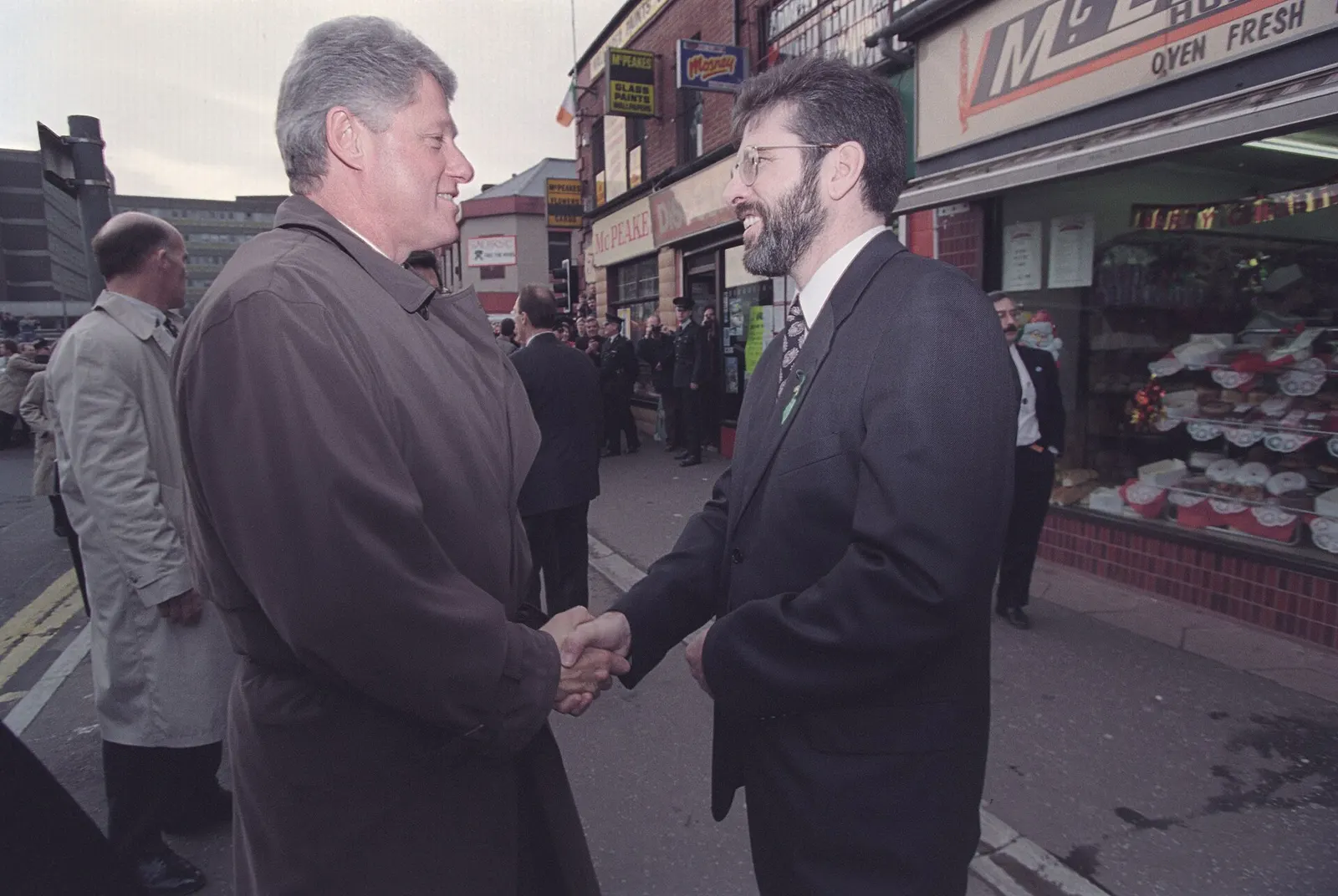
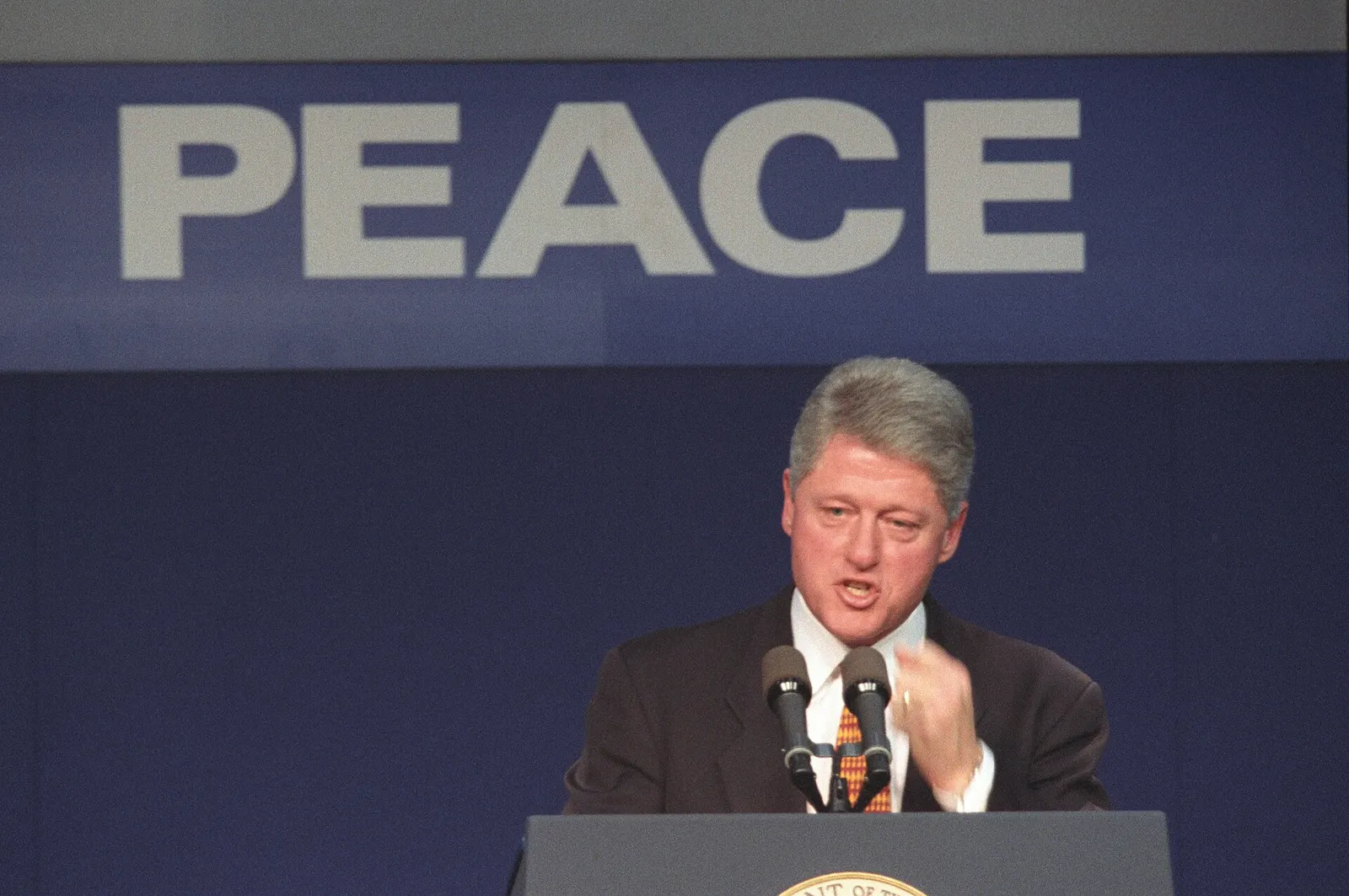
Several visits to the United States have brought Adams a very favorable reception, a fact not lost on him, as he well recognizes the need for international support and involvement. "We appreciate the concern of the North American people, especially the American people. And President Clinton has made every effort to establish and help along a peaceful solution."
Adams knows that the "end game" is near. He has stated in the past that there can be no turning back now because peace, the prize in all of this, is too large and too important for too many people.
All will hope that the sacrifices of many and the fact that freedom is not free will allow for a promising future for the coming generations of all the children of Ireland.
"It is my firm conviction that we can, we will, secure a peaceful and promising future for all of the children of Ireland. The peace process must be fully restored, and all of the voices of all of the parties must be heard. The effort to secure peace must be genuinely pursued by everyone, the British most of all. They have the capability to ensure that a reasonable and peaceful settlement be attained."
In all of my conversations with people in Belfast, I was left with the impression that Adams truly wants a peaceful negotiated settlement to end the conflict. Even those who expressed a dislike for Sinn Fein and Adams grudgingly admitted that he seems to be genuine in his desire to achieve that goal.
And my impression of Adams? The time I met with Adams was brief, but I walked away with a specific sense that I had just spoken to a man of tremendous conviction and compassion.
He would seem to have the conviction to trust in his beliefs and values, yet the compassion to realize that change can come in Northern Ireland only when all of the principal parties involved cast aside the spectres of the past and open a dialogue that looks toward what can be a promising future for all of Ireland. He has, too, the empathy to realize that the people of the North, regardless of religious denomination or political belief, have suffered enough.
One of Adams' favorite sayings is "keep your nerve." He has done that. Just as important, he has kept his vision of a united, peaceful Ireland.
It would be remiss of me not to mention one other thing that impressed me about Adams. After speaking to him, I handed him cards that my children had made for him. They were just simple pieces of orange and green construction paper that bore good wishes and hopes for peace for the children of Ireland. I promised my children that I would personally hand the cards to Adams, and I kept my promise.
Even though Adams accepted the cards with a smile and expressed his appreciation for them, I naturally assumed that he would set the cards aside and forget them.
I was wrong. Only a week after I returned home from Ireland, much to my surprise and my children's delight, two hand-written thank you messages arrived in the mail from Adams.
As we gather as a family on July 4 to celebrate our independence and freedom, I will think of all the people of Northern Ireland and light a sparkler for them in the name of peace, in the name of freedom.
Reading this in 2026
This was an admiring portrait, written in the summer of 1996 and reprinted two months after the Good Friday Agreement. It is worth reading alongside the dates it was written between. The IRA had called its ceasefire on 31 August 1994 and ended it with the Docklands bomb in London on 9 February 1996, which killed two people. The all-party talks did open in June 1996 without Sinn Féin. The IRA declared what it called a final ceasefire in July 1997, and Sinn Féin was then admitted to the talks that produced the Agreement.
Two details in the 1996 text need a footnote. The violence the article lists against Adams is on the record: he was interned in 1972 and again from 1973, and on 14 March 1984 UDA gunmen fired about 20 shots into his car in central Belfast, wounding him in the neck, shoulder and arm. The broadcasting ban, though, was two separate laws. The Republic's Section 31 order lapsed in January 1994, and John Major lifted Britain's own voice restrictions, in force since 1988, that September.
Adams kept the Sinn Féin presidency until 10 February 2018, when Mary Lou McDonald succeeded him, a run of almost 35 years. He represented West Belfast at Westminster from 1983 to 1992 and again from 1997 to 2011 without ever taking his seat, then crossed the border to sit in the Dáil as TD for Louth from 2011 until he stood down in 2020.
The darker questions did not go away. On 30 April 2014 police in Northern Ireland arrested him over the 1972 abduction and murder of Jean McConville and held him for four days; he was released without charge, and in September 2015 prosecutors said there was not enough evidence to proceed. On 30 May 2025 a High Court jury in Dublin found that a 2016 BBC Spotlight programme had defamed him over the killing of Denis Donaldson, and awarded him €100,000.
McCormick's children sent orange and green construction-paper cards. Adams wrote back. Both facts are in the record now, along with the rest.
Questions readers ask
When did Gerry Adams stop being Sinn Féin president?
Gerry Adams led Sinn Féin from 1983 until 10 February 2018, when Mary Lou McDonald succeeded him at a special ard fheis. He had announced in November 2017 that he would step down. He was MP for West Belfast from 1983 to 1992 and 1997 to 2011, and TD for Louth from 2011 to 2020.
Why was Gerry Adams arrested in 2014?
Police in Northern Ireland arrested Gerry Adams on 30 April 2014 for questioning about the 1972 abduction and murder of Jean McConville in Belfast. He was held for four days and released without charge. In September 2015 the Public Prosecution Service said there was insufficient evidence to prosecute him.
Did Gerry Adams win his case against the BBC?
On 30 May 2025 a High Court jury in Dublin found that a 2016 episode of BBC Northern Ireland's Spotlight and an accompanying online article had defamed Gerry Adams, and awarded him €100,000, about £84,000. Jurors found the material meant he had sanctioned the 2006 killing of Denis Donaldson, which Adams denies.
When did the UK broadcasting ban on Sinn Féin end?
Britain's restrictions, which from 1988 barred broadcasters from airing the voices of Sinn Féin members, were lifted by Prime Minister John Major in September 1994, shortly after the IRA ceasefire of 31 August 1994. The Republic of Ireland's separate Section 31 ban had lapsed in January 1994.