Celtic Mythology: Warriors and their weapons
Steve Blamires on Fergus mac Roich and his sword Caladbolg, the poet Feircheirdne, and Fionn mac Cumhaill's thumb of knowledge.
As printed in the Celtic Mirror, June 1998
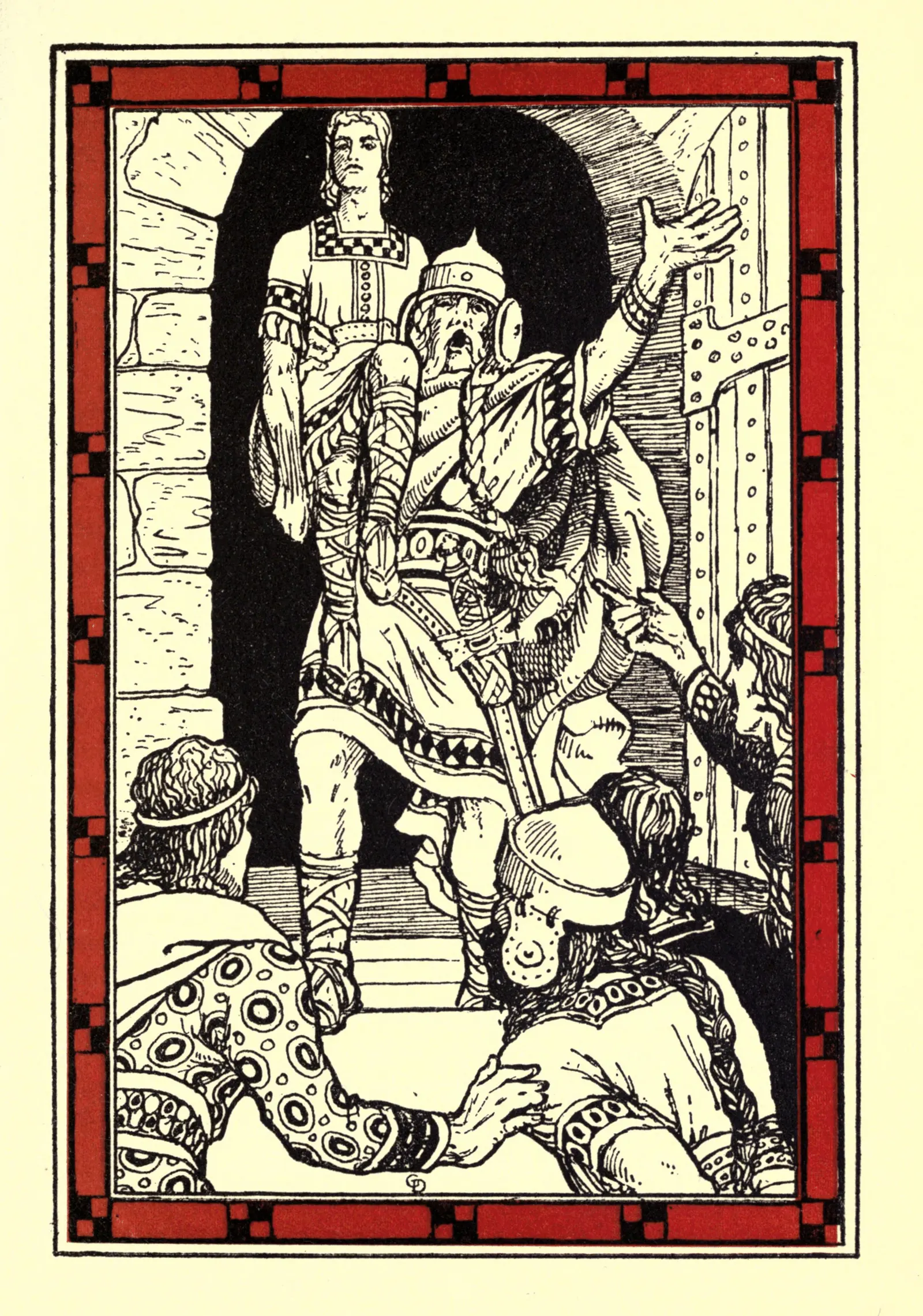
Next in line in our study of ancient Celtic mythological heroes is Fearghus Mac Roich (far-ish mak roik), which means "Virility, Son of the Great Stallion." Given the meaning of his name, it is quite easy to guess what his main interest was. Although he is an Ulsterman, he features prominently in the great Ulster epic "The Cattle Raid of Cooley," in which he is fighting with the Connacht army against his fellow Ulstermen. This traitorous behavior came about because he was originally the King of Ulster, but a woman, Neasa, offered him sexual favors if he would allow her son, Conchobhar, to be king for a year. Fearghus could not resist this beautiful woman and agreed to step down for a year in favor of her son.
After the year was up, Fearghus went to reclaim his throne, but the people of Ulster told him that they did not want a king who would give up his throne, even temporarily, for no reason other than lust. Moreover, Conchobhar had made such a good job of being king during the 12 months that they felt he could do a better job anyway. Fearghus was so enraged, and humiliated, that he left Ulster and went to join forces with Queen Meadhbh of Connacht. Theirs was a good match, as she too had a voracious sexual appetite.
There are some early connections between the Irish Fearghus and the later British King Arthur, especially when it comes to their respective swords. All weapons in Irish mythology have personal names, and the name of Fearghus's sword was Caladbolg ("hardhitter"). When these legends were retold in early Welsh (as many of them were), this name became Caledfwlch. This in turn became Caliburnus when the legends were put into Latin in early Medieval times, and eventually became Excalibur.
As well as featuring in the great "Cattle Raid of Cooley," Fearghus is also a prominent character in "The Sorrow of the Sons of Uisneach" (more commonly referred to as the legend of Deirdre). This is a tragedy of huge proportions, at the end of which Fearghus is deceived into bringing the errant sons of Uisneach back to Ulster with sureties of a safe passage. When the sons and Fearghus arrive at King Conchobhar's court, however, it turns out they have been lied to by the king, and they are slaughtered, except for Fearghus, who escapes. According to some versions, this is why he ended up fighting with Queen Meadhbh against the Ulstermen in the later cattle raid.
Leaving Fearghus aside for the moment, we come next to a character called Feircheirdne (ferr-kaird-neh), which means "Man of Precise Craft." He is the archetypal Celtic poet and the very personification of the poet's art, skill and loyalty to his patron or matron. He features heavily in the Ulster Cycle of tales, but also appears in the legends of Leinster and Munster. It may well be that Feircheirdne was a title bestowed on accomplished poets rather than the name of a particular individual.
One of the ancient legends, "The Colloquy of the Two Sages," describes a lengthy and very technical battle of words he has with a young boy, Neidhe, whom he finds sitting in the poet's chair one day. Despite his tender years, the boy has a very regal and noble mien, and rather than depose him from the chair and have him punished for such impertinence, Feircheirdne challenges him verbally to see how much he really knows about the complex laws and rules that govern Irish poetry. Neidhe fares very well in this combat of verbal dexterity, and Feircheirdne eventually concedes that he does indeed have the right to sit in the poet's chair.
This interchange between the two poets is very lengthy indeed and clearly contains references to things that were important to the ancient Celtic poets but to us today remain vague and obscure. Many people over the years have tried to interpret this legend, but few have managed to get very far. This difficulty only goes to show how much of the old oral tradition has been lost.
Following on from Feircheirdne both alphabetically and logically is another important character called simply Find, which means "Wisdom." He is almost beyond the realm of mythology because of his great antiquity, and variations of the first Find appear throughout the legends right up into more modern folklore. He is always associated with very ancient knowledge, and is able to recite genealogies further back than anyone else can and knows the languages of the animals and birds. He is closely associated in the legends with the salmon, a fish, you may remember from past installments, that was believed to know everything there is to know.
Stepping out of the Ulster Cycle for a moment, we come to the great progenitor of the equally important Fenian cycle, the great hero Fionn Mac Cumhaill (fyoon mak koo-il). To this day in Scotland and Ireland, stories are told of Fionn and his band of heroic warriors, the Fianna (which simply means "warriors"). Many, many place names are associated with him or with his equally famous offspring Oisin and Oscar. Many attempts have been made to translate his name - the usual one you will see is "White Son of the Hazel," or sometimes "Fair Son of Destruction" - but the truth is we really do not know what the name means.
The Fionn part probably comes from the aforementioned character Find. Both Fionn and Find are associated with salmon, and each could find the answer to any question by sucking on his thumb. There are two stories that explain how Fionn achieved this remarkable ability. One says that originally his name was Deimne and, one day, he happens across an old man who is cooking a salmon and asks Deimne to take over for a moment. While the old man is away, three drops of scalding hot juice spurt out from under the salmon's skin and land on Deimne's thumb. Instinctively, he sticks it in his mouth to cool it and discovers that he knows the answers to all questions.
When the old man comes back and discovers what has happened, he tells Deimne that from that day forth he will be known as Fionn because it has been prophesied that one called Fionn will gain all knowledge by eating from the Salmon of Knowledge. Fionn is the old man's name, and he had theretofore assumed the prophecy referred to him, but now he realizes it refers to someone else.
The other legend regarding Fionn's thumb sucking states that he one day tries to follow the Sidhe, or fairies, into their Fairy Mound, but that they slam the door on his thumb just as he is about to enter. In this version as well, he instinctively sticks his thumb in his mouth (no doubt to the accompaniment of some well-chosen ancient Irish curses) and again discovers that he knows everything because the thumb had been inside the Fairy World, even though only for a brief second, and had brought back all knowledge with it.
Fionn is always described as a great warrior, a great leader, a just decision maker and a strong defender of the poor and lowly. According to tradition, Fionn and his Fianna were a sort of early Celtic police force. Their duty was to protect the poor, defenseless and lower classes. They did this by riding throughout Scotland and Ireland during the summer months. In the winter, by way of payment for their protection, they were billeted among the farmers and other peasantry, whose duty it was to feed and sustain them until the following summer.
As with so many other characters in the Irish Celtic mythological cycles, the legends and events surrounding Fionn and his companions mirror very closely those of the later King Arthur and his Knights of the Round Table. The collection of poems known as Duanaire Finn, "The Poems of Fionn," describe his life and adventures in detail and, as well, tell us a great deal about his family and warriors.
Further reading
To finish this article, I will list a few books that I would recommend as good introductions to the complex world of Irish Celtic mythology. As far as I am aware, they are all still in print and should be easily obtainable through any local bookstore. In later articles, I shall expand on this basic list.
- Bellingham, David, "An Introduction to Celtic Mythology," The Apple Press, 1990.
- Berresford Ellis, Peter, "A Dictionary of Irish Mythology," Constable, 1985.
- Delaney, Frank, "Legends of the Celts," Hodder and Stoughton, 1989.
- Lady Augusta Gregory, "Gods & Fighting Men," Smythe, 1979.
- Lady Augusta Gregory, "Cuchulain of Muirthemne," Smythe, 1984.
- Rolleston, T. W., "Celtic Myths & Legends," Bracken Books, 1985.
- Squire, Charles, "Celtic Myth & Legend," Gresham, 1905.
Notes from the reference shelf
Steve Blamires wrote this series for readers who wanted the old stories without a university library, and his outlines still match the standard accounts. A few points have shifted, or deserve a footnote, since June 1998.
The sword first. Caladbolg is usually glossed as "hard cleft" or "hard blade," and T. F. O'Rahilly argued for "hard lightning." The Welsh Caledfwlch, the name of Arthur's sword in the tale "Culhwch and Olwen," breaks down as caled ("hard") and bwlch ("breach"). Geoffrey of Monmouth turned it into the Latin Caliburnus in his "Historia Regum Britanniae" around 1136. The chain from Ireland to Wales is less certain than our 1998 piece suggests. Rachel Bromwich and D. Simon Evans thought direct borrowing unlikely, and suggested both names may have grown up independently as stock words for a good sword.
Fergus does not get a happy ending. In the usual telling, Ailill, jealous of Fergus swimming with Medb, has his blind brother Lugaid Dalleces throw the spear that kills him. A later legend gives him a last job: when the poets of Ireland found they could no longer recite the whole of the Táin, the ghost of Fergus rose and told it to them.
For readers starting now, two translations of the Táin are the obvious first step: Thomas Kinsella's "The Táin" (1969) and Ciarán Carson's version of 2007. Both rest mainly on the first recension, preserved in pieces in Lebor na hUidre (late 11th or early 12th century) and the 14th-century Yellow Book of Lecan. The Book of Leinster holds a tidier 12th-century retelling. Fionn readers can add James Macpherson's "Ossian" of 1760, which renamed him Fingal and set off a long argument over its authenticity, and Morgan Llywelyn's 1994 novel "Finn Mac Cool."
Questions readers ask
What was the name of Fergus mac Roich's sword?
Fergus mac Róich carried Caladbolg, a sword of the Ulster Cycle whose name is usually translated as "hard cleft" or "hard blade." The scholar T. F. O'Rahilly proposed "hard lightning" instead. In the Táin Bó Cúailnge, Fergus loses the sword to Ailill's charioteer, and he later yields to Cúchulainn in single combat.
Is Excalibur based on an Irish sword?
The Welsh name for Arthur's sword, Caledfwlch, looks very like the Irish Caladbolg, and Geoffrey of Monmouth Latinised it as Caliburnus around 1136, the ancestor of Excalibur. Scholars disagree on the link. Rachel Bromwich and D. Simon Evans considered direct borrowing unlikely and suggested both names arose separately as generic words for a sword.
How did Fionn mac Cumhaill get his wisdom?
In the best-known story, the boy Deimne was cooking the Salmon of Knowledge for the poet Finn Éces when he burned his thumb on the fish and put it in his mouth. He gained all the salmon's wisdom and took the name Fionn. Afterwards he could summon that knowledge simply by sucking his thumb.
Who was Fergus mac Roich in Irish mythology?
Fergus mac Róich was a king of Ulster who gave up his throne for a year to Conchobar, son of Ness, and never got it back. After Conchobar betrayed the sons of Uisneach, Fergus went into exile in Connacht with about 3,000 followers and served Queen Medb and Ailill, guiding their army in the Cattle Raid of Cooley.
What is the best English translation of the Táin?
The two best-known English versions are Thomas Kinsella's "The Táin," published in 1969, and Ciarán Carson's "The Táin" of 2007. Both are based mainly on the first recension of the epic, which survives in Lebor na hUidre and the Yellow Book of Lecan. Lady Gregory's "Cuchulain of Muirthemne," on Steve Blamires's 1998 list, offers a looser retelling.