Celtic Mythology: Kings, gods link Celts to supernatural
Part of a 1998 series on Irish myth: Cú Roí and the beheading game, the death gods Dearg and Donn, Deirdre of the Sorrows, and Diarmuid and Gráinne.
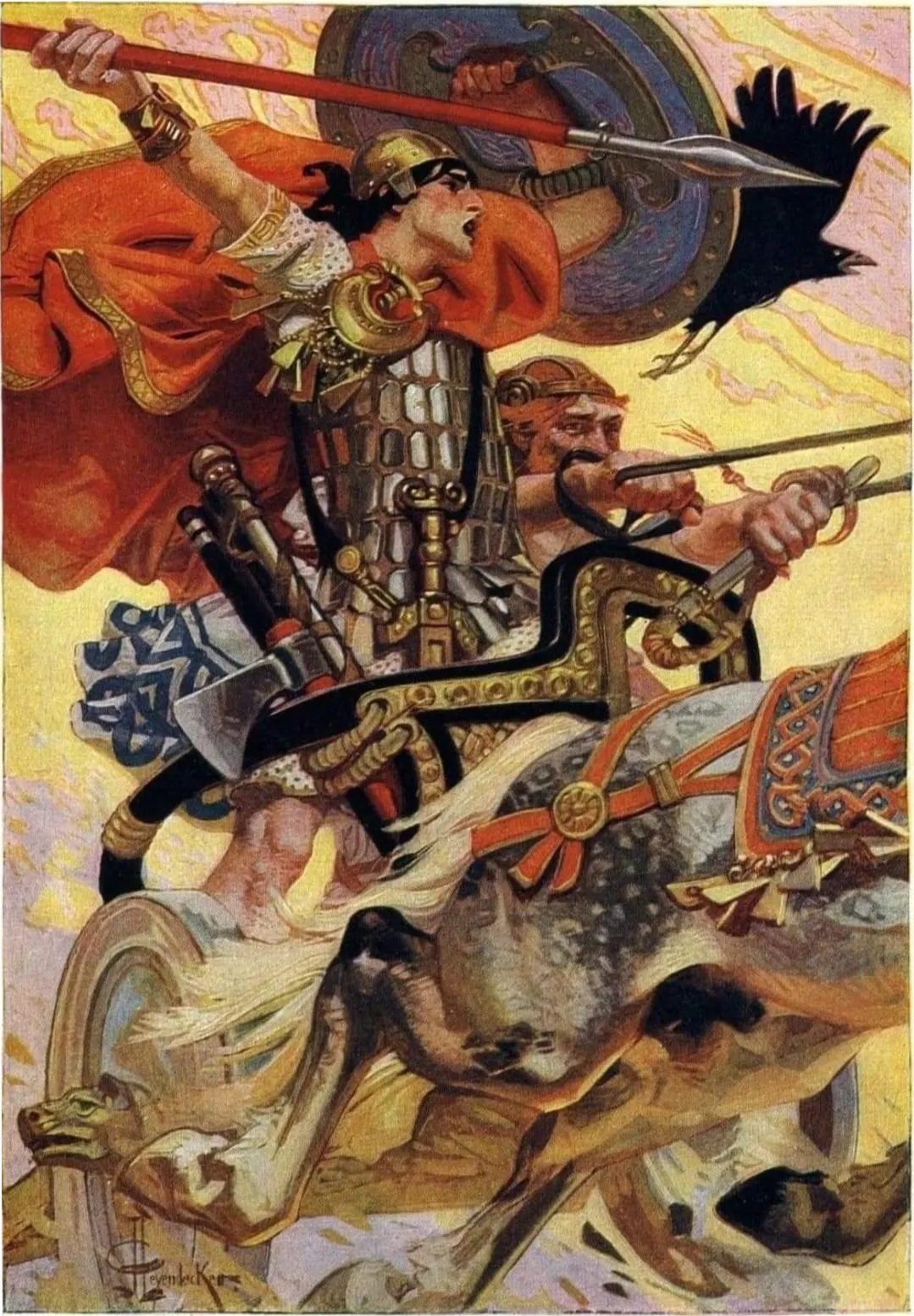
As printed in the Celtic Mirror, May 1998
After having traced the short life of the great hero Cu Chulainn in the last article, we can now return to look at some of the other important characters from the Irish mythology of the Ulster and Fenian cycles. I should stress again at this stage that this series of short articles on Celtic mythology barely scratches the surface of what is a huge body of myths and legends. It is my hope, though, that it will be enough to encourage readers new to the subject to go off and learn more on their own. To help in this search, I shall be giving an extensive list of recommended further reading in a future article.
Meantime, we must pay homage to the King of Munster at the time the Ulster Cycle was being composed. That king was Cu Roi (koo-ree), which means "roaring hound." He is equivalent in status and rank to king Conchobhar mac Nessa of Ulster and King Cormac of Leinster. He is connected with the fantastic Cauldron of Plenty, which would feed all who sat at it - apart from cowards and liars.
He is also connected with the mythical Salmon of Knowledge, which would impart all knowledge and wisdom to whoever ate of its flesh. Some versions of the life of Cu Roi claim that the king's soul was embodied in this salmon.
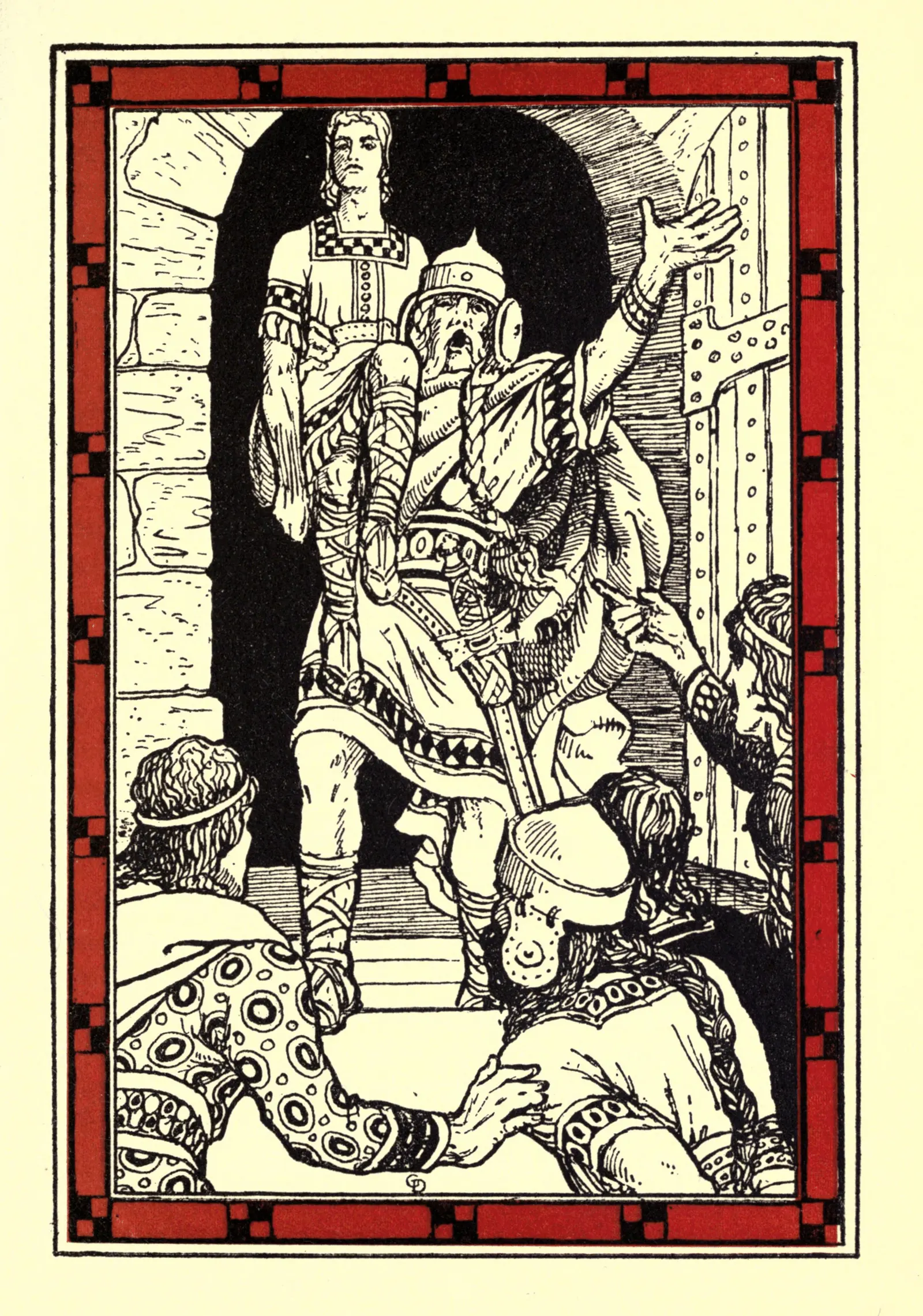
Cu Roi is further associated with the ancient "beheading game," a motif that crops up in legends across the globe. In this story, a strange creature, usually an ugly giant, appears at a feast and challenges anyone who dares to cut off his head - but on the one condition that the giant can then cut off that person's head in turn. In the legend of Cu Roi, it is he who assumes the form of the threatening giant and lays down the challenge to the men of Ulster. Only the great hero Cu Chulainn is willing to risk his life by taking up this bizarre challenge.
During the reign of Cu Roi, there was peace and plenty in Munster, and he was considered to be one of the wisest and fairest of all that province's many rulers.
An obscure but important character who crops up from time to time in Irish mythology is a man called Dearg (jarrig), which simply means "red." He is a god of death, and all the legends in which he features center around battles and violent events. Since he is associated with death by violent means, as opposed to death by natural causes, the name "red" is accordingly symbolic of bloody death. He is also closely associated with wild places, wild animals and the need to hunt to survive (in which, of course, the blood of creatures must be shed by violent death that humans may survive).
Dearg, too, has many parallels in otherworld mythologies and is clearly a remnant of a very ancient god-form recognized by the early forebears of the Celts, who lived close to nature, saw death around them all the time, and had to struggle very hard in a harsh environment just to survive.
Next in our alphabetical list of characters from Irish Celtic mythology is perhaps one of the most tragic, and probably best known, of all - Deirdre (dairdir-eh), often called Deirdre of the Sorrows. Her story is recorded in the legend known as "The Tragedy of the Sons of Uisneach." This classic tale has been told and retold throughout the centuries and is to this day a very popular story in the Western world. It is a classic tale of two lovers caught up in events beyond their control and the all-consuming jealousy of a spurned partner.
At the moment of Deirdre's birth, King Conchobhar mac Neassa and his Red Branch Knights are dining at her father's house. When her birth is announced, the druid, Cathbhadh, foretells that she will be the cause of the downfall and eventual destruction of the great Red Branch Knights and the fort of Eamhain Mhacha. The knights demand that if this be true, she must be put to death immediately. Conchobhar decrees, however, that no child under his dominion will be so brutally slain. Instead, he causes her to be quartered in a remote fort that no man is allowed to visit, hoping thereby to alter the course of Fate and at once save Deirdre for himself and his warriors from Fate.
As always, however, Fate finds Her way around even the best of the old king's plans, and Deirdre eventually falls in love with another man, one whom the king has very foolishly sent to fetch Deirdre to be his bride. Deirdre flees Ulster with her lover and his faithful brothers, and they all live in peace for some years on the banks of Loch Etive in Scotland.
One day a messenger arrives from Ulster to say that the king is growing old and weary and does not want to end his days hating the Sons of Uisneach. He forgives them for what happened all those years ago and asks them to come back, with sureties of peace and safe conduct, so that he might die a happy man and in peace once more. Deirdre knows instinctively that this is a trap and pleads with her lover and his brothers not to go. Unable to imagine that the king might be lying to them, they discount her warning, and they all of them return.
Deirdre proves to be right, and she and her companions find themselves trapped in a small house that the king has ordered to be set on fire. The brothers make a valiant attempt to fight their way out of the firetrap and at least save Deirdre. Inevitably, though, they are all killed in the conflagration. The story, truly a classic tale of world mythology, ends with the tragic death of Deirdre herself. Some of the earliest known versions contain prose and poetry of such heartbreaking intensity and emotion that even today many readers weep softly as they follow the events of Deirdre's short and unhappy life.
The next character in our list could almost be called the male equivalent of the tragic Deirdre. He is Diarmaid ua Dubhne (jee-oor-mid oo doov-neh), which means "the unenvious descendant of Duibhne." This last word is sometimes incorrectly translated as "brown." Diarmaid, too, has to flee his leader and companions - in this case Fionn mac Cumhail and the Fenian Warriors - because of an illicit love affair.
Unlike the tale of Deirdre, though, in which true love is the cause of the tragedy, this time it is true lust - and on the part of the woman. The woman in question is Grainne, who has been betrothed to the aging Fionn mac Cumhail. At the feast before their wedding, she sees the young and handsome Diarmaid and realizes that he would make a much better husband than the old man Fionn. She therefore puts him under "geis" (a sort of taboo or unbreakable oath) to do her whim and run away with her as her husband.
Diarmaid is thus placed in a very difficult position in that he cannot escape this magical geis but, on the other hand, by fleeing with Grainne will be betraying Fionn's trust and friendship. Eventually they do flee, but all the time they are on the run from the furious Fionn and the Fianna, Diarmaid never sleeps with Grainne and leaves signs wherever they spend the night letting Fionn know of his fealty. To this day, many a dolmen (a dolmen being three upright stones with a large, flat capstone) in Ireland is known as "Diarmaid and Grainne's Bed." Once again, the tale ends in death and tragedy and emphasizes to the modern reader just how close to death and nature our early forebears lived.
Above, I mentioned one god of death, Dearg, and now we must look at the other god of death, known as Donn. The name means simply "dark," and Donn was the god of natural death as opposed to the violent death that was Dearg's domain. He appears in many legends throughout the whole time span of the mythology and was clearly an important character.
I have made clear that the early Celts lived much closer to nature than we do and were much more aware of death than we tend to be in our sanitized world, but we must also be aware that to the ancient Celts, death was not to be feared. Quite the opposite. The mythology tells us that the early Celts believed that they were born from death into this world, that death was literally their father, and that when life here on earth ceased they would return to the blissful state of the Otherworld and be once again with Donn their father. This belief goes far toward explaining the well-documented ferocity and bravery of the Celtic warriors in battle: They had no fear of death or dying.
My next article will in a way refer back to the previous article on Cu Chulainn in that I wish to spend some time looking at a character known as Fear Diadh, who was Cu Chulainn's greatest friend and companion and who also had a short but illustrious life. I shall also begin my list of recommended book titles for readers interested in learning more about this fascinating subject.
Notes from the archive desk
Steve Bemires wrote his series as a doorway, not a textbook, and he said so. Reading it again, we wanted to add the sources a curious reader would look for next.
The beheading game belongs to Fled Bricrenn, Bricriu's Feast, one of the Ulster Cycle tales. There Cú Roí comes in disguise as a hideous churl, and only Cú Chulainn takes up his challenge, which wins him the championship. English readers know the same motif from the 14th-century poem Sir Gawain and the Green Knight, and scholars point to closer parallels still in the medieval romances Diu Crône and La Mule sans frein. Cú Roí's salmon turns up again in the story of his death: in one version his soul is hidden in an apple inside a salmon, and his lover Blathnát gives the secret away to Cú Chulainn. The ruin of his fort, Caherconree, still stands high in the Slieve Mish Mountains on the Dingle Peninsula in County Kerry.
Deirdre's tale is usually catalogued as Longes mac nUislenn, the Exile of the Sons of Uisliu. The ending varies. In the best-known version she does not die in a burning house but throws herself from a chariot after Conchobar hands her to Éogan. Her story drew a whole generation of Irish Revival writers: George William Russell staged a Deirdre in 1902, W. B. Yeats followed in 1907, and J. M. Synge's Deirdre of the Sorrows reached the stage in 1910.
Diarmuid and Gráinne's chase is told in Tóraíocht Dhiarmada agus Ghráinne. The surviving manuscripts are in Modern Irish, the earliest from the 16th century, though parts of the story may be 10th-century. It ends at Ben Bulben in County Sligo, where a boar wounds Diarmuid. Fionn could save him with water carried in his hands and twice lets it slip. The dolmens Bemires mentions are real enough; many Neolithic tombs across Ireland are still called Leaba Dhiarmada agus Ghráinne. George Moore and Yeats wrote a play on the story, Diarmuid and Grania, in 1901, with incidental music by Edward Elgar.
Questions readers ask
Who was Cú Roí in Irish mythology?
Cú Roí mac Dáire was a legendary king of Munster in the Ulster Cycle, a warrior with superhuman powers and a master of disguise. In Fled Bricrenn he appears as a churl and offers the beheading challenge that only Cú Chulainn accepts. His fort, Caherconree, lies in the Slieve Mish Mountains of County Kerry.
How does Deirdre of the Sorrows die?
The best-known version of Longes mac nUislenn has King Conchobar give Deirdre to Éogan after the sons of Uisliu are killed, and she throws herself from his chariot, dashing her head against a rock. Later retellings vary. W. B. Yeats in 1907 and J. M. Synge in 1910 both wrote plays on her story.
What is Diarmuid and Gráinne's Bed?
Leaba Dhiarmada agus Ghráinne, Diarmuid and Gráinne's Bed, is the local name for many Neolithic tombs in Ireland, including dolmens, court cairns and wedge tombs. Folk tradition held that the fleeing lovers camped at these stones while Fionn mac Cumhaill pursued them. The tale survives in manuscripts dating from the 16th century.
Is the Green Knight based on Irish mythology?
The beheading game in Sir Gawain and the Green Knight, an English poem of the 14th century, closely resembles the challenge Cú Roí sets the Ulster heroes in the Irish tale Fled Bricrenn. Scholars also note close parallels in the medieval romances Diu Crône and La Mule sans frein, so the motif clearly travelled between traditions.