Samhain: A Celtic feast lives today as Halloween
Druid fires, disguises, Stingy Jack's turnip lantern and a Pennsylvania witch named Aolsta: our October 1995 look at how Samhain turned into Halloween.
As printed in the Celtic Mirror, October 1995
Halloween, or All Hallows Eve, is a night when ghosts roam, witches exult powerful incantations and evil demons are free to wander the earth. It is a time when harvests are in, and Mother Earth is about to give way to the cycle of seasons by taking winter to her breast.
An ancient group of people known as the Celts passed through the centuries, leaving behind their tradition of celebrating this ancient holiday.
Ruling supreme in the territories of Ireland, Wales, Scotland, Britain and much of Europe, they were a culture of people, not an ethnic race.
Their story begins in a time before history was recorded. Historians say that the Celtic social structure included a fraternity of lawmakers and priests known as Druids, and that their most important feast day is on Nov. 1, which is known as Samhain or All Hallows. It is the feast of their Lord of Death, and represents the end of light and summer and the beginning of dark and winter.
Actually, Halloween was their New Year's Eve.
"The Celtic New Year is still observed today," said Mickey Burke of the American Celtic League in New York. "Members gather with candles to take a light from the central candle."
There is a renewed interest in the Celtic religion.
But for Burke, it's not a devotion. He looks on it as a symbolic act.
"For me," Burke said, "it's an observance of a culture to be appreciated. It's part of what we are, and we should recognize it."
This modern day candle ritual is linked to an ancient Druid practice in which the Celtic people used the rite of lighting new fires on All Hallow's Eve to welcome back dead ancestors.
In Celtic dwellings, hearth fires were extinguished, then the people gathered at the sacred groves with their Druid priests. From oak wood, a ceremonial fire was built upon the altar, then the people lighted torches to carry home for the lighting of new fires.
Even though ancestral spirits were greeted with food feasts and newly laid fires, there was great fear of the evil spirits that also crossed over from the world of the dead.
So, to walk about at night among the evil spirits, people masqueraded by dressing in animal heads and skins. The idea was to fool the spirits into thinking they were one of them. And, just in case they were accosted by a cunning spirit, a food treat was tucked away to use as a bribe.
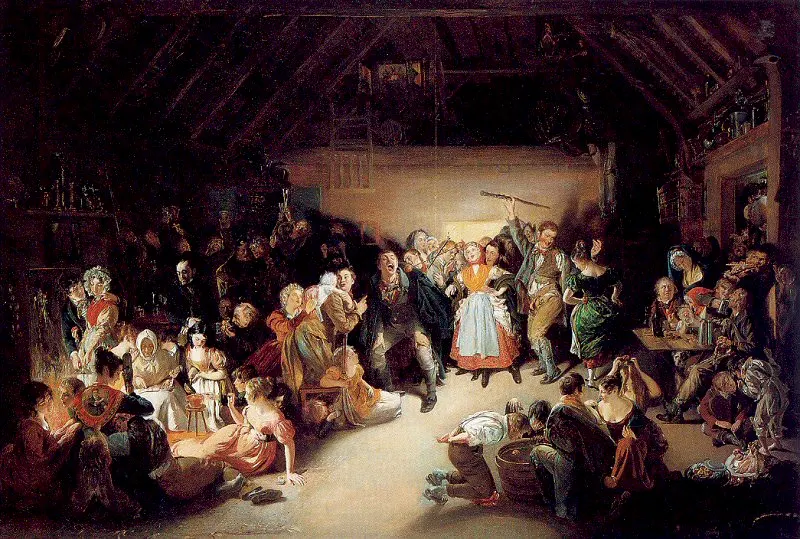
Townsfolk massed around huge outdoor bonfires in frantic dances to frighten away harmful spirits. Then late into the night, people would gather indoors before their hearths to tell tales of their encounters with the spirit world.
So began our custom of trick or treat, Halloween bonfires, and the telling of ghost stories on Halloween.
The Celtic nations' realm diminished over the centuries from invasions by the Romans, Anglo Saxons, the Vikings and Normans. And, by the time Christianity was introduced, it was a gradual process with compromise from both the pagan and Christian sects.
The church tried to divert the pagan devotion to All Hallows by initiating All Saints Day on Nov. 1. But, willing to compromise, the church recognized the old beliefs and designated a feast day to honor the dead, All Souls Day, Nov. 2.
The country of Ireland, surrounded by water, and its people were undisturbed in their rich Celtic tradition longer than their European neighbors. Clinging to old lore, the Irish entertained with tales of a clever, stingy drunkard by the name of Jack.
The legend says Jack sold his soul to the devil, but then tricked the devil out of the pact.
When Jack died, he was turned away from heaven, and the devil refused him entrance into hell.
So Jack was doomed to wander the earth, lighting his way with a lantern carved out of turnip that was glowing with a coal from hell, thrown at him by the devil.
So began the custom of jack-o-lanterns. Although pumpkins are the American lantern of choice, the Irish carved lanterns from potatoes, turnips and beets.
The connection between Halloween and witches is no coincidence.
According to Aolsta, a practicing, modern day witch living in rural Pennsylvania: "Halloween is a time to bring down the veil between this life and the spirit world."
Published folklore tells us that witches took flight on brooms, rakes or shovels to celebrate this night with goblins and demons. One such account said that witches were observed dancing on hill-tops to a strange music of bagpipes, drums and castanets that were fashioned from bones of the dead.
Consider this eerie Halloween spectacle.
Farmers, on watch for witches, patrolled orchards with blazing torches. The livestock had to be protected, for it was believed that witches were notorious for stealing cows' milk or for taking horses on frantic night rides. So barn doors were draped with branches of ash and juniper trees while farmers lighted pitchforks of hay on fire to wave at the night sky to ward off witches' approach.
Their craft is still practiced today.
Aolsta, in a recent interview, talked about her beliefs.
"Witchcraft has been around since the beginning of time," she said.
Despite prejudiced opinions about witches, Aolsta said, "I am not a Satanist." Although some witches do perform black magic, Aolsta said most of her requests are for love spells, healing or money.
Her spiritual beliefs do not include the biblical God or Christianity. Her faith is based on a deity she calls "the Goddess, the creatoress of everything."
She practices her faith by venerating all phases of the moon through age-old rituals. "I try to treat the earth good," she said.
In October, she usually attends the New Year Witches' Ball in New York City.
"It is a gathering of witches, a chance to get together and practice solidarity."
"It is a time to re-evaluate your life and what it's worth," she said.
Aolsta said of Halloween, "It's the time I make my resolutions. And, a powerful time for spells.
"A lot of the magic I do is practiced in the kitchen," she said.
Aolsta, who says she has been a practicing witch for 19 years, boasts a 90 percent success rate, but not for self-gain. "Most times, spells work better on other people," she said.
Aolsta said she personally chose her name, which is based on the spirit god, lola. According to Celtic history, women were allowed a place in worship and "their goddesses were given equal footing with their gods."
Historians tell us that the Celts were a spiritually advanced culture. And even after the introduction of Christianity, the Druidic and Celtic influence is vividly displayed in Ireland's ancient manuscript of the gospels, the Book of Kells.
Besides conversion to Christianity in the 5th century, the Irish people didn't experience any major intrusion to their culture until the 9th century Viking raids. Even then, the Irish stubbornly managed to preserve and pass on much of the rich Celtic heritage. Even today, an ancient pagan religion exists, and strangely enough, in a holiday that has been adopted by children.
What scholars say now
Joan Farrell's piece gives the version of Samhain that most Americans grew up with in 1995, and much of it still holds. Some of it has been trimmed by the historians since.
The solid part first. Samhain was a real festival on November 1, and because the Celtic day was reckoned from sunset, its celebrations began on the evening of October 31. It turns up in early Irish literature from the 9th century; the 10th-century tale Tochmarc Emire lists it among the seasonal feasts. The bonfire story has a source too. The 17th-century historian Geoffrey Keating claimed that druids lit a sacred fire on the Hill of Tlachtga, now the Hill of Ward in County Meath, and that other fires were relit from it.
The shakier parts are the ones the article states most confidently. The idea of Samhain as the Celtic New Year was put forward by the scholars John Rhys and James Frazer, and the historian Ronald Hutton has called the evidence for it flimsy. The church history is also more tangled than the article allows. November 1 as All Saints' Day was adopted officially across the Frankish Empire in 835, possibly under the influence of Alcuin or Irish clerics.
The lantern story survives the scrutiny well. Stingy Jack is a genuine Irish folk tale, recorded from the mid-18th century. In the 19th century people in Ireland and the Scottish Highlands hollowed out turnips or mangel wurzels and carved faces into them. The Oxford English Dictionary dates the use of "jack-o'-lantern" for a carved vegetable lantern to 1837, and by 1866 a newspaper in Kingston, Ontario, was describing pumpkin carving at Halloween as an established custom. Disguised door-to-door visiting, known as guising, is first recorded in 16th-century Scotland.
Aolsta and Mickey Burke were early voices of something that has since grown. Since the later 20th century, Celtic neopagans and Wiccans have kept Samhain as a religious holiday in its own right.
Questions readers ask
Is Halloween really Celtic in origin?
Halloween draws on several sources. The Gaelic festival of Samhain, held on November 1 with celebrations from the evening of October 31, contributed bonfires and the sense of a night when the dead were close. The Christian feast of All Saints, fixed on November 1 in the Frankish Empire in 835, gave the name All Hallows' Eve. Later folk customs supplied guising and lanterns.
Was Samhain the Celtic New Year?
The idea is popular but disputed. The scholars John Rhys and James Frazer proposed that Samhain marked the start of the Celtic year. The historian Ronald Hutton has argued that the evidence for a Celtic New Year at Samhain is flimsy, so most specialists now treat it as a theory.
Why did the Irish carve turnips at Halloween?
In the 19th century people in Ireland and the Scottish Highlands hollowed out turnips or mangel wurzels as Halloween lanterns, often carving grotesque faces into them. The custom is tied to the Irish tale of Stingy Jack, recorded from the mid-18th century, who wanders with a coal from the devil inside a turnip. Emigrants switched to pumpkins in North America.
Where was the Samhain bonfire lit in ancient Ireland?
Tradition places the great Samhain fire on the Hill of Tlachtga, today the Hill of Ward, between Athboy and Ráth Chairn in County Meath. The 17th-century historian Geoffrey Keating, who died in 1644, wrote that druids lit a sacred bonfire there and that other fires across the region were rekindled from it. Archaeology shows ritual use of the hill from the Bronze Age to the late Iron Age.
When did people start carving pumpkins for Halloween?
Carved vegetable lanterns came to North America with Irish and Scottish immigrants, who found pumpkins plentiful and easier to work than turnips. The Oxford English Dictionary dates the term jack-o'-lantern for a carved lantern to 1837, and an 1866 newspaper in Kingston, Ontario, already described pumpkin carving at Halloween as an established custom.