Faeries live in epic tales, stunning illustrations
A 1998 review of John Matthews' collection of rare Celtic tales: Beira the winter queen, the maid who became Loch Ness, sea faeries and selkies.
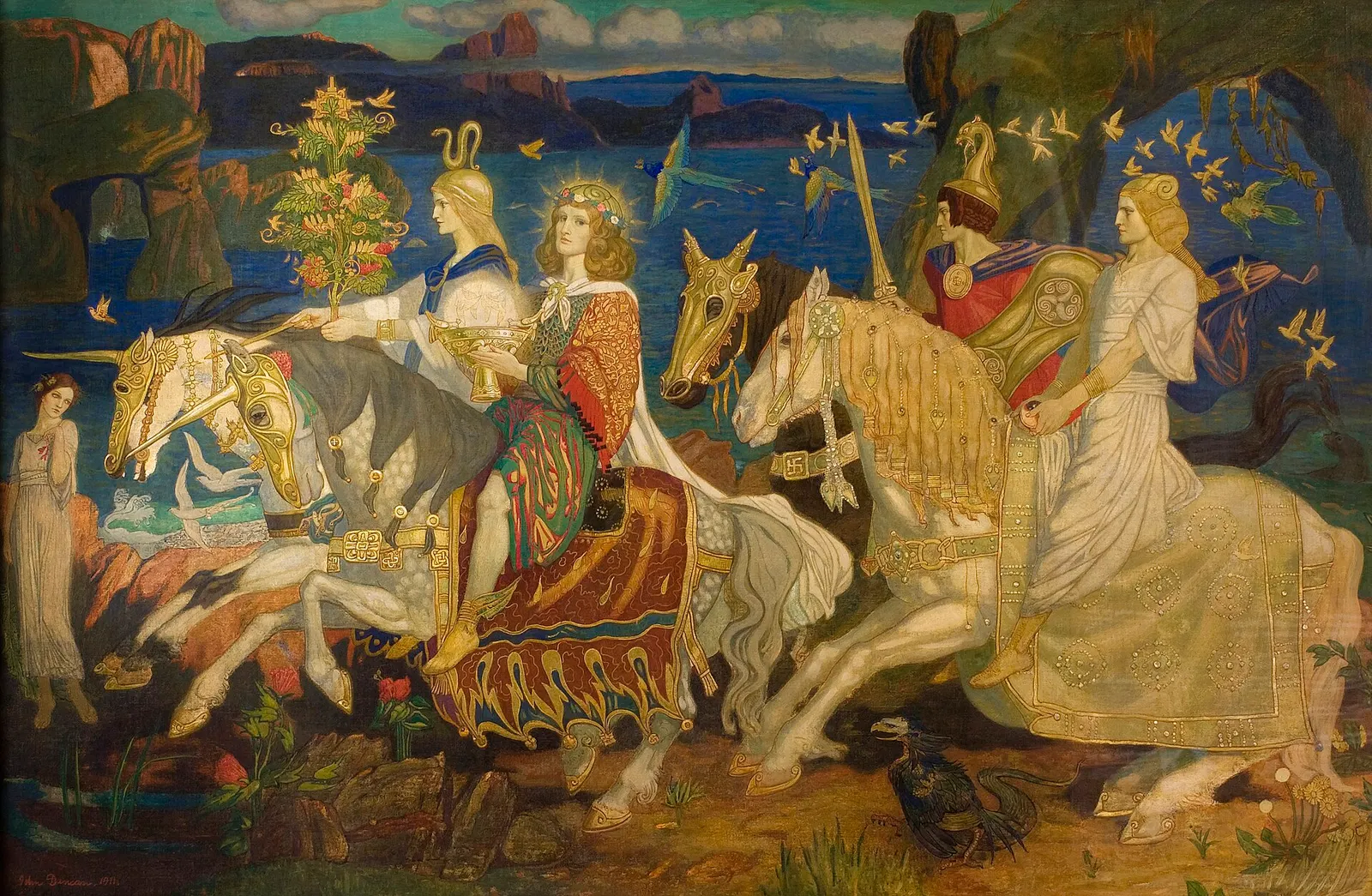
As printed in the Celtic Mirror, May 1998
Celtic historian and writer John Matthews has sought out the rarer Celtic tales. With his book, readers can drop out of the 20th century and let their minds escape to a world and dimension where anything is possible - a world filled with danger, excitement and superstition.
One such tale is of Scotland's winter queen, Beira, who slumbered in the form of a young woman while the summer king ruled. In the autumn, she aged, and her beauty faded. By winter, she was old and weathered and ruled as a fierce queen who wandered about on stormy nights singing her chilling songs.
Beira possessed numerous wells and guarded them jealously. She kept them covered with slabs of rock and opened them only to draw water. If the wells were to be left uncovered after the sun went down, the water would stream down the mountain. One evening, Beira sent out her maid, Nessa, to cover one of the wells, but Nessa dawdled and arrived late. As she drew near the well, the water was flowing so fast she quickly turned away and ran for her life.
Watching from the top of her mountain throne at Ben Nevis, Beira cried out, "You have neglected your duty. Now you will run forever and never leave the water." With that, the maiden was changed into a river. Both the river and the loch, Loch Ness, were named after her. It is said that once a year, Nessa can be seen to rise out of the river in her girl form in the pale moonlight, and can be heard to sing a sad, sweet song. Witnesses have said Nessa's voice is as beautiful as the sound of the silvern pipes of fairyland.
Matthews' book reintroduces readers to the faery race. These Celtic beings are not the tiny, winged, vapid sprites of Victorian writers or of modern-day Walt Disney films.
Celtic faeries are the old race of the land. In bygone days, faeries represented a bond to the land and the natural world - a fellowship that has been all but forgotten in our modern world. In his desire to tame the natural world, man has tried to explain away all the wonders scientifically.
The Irish, though, have doggedly championed the faery, ghost and otherworld figures. To the Irish, the otherworld connects effortlessly with the present. Following that lead, if readers discard their inhibitions, they can be transported by Matthews' book to a place where surprises are everywhere. It is a place where heroes grow overnight, animals talk and know significantly more than humans, and beauty breeds danger. All these extraordinary happenings and beings emerge from everyday events.
There are stories that begin with wonderfully engaging lines like "When the wind blows ..." or the traditional "Once upon a time...." There are tales of sea faeries who dwell in their kingdom beneath the sea, living under the waves in cave houses where land meets water. Like the land faeries, they love music. They might come up from their cave houses to hear a piper playing at the beach. On moonlit nights, when human beings are fast asleep and mermaids lounge upon the rocks, the sea faeries come up to hear the mermaids singing. The sea faeries are skilled at human speech, and also come ashore in the form of men or women. It is said that they transform the billows into dark horses with long gray manes and ride about the mountains and moors on these horses.
Other sea beings that can change into human form on land are the selkies, or seal women. Sometimes, in their visits to the land, they meet and fall in love with human men. But a selkie is not usually content to stay upon the land. Pining for her home beneath the waves, she is drawn to return to the sea - sometimes leaving behind a daughter who may inherit the selkie peculiarity.
Thanks to the dedication of writers like Matthews, these almost forgotten tales are rescued from the pages of forgotten books and obscure journals to share the limelight with some of the more prominent Celtic literature. In the last century, people of Celtic ancestry knew little or nothing about the ancient Celts. Thankfully, these stories were still told among the country people. Now - and high time it is - they are brought to present-day readers.
Where Beira came from
Joan Farrell's review never gives the title of the book, and our 1998 files do not either, so we will not guess. What we can trace is the winter queen herself.
Beira, under that name, is largely the work of the Scottish folklorist Donald Alexander Mackenzie. His collection Wonder Tales from Scottish Myth and Legend, published in 1917 with illustrations by the Symbolist painter John Duncan, opens with a chapter called "Beira, Queen of Winter." The Nessa story Farrell retells is there almost beat for beat: a well in Inverness-shire that must be covered from sunset to sunrise, a maid who arrives late, a girl turned into a river, and a loch and river named Ness after her. Mackenzie adds that once a year, on the night of her change, she rises from the river in her girl's shape.
The same chapter carries a twin tale. Another of Beira's wells, high on Ben Cruachan in Argyll, was left uncovered one night, and by morning the glen below had filled to become Loch Awe. Mackenzie's Beira is not gentle. He describes a one-eyed giantess with white hair, dark blue skin and rust-coloured teeth, enthroned on Ben Nevis, who drinks from the Well of Youth at the end of the longest night and grows younger day by day.
Behind Mackenzie stands an older Gaelic figure, the Cailleach, the hag of winter. In Scottish tradition she rules from Samhainn to Bealltainn, the start of May, while the goddess Brìghde holds the summer half. On Imbolc, 1 February, the Cailleach is said to go out gathering firewood; foul weather that day is read as a sign that winter is nearly done.
John Matthews, born in the north of England in 1948, has been writing professionally since 1980 and has turned out dozens of books on Arthurian legend, the Grail and Celtic tradition, many of them with his wife, Caitlín Matthews. Farrell's point stands: much of this material survives because collectors kept copying it out of old books and country memory into new ones.
Questions readers ask
Who is Beira, Queen of Winter?
Beira is the winter queen of Scottish folklore as written up by Donald Alexander Mackenzie in Wonder Tales from Scottish Myth and Legend (1917). He drew on the Gaelic Cailleach, the divine hag of winter, and described Beira as a one-eyed giantess with Ben Nevis as her mountain throne, who rules the dark half of the year.
What is the legend of how Loch Ness got its name?
In Mackenzie's 1917 retelling, Beira had a well in Inverness-shire that had to be covered between sunset and sunrise. Her maid Nessa was late to cover it, ran from the flood, and was turned into a river by the angry queen. The river and loch were then called Ness after her, and she is said to rise once a year.
What is a selkie in Scottish folklore?
A selkie is a seal that can shed its skin and live on land in human form. The legends come mainly from Orkney and Shetland. In the usual tale a man hides a seal woman's skin, she marries him and bears children, and when she finds the skin, often hidden in the roof or a chest, she returns to the sea.
Who was the Cailleach in Celtic mythology?
The Cailleach is the Gaelic hag of winter in Scottish, Irish and Manx tradition. Scottish lore has her ruling from Samhainn in November to Bealltainn on 1 May, while Brìghde rules summer. Legends credit her with shaping mountains and lochs, and say she washes her plaid in the Corryvreckan whirlpool until snow covers the land.