Milberg collection comes to Princeton: Opening features Nobel laureate Seamus Heaney
In April 1998 more than 1,500 people braved the rain to hear Seamus Heaney open Princeton's new Leonard L. Milberg collection of Irish poetry.
As printed in the Celtic Mirror, May 1998
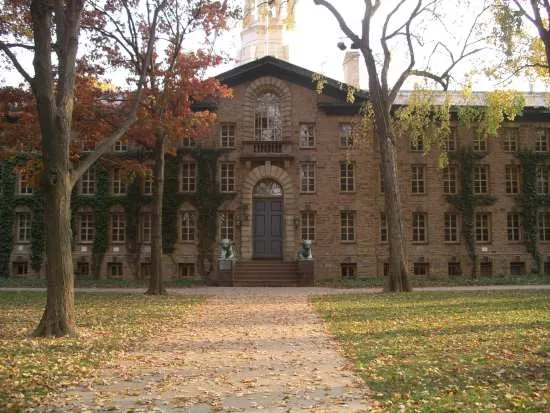
"Sing whatever is well made" is the theme of Princeton University's six-month display of Irish poetry, which opened on Sunday, April 26, with a reading by Nobel Prize-winning poet Seamus Heaney. Successful beyond the most optimistic expectations, the opening brought out more than 1500 people on a rainy afternoon - and how thoughtful it was of the university curator to arrange Irish weather - to listen to Heaney. The 850-seat capacity of Richardson Auditorium was quickly exceeded, and more than 500 attendees crammed into the McCosh Center to watch the proceedings via simulcast.
The occasion marked the university's acquisition of the Leonard L. Milberg collection. Milberg, a member of Princeton's Class of 1953 and a self-admitted collector at heart, donated to the university more than 1,100 printed works by 50 Irish poets. Milberg explained his inspiration for assembling an Irish poetry collection in these words: "They are people of exceptional learning and interest writing in a way that reflects the beauty of the language...."
The collection is magnificent. Items in the exhibit include many first editions of works by literary superstars and poets' books, poem cards and even a box of pen nibs that belonged to James Joyce. Other items are an original manuscript of Oscar Wilde's sonnet "Helas!," a personally inscribed program from London's St. James theater for Wilde's play "The Importance of Being Earnest," rare photographs of Joyce and a first edition copy of William Butler Yeats' play "The Land of Heart's Desire" with an illustration by artist Aubrey Beardsley.
Heaney officially opened the acquisition events, and his immense popularity drew in the audience. Once there, they were treated to his warmth, wit, candor and talent. Heaney's all-around humanness has the ability to change a very ordinary topic into something shimmering, poignant and thought-provoking. He clarifies any misconceptions about poetry of this caliber. Heaney's work is equally revered by the ordinary mainstream audience and the literary. His poetry can be described as a cultural and social tapestry, a sometimes political agenda and something of the history that produces these elements. There is something in it for everyone.
This native and one-time inhabitant of Mossbawn, County Derry, the oldest of nine siblings, returns via his work to canvass the Northern Ireland rural landscape. In his 1995 Nobel Prize acceptance speech, Heaney talked about his humble beginnings, saying of himself and his eight siblings that "we crowded together in the three rooms of a traditional thatched farmstead." Since then, he has moved on to become the Boylston Professor of Rhetoric and Oratory at Harvard, then Professor of Poetry at Oxford. The culmination of his prize-winning career came with the announcement in October of his winning of the Nobel Prize.
At a reception in the university's Firestone Library after the reading, Heaney and two other major Irish poets, Paul Muldoon and Michael Longley, mingled and chatted with the guests. One of the highlights came in the form of a surprise appearance by author Toni Morrison. Even Heaney was delighted by Morrison's unexpected visit. Morrison is herself a recipient of the Nobel Prize in Literature in 1993 for her novel "The Bluest Eye," and in 1987, she received the Pulitzer Prize for her best-selling novel, "Beloved." Her current novel, "Paradise," has been riding high on the New York Times best seller list for more than 14 weeks.
These events signal Princeton's interest in Irish history and culture and a commitment to expand academic activities in this area. The university plans to announce the formation of a committee for the Funds for Irish Studies.
The Milberg exhibit is open to the public and will continue at the Firestone Library until September 20.
The people in the room
Read this report today and the reception at Firestone Library looks like a group photograph of Irish letters at full strength. Twenty-eight years later, most of the faces have gone.
Seamus Heaney had won the Nobel in 1995 and had held the Boylston chair at Harvard from 1985 to 1997. After that April afternoon came his Beowulf translation, which took the Whitbread Book of the Year for 1999, and District and Circle, which won the T. S. Eliot Prize in 2006. He died at the Blackrock Clinic in Dublin on 30 August 2013, aged 74. Minutes before, his son Michael told the funeral congregation, he had texted his wife Marie two words of Latin: Noli timere, do not be afraid. He is buried at Bellaghy, near the Mossbawn farm the article mentions.
Michael Longley won the T. S. Eliot Prize in 2000 for The Weather in Japan, served as Ireland Professor of Poetry from 2007 to 2010, and died on 22 January 2025 at 85. Toni Morrison, who taught at Princeton in the Robert F. Goheen Chair from 1989 to 2006, died on 5 August 2019. Two small corrections to the 1998 copy: her Pulitzer for Beloved came in 1988, and her 1993 Nobel cited a body of novels "characterized by visionary force and poetic import," not The Bluest Eye alone.
Paul Muldoon stayed. He won the Pulitzer Prize for Poetry in 2003 for Moy Sand and Gravel, was Oxford Professor of Poetry from 1999 to 2004, received the Queen's Gold Medal for Poetry in 2017, and became the founding chair of Princeton's Lewis Center for the Arts.
The committee promised in the last paragraph did take shape. Princeton's Fund for Irish Studies still runs a public lecture series through the Lewis Center; Fintan O'Toole chaired it in 2023 to 2024, and in November 2024 Muldoon gave a talk there titled A History of Ireland in 10 Poems. Milberg kept collecting. His Irish prose collection followed in 2011, celebrated with an exhibition and symposium called The Cracked Lookingglass.
Questions readers ask
What is the Milberg collection of Irish poetry at Princeton?
The Leonard L. Milberg Collection of Irish Poetry is a rare book collection at Princeton University Library, given by Leonard Milberg of the Class of 1953 and compiled largely by J. Howard Woolmer. At its 1998 launch it held more than 1,100 printed works by 50 poets from Ireland and Northern Ireland, mostly published after World War II.
When did Seamus Heaney die?
Seamus Heaney died on 30 August 2013 at the Blackrock Clinic in Dublin, aged 74. Born on 13 April 1939 at Mossbawn, County Derry, he won the Nobel Prize in Literature in 1995. He is buried at St Mary's Church in Bellaghy, in the same graveyard as his parents.
What were Seamus Heaney's last words?
At his funeral mass his son Michael said that Heaney sent a text message to his wife, Marie, minutes before he died on 30 August 2013. It read Noli timere, Latin for do not be afraid. Heaney, born at Mossbawn in 1939, is buried at Bellaghy in County Derry.
Does Princeton have an Irish studies program?
Princeton's Fund for Irish Studies, run through the Lewis Center for the Arts, presents a public lecture series on Irish history, literature and culture. Paul Muldoon organised it for years, and Fintan O'Toole chaired it in 2023 to 2024. The university also holds the Milberg collections of Irish poetry and Irish prose.