'Belfast' records the city in new light
A 1995 review of Chris Hill and Jill Jennings's colour photo book, which showed Belfast's pubs, parks and opera house in the first year of ceasefire.
As printed in the Celtic Mirror, November 1995
The book "Belfast", a collection of 250 full-color photographs by Chris Hill and Jill Jennings, shows the city as few have recorded it in the last 25 years of media attention.
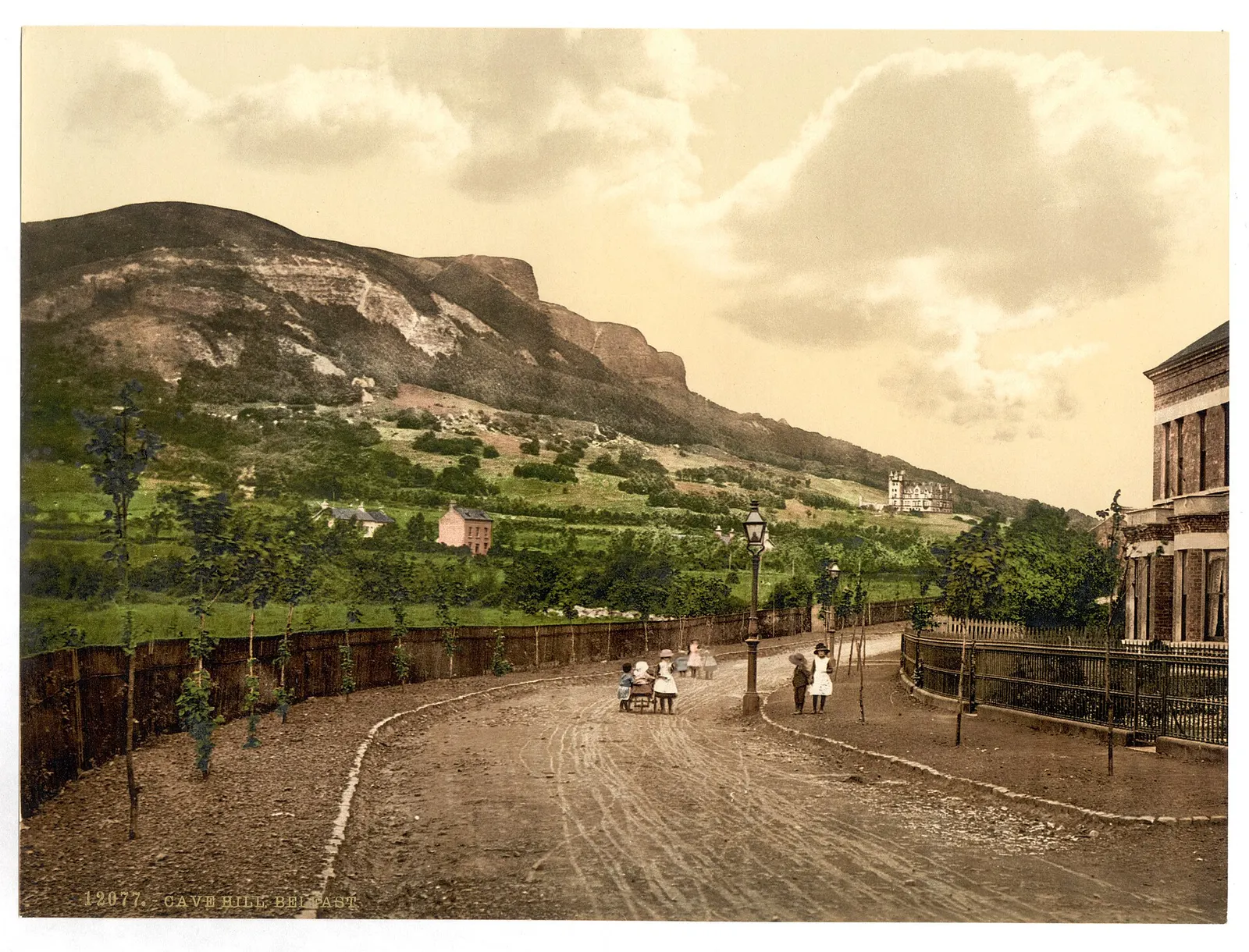
There are none of the stark, black-and-white images of ragged kids and burnt-out houses. Instead the intricate Victorian decor of the Crown Bar and the Grand Opera house; the city center crowded with casual strollers; the greenly beautiful Cavehill, Lagan towpath and dear old Botanic gardens.
All these and other places and scenes so beautifully rendered in this book exist and always have existed. So too, the ragged kids, poverty and mass unemployment not recorded.
New York City with its Times Square, Empire State Building and Central Park has legions of homeless crowded in shelters. Belfast with its lovely ring of hills; its excellent Queen's University and its rollicking nightlife also has project areas with unemployment at more than 80 percent and a long haul ahead to bury the hurt of all those deaths.
"Belfast" is beautiful to browse through. The cover photo shows a man and his dog on the slopes of Cavehill, with the peak, McArt's fort, in the sky above. It was on this peak that Protestant dissenters Henry Joy McCracken, Theobald Wolfe Tone and Thomas Russell took their oath to drive the English out of Ireland. They founded the Society of United Irishmen who rose in 1798 and fought desperately, but in vain, to fulfill that oath.
On pages 56 and 57 are eight photos taken in and around Cornmarket, with its bustling shoppers, street performers and air of intimate busyness. There is Mike Moloney, a lanky Australian with Belfast Community Circus, breathing fire for the crowds. There are beer-drinking punks smiling at the ancient street Evangelist who plied his trade there.
There is the magician-clown who has performed in the city center for the last few years. And there is Mickey Marley's roundabout, which he spins by hand for the kids.
Probably similar sights could be seen in the 18th century Cornmarket, where Thomas Russell was publicly hanged for his part in the 1798 Rising.
On pages 51 and 55 are photos taken in the Linenhall Library, where students spend so many hours studying earnestly, undisturbed by anything but their thoughts. The Linenhall library is the oldest surviving subscription library in the world. Its chief librarian is a friendly person who can tell the story of how Thomas Russell, mentioned above, was arrested by troops in the original library building, where he, in his day, held the title of chief librarian.
On page 44 are three beautiful evocative shots in the Crown Liquor Saloon, which is still lighted by gas mantles and serves the best Guinness in Belfast as well as a most delicious Irish stew made properly with lamb.
The ornate carvings and plasterwork of the (almost) intact Victorian Bar were created by Italian artisans in the last century while they were in town to work on the Grand Opera house nearby. Sadly, most of the original painted windows shown in the photos were destroyed by IRA bomb attacks on the hideously ugly Europa hotel (not pictured in the book) which is just across the street.
Belfast, like many another place, but probably more than most, is a melange of heartiness and zestful living. It is tinged with a poignancy that is difficult to describe.
Life goes on. Belfast has had peace now for more than a year.
Jennings said average house prices have increased by about $15,000 in the last year. This in a city where, in the late 1980s, a reasonably-sized house could be had for less than $40,000.
The pictures by Hill and Jennings show a busy, dynamic city. Belfast always had a certain energy about it. People always come to have a good time, and maybe drink a bit too much.
One might find special interest in the section of the book that features Belfast pubs. The photos capture something of the atmosphere and cozy familiarity of these old watering holes, where it seemed that all of life could be experienced or at least discussed over a pint.
However, page 46 has a picture of "The Washington", a glitzy London-style establishment built on the site of an old working man's bar.
Pictured on the opposite page, meanwhile, is "Manhattan Bar, Club and Diner," a noisy, bright and inhospitable place where secretaries and civil servants dance it out at weekends and fights are not hard to find. These are intrusions in a city where once a pub was a pub.
On the previous page, though, with the shots of the Crown, there is the upper room of Maddens, in Smithfield (the old market that was bombed and destroyed in the early 70s). Ah! Maddens. There is a session in progress in the foreground of the photo. Two fiddles, guitar and a mandolin, and in the top left corner is the face of Seamus O'Property, the owner who also has the most beautiful speaking voice.
The musicians have their pints of plain set up, courtesy of Seamus, the wood-paneled room glows as the reels and jigs do their good work on the ears and sensibilities of the drinking men and women.
Like the beautiful green countryside that surrounds and encroaches into the city, there is a lovely panoramic shot of Barnett's park and its "big house," where once the gentry would have strode or rode across the gentle landscape. Now Barnett's is a public park and, on weekends, city dwellers wander among the chestnut trees and often make their way to the towpath of the River Lagan which touches the east side of the park as it flows through the city and into Belfast Lough. On pages 102 and 103 are shots of the towpath, where it is possible to forget that cities exist at all. The walk along the Lagan, where once dray horses pulled commercial barges, goes all the way to Lisburn, about nine miles southwest. Some would walk all the way, then take train or bus back to the city.
These landscape shots and those in the pub section of the book are the parts one might most easily recognize. Many people from the United States who have visited Belfast seem to have a fondness for the place.
So, this reviewer is pleased to see a book like this which, as Jennings said, is perhaps the first positive representation to be made available.
"Belfast" has been on the best seller list in the North of Ireland since it was released just after the cease-fire was announced in September 1994. The book has been criticized by some as a "celebration of normalization." It has been called a window-dressing for a society riven with bitterness and injustice, and still bearing within it the seeds of war.
But Maddens Bar is real. So is the opulence of the Grand Opera House.
Perhaps Belfast's luck is changing and to the fore will come what the publisher's blurb calls "the undaunted vitality of a remarkable city."
For Belfast also has been, in the words of poet Padraig Fiacc, "like a beaten, sexless dog, cowed, waiting for where or when the next blow will fall."
Jennings quoted the words of a woman from the Falls Road who cleans Hill's studio. She looked at the juxtaposed shots of Falls (Catholic) and Shankill (Protestant) and said "Ach! Is that the Shankill? I've never been there, but it looks just like the Falls."
It does look like the Falls. People from the Falls look like those from the Shankill, and all speak in the same thick vowels.
The book "Belfast" is a sign of the times or perhaps a sign of times to come. Belfast is beautiful on these pages and God knows its people deserve and need some beautiful things in their lives. We all do.
To Chris Hill and Jill Jennings: congratulations on a skillful piece of work. And to Belfast also, tentative congratulations.
Thirty years on the same streets
Colin Hamilton's "tentative congratulations" turned out to be the right tone. Later that month, on November 30, 1995, Bill Clinton spoke to a crowd outside Belfast City Hall. On February 9, 1996, the IRA ended its ceasefire in London's Docklands. It took until April 1998 and the Good Friday Agreement for the calm in these photographs to look settled.
Most of the places Hill and Jennings photographed are still there, and several are in better shape than in 1995. The Crown Liquor Saloon, bought by the National Trust in 1978, is still gas-lit and had a further £500,000 restoration in 2007. Its tiling, glass and woodwork are now credited to Italian craftsmen brought to Ireland for Belfast's new churches, whom the publican Michael Flanagan persuaded to work after hours, which differs a little from the opera house version in the review. The Grand Opera House, a Frank Matcham theatre that opened on December 23, 1895, was damaged by bombs aimed at the Europa in 1991 and 1993, and reopened after a £12.2 million restoration of its auditorium and foyers in 2020 and 2021.
The Linen Hall Library, founded in 1788 as the Belfast Reading Society, is still the oldest library in the city. Its Northern Ireland Political Collection, gathered since 1968, now holds about 250,000 items and is the standard archive of the Troubles.
A correction for the history buffs. The famous Belfast hanging of 1798 is Henry Joy McCracken's, on July 17 of that year, from gallows in front of the Market House on High Street. The review's account of Thomas Russell's fate we have left as printed.
Questions readers ask
Who owns the Crown Bar in Belfast?
The Crown Liquor Saloon has belonged to the National Trust since 1978, when campaigners including Sir John Betjeman persuaded the Trust to buy it. It is leased to Mitchells & Butlers and run as a Nicholson's pub. The Trust spent about £400,000 restoring it around 1981 and another £500,000 in 2007.
How old is the Linen Hall Library?
The Linen Hall Library was founded in 1788 by a group of Belfast artisans as the Belfast Reading Society, which makes it the oldest library in the city. It is best known today for its Northern Ireland Political Collection, gathered since 1968, which holds about 250,000 items on the Troubles and the politics of Northern Ireland.
When was the Grand Opera House in Belfast built?
The Grand Opera House opened on December 23, 1895, to designs by Frank Matcham, the most prolific theatre architect of his era. It was badly damaged by bomb blasts in 1991 and 1993, often caught in attacks on the Europa Hotel nearby, and its auditorium and foyers were restored in a £12.2 million project completed in 2020 and 2021.
Where was Henry Joy McCracken hanged?
Henry Joy McCracken, a founder of the Society of United Irishmen, was hanged on July 17, 1798, from gallows set up in front of the Market House on Belfast's High Street. With Wolfe Tone and Thomas Russell he had taken an oath on Cavehill, at McArt's Fort, to work for Irish independence.