Enlisting Irish-Americans in aid of Ireland
After hearing Gerry Adams at Seton Hall, a New Jersey reader drew up a to-do list for Irish America, from UN status to radio requests and famine stamps.
As printed in the Celtic Mirror, May 1998
At Seton Hall, N.J., someone posed this question to Gerry Adams: "What should Irish America do to help?" His answer was a general suggestion that we join the efforts of concerned Irish-American organizations and exert pressure on our politicians. After hearing his response, I began pondering what specific steps we might take. I submit them herewith for your consideration.
Take advantage of democracy: We here in the United States have a luxury available to the citizens of very few countries - that of making our demands heard. We have taken advantage of that luxury in the past and must continue to do so in calling for the ultimate goal of Irish sovereignty.
Get a voice in the United Nations: There is available at the UN something called Roster Status, which affords a group access to the UN complex and the opportunity to present its position on issues and offer its expertise. Led by Irish-Americans, a coalition of Hibernian organizations from the more than 30 countries with sizable Irish populations could apply for this status.
Use the media to promote and to protest: If you listen to a radio station that takes requests, ask for some Irish music. There's an appropriate song, whatever the station format: Johnny Cash singing "Forty Shades of Green" for country, Jackie Wilson's "Danny Boy" for a '50s program, the Beatles' "Give Ireland Back to the Irish" for rock.
Rebut British misinformation: A number of recently published British articles and books cry for stringent criticism and refutation. Two of the more egregious examples are Thomas Hennessey's "A History of Northern Ireland 1920-1996" and Peter Taylor's "Provos: The IRA and Sinn Fein."
Enlist legislators at the state and local levels: As an indication of what can be done by determined citizens, here in New Jersey, an educational curriculum on the Irish Famine has been made available to the schools, and two Congressmen are advocating for passage of HR 1075 calling for a ban on the exportation of American-made plastic bullets to England.
Enter candidates in elections: In the past, there has been perhaps no other activity so quintessentially American, indeed quintessentially Irish-American, as putting up a slate of able candidates and getting out the vote. We should do it again - and keep on doing it.
Lobby for commemorative postage stamps: Though no Irish-themed stamp has yet been approved, there are signs of progress. As just one example, a Great Hunger stamp has gathered the support of a number of Senators and Representatives. More signatures and letters and lobbying might actually get us a stamp.
Implement organizational fund-raising: I mailed back a couple of Noraid raffle tickets with the notation that if I won I'd rather see the $5,000 used to bring a couple of ex-prisoners to the United States. In 1994, I wrote a flyer about the case of the Ballymurphy Seven that the AOH distributed at screenings of the film "In the Name of the Father." Irish organizations might bring a couple of the Seven over here for a vacation and a chance to tell their stories to the American media.
Use your head: I'm out of ideas, temporarily at least, so now it's up to you. Don't let this list end here. Tell us what else we can do to make Ireland what it should be - a free, united country.
A note on the list
Tom Culhane wrote as a reader with a cause, and the column belongs to a particular month: May 1998, weeks after the Good Friday Agreement and just before the referendums of 22 May. The list is a snapshot of how one strand of Irish America thought it could push from across the Atlantic.
A few items need a gentle footnote. "Give Ireland Back to the Irish" was not a Beatles record. It was the debut single of Paul McCartney's new band, Wings, released on 18 February 1972 in response to Bloody Sunday in Derry, when British soldiers shot dead thirteen civil rights marchers. The BBC banned it. It still went to number one in Ireland and reached number 16 in the UK. The mix-up is understandable; it was on the Beatles' own Apple label.
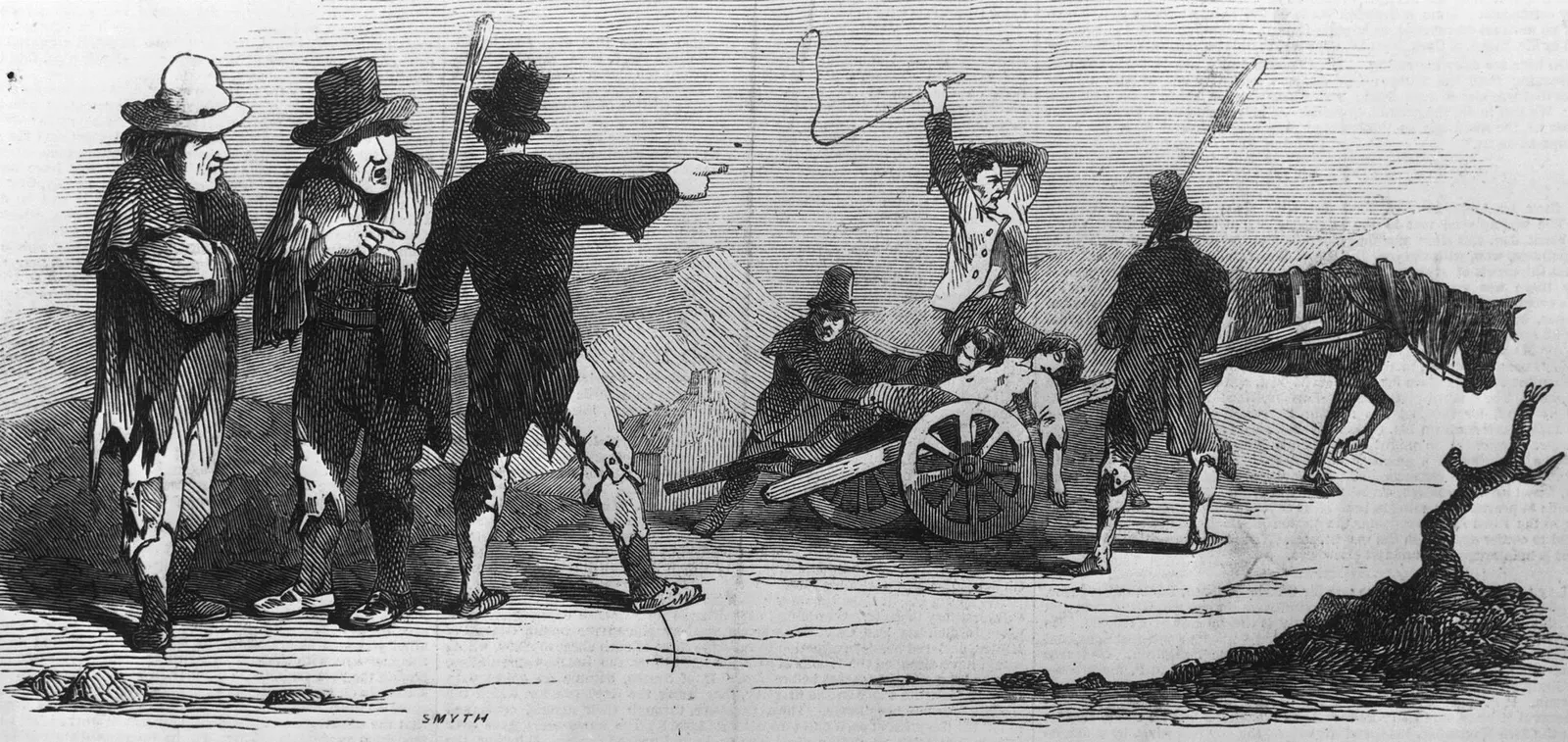
The famine curriculum Culhane cites was real and came out of exactly the kind of local lobbying he recommended. James Mullin approached Paul Winkler of the New Jersey Commission on Holocaust Education in 1995 to ask whether the Great Irish Famine could be taught under the state's 1994 Holocaust and genocide education mandate. The result was a curriculum of about 116 pages, adopted in New Jersey and, in the same period, used in New York. Whether the Famine counts as genocide was argued over from the first draft, and still is.
NORAID, whose raffle tickets Culhane mailed back, had been founded in 1969 by Michael Flannery. It backed the peace process and the Agreement, and printed the last issue of its newspaper, The Irish People, on 13 March 2004.
The core advice, organise and vote, has aged better than any single item on the list. We did not find any record that the bills and stamp campaigns named here succeeded, so we say nothing more about them.
Questions readers ask
Did the Beatles record Give Ireland Back to the Irish?
The song was recorded by Wings, Paul McCartney's band formed after the Beatles split, and released on 18 February 1972 on Apple Records. Paul and Linda McCartney wrote it after Bloody Sunday in Derry on 30 January 1972. The BBC banned it from broadcast, yet it reached number one in Ireland and number 16 in the UK.
Is the Irish Famine taught in New Jersey schools?
New Jersey developed a Great Irish Famine curriculum in the mid-1990s as part of its Holocaust and genocide education, which the state mandated in 1994. Advocate James Mullin raised the idea with the New Jersey Commission on Holocaust Education in 1995, and the resulting curriculum runs to about 116 pages. New York included the Famine in similar studies.
What was NORAID?
NORAID, the Irish Northern Aid Committee, was founded in New York in 1969 by Michael Flannery, a former IRA man from Tipperary. British, Irish and US governments accused it of funding the Provisional IRA, and in 1981 a US court ordered it to register the IRA as its foreign principal. It later supported the Good Friday Agreement.
What did Irish-Americans do to support the Northern Ireland peace process?
Irish-American groups lobbied Congress and the White House, raised money and hosted visiting politicians such as Gerry Adams, who toured US campuses including Seton Hall in New Jersey. Former Senator George Mitchell chaired the talks that produced the Good Friday Agreement on 10 April 1998, approved by 71 percent of voters in Northern Ireland.