PEC calls on Britain to apologize for famine: Petition drive initiated
In the 150th-anniversary summer of the Great Hunger, an Irish-American committee asked Downing Street for an apology and tied it to the peace process.
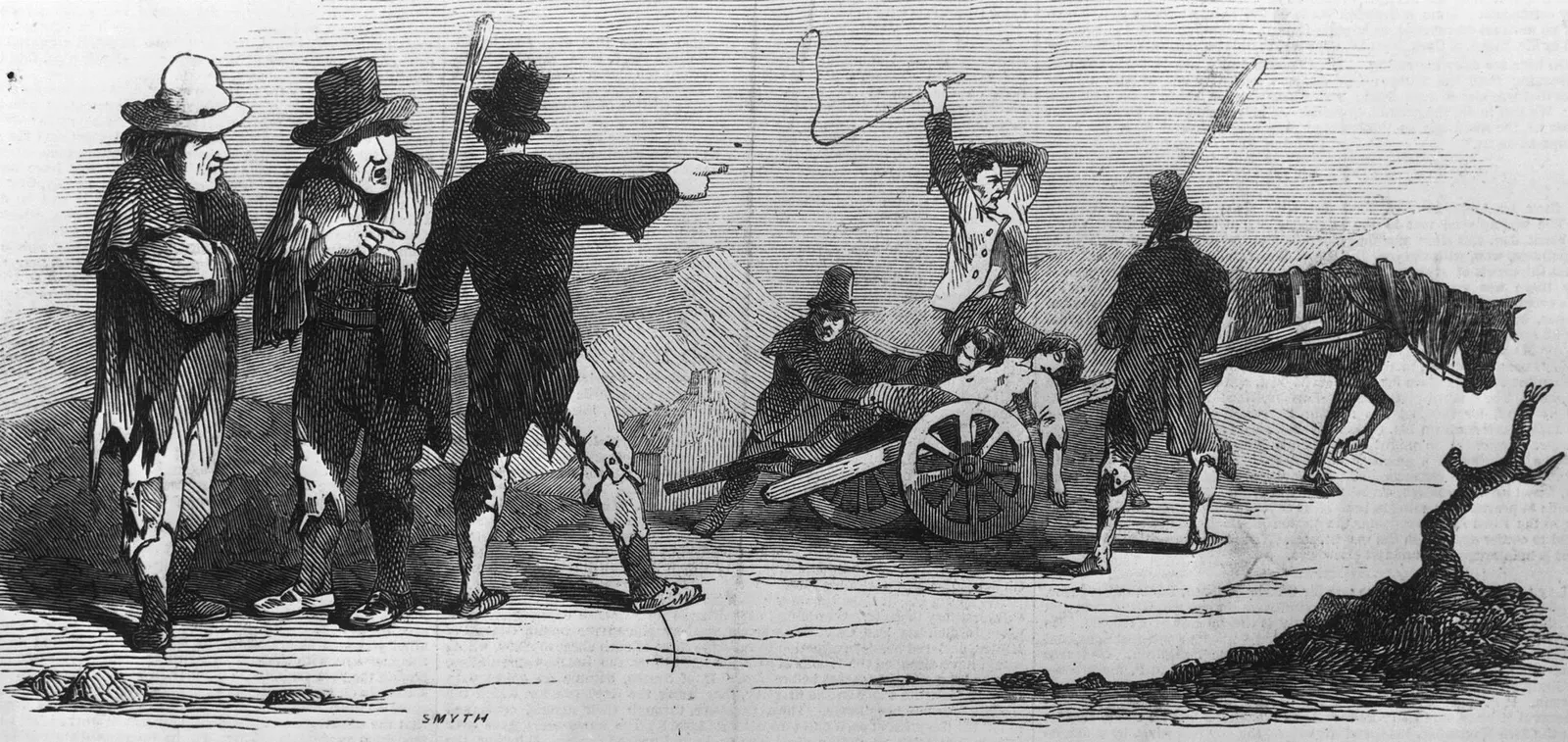
As printed in the Celtic Mirror, August 1995
The American Irish Political Education Committee has launched a petition campaign asking the British government to apologize to the Irish people for the criminal neglect that caused the death and exile of millions of Irish during the Great Hunger of the mid-19th century.
The organization is linking its commemoration of the Great Hunger with the current English-Irish peace process. The petition to the British prime minister says:
“One hundred fifty years have passed since Ireland's Great Hunger (The ‘Famine’). We believe the British government should apologize for its neglect at the time, which caused the death and forced exile of millions of Irish people in the 1840s, cutting Ireland's population in half. Britain's apology will greatly assist the English-Irish peace process by helping to heal the legacy of pain and anger the Irish people and the Irish diaspora continue to experience.”
PEC President John J. Finucane says the PEC received hundreds of signatures in the first week of its campaign. The petition campaign follows the PEC's letter to Robin Renwick, British ambassador to the United States, in which the organization asked Britain to apologize for the neglect that caused the Great Hunger.
The PEC hopes the Irish-American and other interested organizations will participate in the campaign by copying the petition and soliciting as many signatures as possible.
It is also hoped that other organizations will help educate a wide audience about Britain's obligations to Ireland.
The PEC, a committee of the American Ireland Education Foundation, has been promoting public awareness of the Great Hunger since 1983.
For copies of the petition, contact the PEC at 54 S. Liberty Drive, Stony Point, NY 10980 or telephone (914) 947-2726.
What London said next
The petition in this short item went out in the summer of 1995, the first of the 150th-anniversary years. The Irish government had set up a committee in 1994 to fund commemorations of the Famine, and it kept working until 2000. Across the Atlantic, Irish-American groups pushed on several fronts at once: schools, monuments, and the question of a British apology.
The apology question got its answer, of a kind, in 1997. At a commemoration event in County Cork that year, the actor Gabriel Byrne read out a message from the new prime minister, Tony Blair. It said that those who governed in London at the time had failed their people by standing by while a crop failure turned into a massive human tragedy. Irish newspapers treated it as the apology people had been asking for. It was not phrased as one, and the British government has never made a formal apology for its role in the Famine.
There is a footnote we could not have guessed at in 1995. Archive papers released in 2021 showed that Blair neither wrote nor approved the message himself. His aides could not reach him in time, and it went out on the authority of his principal private secretary, John Holmes.
Robin Renwick, the ambassador who received the committee's letter, left Washington in 1995. He sat in the House of Lords as Lord Renwick of Clifton and died on 4 November 2024, aged 86.
The education campaign moved faster than the diplomatic one. On 10 September 1996 the New Jersey Commission on Holocaust Education approved Famine material for its Holocaust and Genocide Curriculum at secondary level, drafted largely by the librarian James Mullin. In New York, the Irish Hunger Memorial in Battery Park City was dedicated on 16 July 2002. It is a half-acre park with a real 19th-century cottage from Attymass, County Mayo, set into it.
Ireland itself took longer to settle on a date. The state has organised a National Famine Commemoration Day since 2008, usually on a Sunday in May, with the main event rotating among the four provinces and a second ceremony somewhere in the diaspora. Toronto, New York, Boston, Liverpool and Phoenix have all hosted it.
Historians, meanwhile, still argue about the word the petition used. Few academic historians in Ireland accept that British policy amounted to genocide. Most do agree that the policies chosen in London shaped who starved and who got on a ship. Roughly a million people died between 1845 and 1852, and more than two million left in the decade after 1845.
Read today, the PEC's text is notable less for its demand than for its timing. It bet that an apology would help the peace talks. Two years later London offered words that sounded close enough, and the talks were back on.
Questions readers ask
Did Britain ever apologize for the Irish famine?
Britain has never issued a formal apology. In 1997 the actor Gabriel Byrne read a message from Tony Blair at a commemoration in County Cork saying that those who governed in London had failed their people by standing by during the crisis. Irish media widely received it as an apology. Papers released in 2021 showed Blair had not written or approved it himself.
Who wrote Tony Blair's famine statement?
Archive documents released in 2021 showed the 1997 message was prepared by aides and approved by John Holmes, Blair's principal private secretary, on his own initiative because the prime minister could not be reached in time. Gabriel Byrne read it aloud at the County Cork event, and it was treated in Ireland as the long-sought British acknowledgement.
How many people died in the Great Famine in Ireland?
About one million people died between 1845 and 1852, and at least 2.1 million left Ireland between 1845 and 1855. The island's population, around 8.5 million on the eve of the Famine, fell by 20 to 25 percent between 1841 and 1871 because of death and emigration combined.
When is Ireland's National Famine Commemoration Day?
The day has been organised by the Irish government since 2008 and usually falls on a Sunday in May. The main ceremony moves between the four provinces each year, starting with Dublin in 2008 and Skibbereen, County Cork, in 2009, and a second event is held abroad in a city with a large Irish diaspora.