Past struggles in Pa. coal fields become inspiration for artist: Monuments, memorials salute coal miners
In 1995 the hard coal towns of northeastern Pennsylvania were racing to cast their miners in bronze, and one local sculptor found himself in the middle of it.
As printed in the Celtic Mirror, November 1995
Mining anthracite coal provided employment, and for many families in northeastern Pennsylvania, it became a way of life.
The Pennsylvania anthracite miners were men and boys from diverse backgrounds, Welsh, Irish, Polish, Lithuanian, Ukrainian, German and Russian to name a few.
They had their own churches and lived in homogeneous neighborhoods and patch towns, but when they went underground, they shared a dangerous existence - so dangerous that most fathers didn't want to see their sons go into the mines.
Today, many people throughout the anthracite region seem to have stopped thinking about coal mining, but they are remembering the miners with pride. And one Schuylkill County artist, Martin Heffron, is immortalizing miners by creating a work of art and heritage.
Heffron sculpted for Forest City, Pa. in Susquehanna County what is, at this time, the largest memorial to miners. The four-panel bronze mural is a 17-foot lunette that depicts scenes of miners and their families.
Heffron, who lives in the small town of Duncott, near Minersville, Schuylkill County, Pa. has a lifelong identification with the life of a miner. Both his father and his grandfather worked in the mines.
The idea of immortalizing miners seems to have caught on in the hard coal region. At least two Schuylkill County communities, Shenandoah and Minersville, have projects under way. Shenandoah expects to unveil its monument next September. It will be a mural accompanied by a statue.
Heffron was originally involved in the Shenandoah project but left after a disagreement with the committee that formed to oversee the monument project.
Heffron explained that he was contracted by the Shenandoah Chamber of Commerce (and later the Pennsylvania Anthracite Miners' Memorial Committee Inc.) to do the design.
"They heard about my work on the Forest City project," he said.
Heffron came up with drawings of five panels that depicted not only the miners, but also a historical theme.
He recalled "They were incredibly detailed - more so than the Forest City panels."
Heffron said that after submitting a contract for the bronze relief, he was disappointed to hear that the Shenandoah group was soliciting other artists.
"I was eager to get the Shenandoah project and reduced my commission as it was, asking $80,000. It is my home region," he said. Nevertheless, contract negotiations between the memorial committee and Heffron broke down and Heffron ended up leaving the project.
Ted Souchuck, Pennsylvania Anthracite Miners Memorial Committee chairman, recently said of the matter, "Our problem was contract differences. I'm happy for Marty on the success of his Forest City memorial. He's a very talented young man. We approached Marty because he was local and he produced a very good layout. Things just fell apart during the contract talks."
Souchuck indicated that during negotiations with Heffron, the cost of the monument increased several times, and the committee decided to seek other estimates.
Zenos Frudakis of Glenside, Pa., a Philadelphia area sculptor and artist, signed onto the project for $82,000. The one-and-a-quarter-acre plot along North Main Street, adjacent to Girard Park, will include a donors' plaque. Contributors may also buy into the walkway surrounding the monument by purchasing a brick dedicated with a miner's name.
Costs for the project, including landscaping and the addition of a parking area, will exceed $200,000, Souchuck said.
"And this memorial is something the entire region can take pride in," he said.
Souchuck did his time in the mines, picking slate and bearing the job title "breaker boy." Later, alongside his father, Souchuck worked deep in the mines until leaving home for the military. He is now a successful businessman, but he remembers his mining days.
"The work was hard, and many men paid with their lives. This monument is long overdue," he said.
A Minersville group recently launched a fund-raising effort for an eight-foot bronze statue. The group projected a 1996 completion date. The monument site is along Route 901 at the intersection of Route 209.
The artist, Tom Pontor, is a Pottsville, Schuylkill County, native and resident artist at the Philadelphia Mint.
Minersville's project chairman, Joseph Walacavage, said there has been talk that a neighboring city, Pottsville, is interested in participating with the Minersville effort.
"If so, Pottsville may contract a duplicate statue," Walacavage said. "Using the same mold will be a significant cost saving."
The tentative Pottsville miners' memorial site is along the southeast corner of the Schuylkill County Courthouse.
Heffron, having enjoyed success with the Forest City memorial, is currently working on limited edition bronze castings of the monument.
"I've had a lot of people asking for something small for their homes ... a sort of piece of the wall ... I'm so pleased ... those miners deserve our respect," he said.
(To visit the Forest City Miners' Memorial, travel Interstate 81 North to the Carbondale exit. Follow Route 6 through Carbondale. Take Route 171 north into Forest City.)
The bronze, and the towns, since
Shenandoah got its memorial. Zenos Frudakis's catalogue lists an Anthracite Miners' Memorial in bronze relief at Girard Park, dedicated in 1996: a central panel eight feet square flanked by two panels six feet by four. Frudakis, born in San Francisco in 1951 and based near Philadelphia, went on to a long public career; his best-known work is Freedom, the figures pulling themselves out of a wall in downtown Philadelphia. We could not confirm from a reliable source what became of the Minersville and Pottsville statues described here, or of Martin Heffron's small castings, so we leave those threads where Joan Farrell left them.
The towns the memorials were built for kept shrinking. Shenandoah had close to 30,000 people around 1920. The 2020 census counted 4,243. Minersville counted 4,370. The region as a whole, Carbon, Lackawanna, Luzerne, Northumberland and Schuylkill counties, still sits on what is described as the largest known anthracite deposit in the world, some seven billion short tons, but very little of it is dug by men underground.
Two dates explain much of that. The breaker boys Ted Souchuck remembered were a fixture from the mid-1860s, and public pressure did not end the practice until the early 1920s. Then on 22 January 1959 the Susquehanna River broke through the roof of the River Slope Mine at Port Griffith, near Pittston. Twelve miners died in the Knox Mine disaster, and the flooding all but finished deep mining in the northern field.
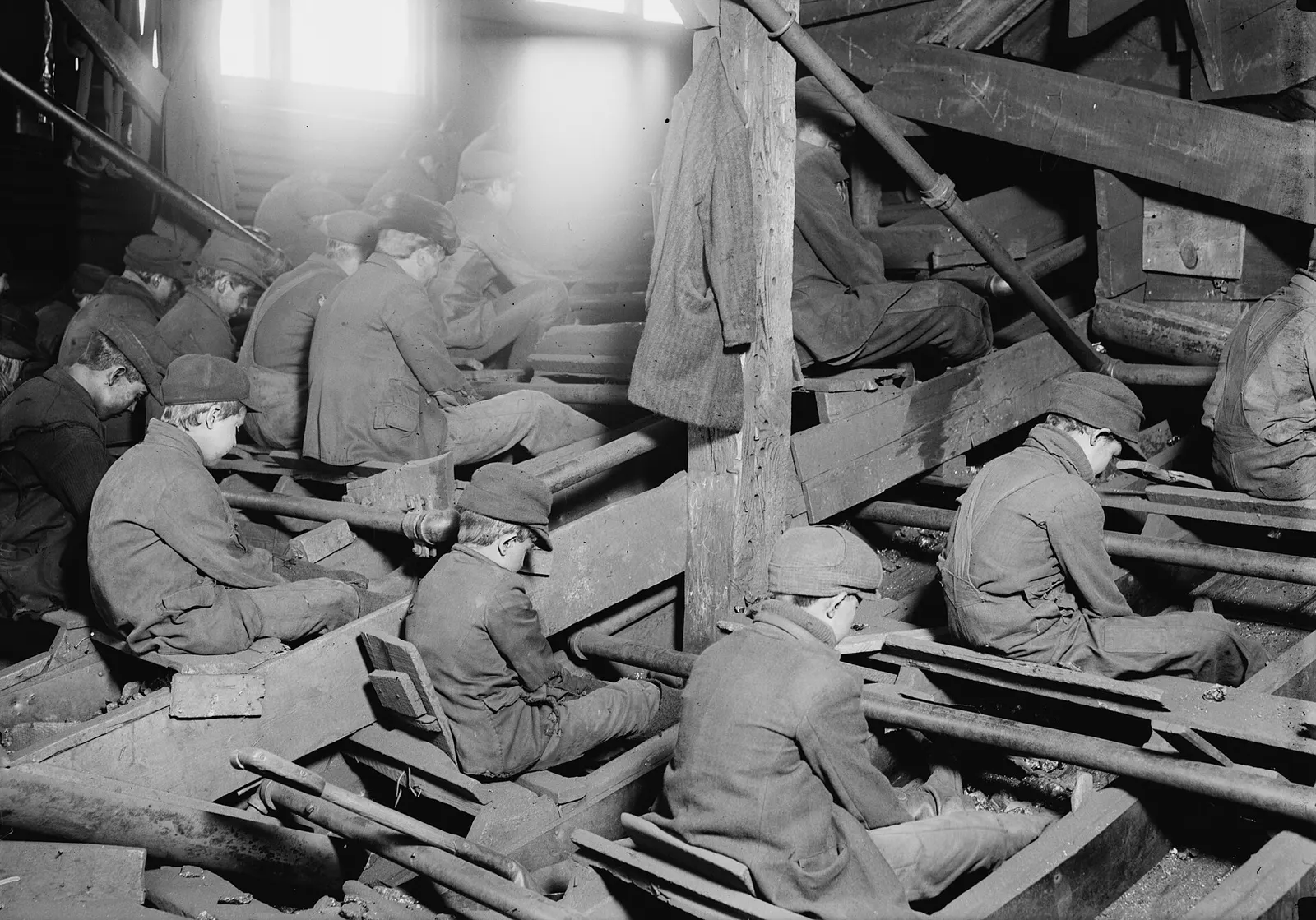
Reading this in a Pacific Northwest office, with a 1911 Lewis Hine photograph of breaker boys on the desk, the memorial boom of 1995 makes sense. The last generation that went underground was still alive to see its work cast in bronze, and still arguing, quite properly, about the price.
Questions readers ask
Where is the anthracite miners memorial in Shenandoah PA?
The Anthracite Miners' Memorial in Shenandoah, Schuylkill County, stands at Girard Park off North Main Street. It is a bronze relief by Philadelphia-area sculptor Zenos Frudakis, dedicated in 1996, with a central panel eight feet square and two side panels six feet by four. In 1995 the organizing committee said the whole project, with landscaping and parking, would cost more than $200,000, partly raised through engraved bricks.
What were breaker boys in Pennsylvania coal mines?
Breaker boys were workers, mostly children, who picked slate, rock and other impurities out of coal by hand in a coal breaker. The job appeared in the American anthracite fields in the mid-1860s and lasted until the early 1920s despite public criticism from the 1880s. Elderly or injured miners sometimes did the same work. Lewis Hine photographed many of them around Pittston in 1911 for the National Child Labor Committee.
Why did anthracite coal mining decline in Pennsylvania?
Pennsylvania anthracite output peaked around the First World War. The 1929 crash closed mines across the region, and after 1945 the industry declined again, driving heavy emigration from towns such as Shenandoah. The Knox Mine disaster of 22 January 1959, when the Susquehanna River flooded the River Slope Mine and killed twelve men, all but ended deep mining in the northern anthracite field. Towns like Shenandoah lost most of their population.
Which counties make up Pennsylvania's Coal Region?
The Coal Region, or Anthracite Coal Region, is usually defined as five counties in northeastern Pennsylvania: Carbon, Lackawanna, Luzerne, Northumberland and Schuylkill. It holds the largest known anthracite deposits in the world, estimated at about seven billion short tons. The 2010 census counted 910,716 people there. Welsh, Irish, Polish, Lithuanian and other immigrants built its mining towns in the nineteenth century.