Kelly: Great QB and humanitarian
On the eve of the 1995 season, a salute to Buffalo Bills quarterback Jim Kelly for his late-game comebacks and his charity work in western New York.
As printed in the Celtic Mirror, August 1995
It’s mid-December in Buffalo. The wind chill factor is 5 below zero and it has been snowing since the second quarter.
The Buffalo Bills have possession of the ball on the Miami Dolphin 17 yard line. As they break the huddle, quarterback Jim Kelly looks over the Miami defense. Kelly takes the snap, side steps a lunging defensive lineman, and unleashes a frozen rope pass right into a frigid wind.
A second later, the ball is in the hands of Andre Reed, three yards deep in the end zone, securing a Bills’ victory.
Football fans have grown accustomed to this type of late game theatrics from Kelly in the last nine years.
Kelly stands at the twilight of his career as one of the most prolific passers in his era.
Entering the 1995 season, Kelly has thrown for 29,527 yards and 201 touchdowns in his career, which ranks him 19th on the all-time NFL passing chart.
Eleven times during his career, Kelly has engineered stirring comebacks with the winning score coming with under two minutes to play.
Kelly has led the Bills to four super bowl appearances.
More importantly, Kelly has been active in charitable and humanitarian causes in his community.
The Leukemia Society honored Kelly as its “Man of the Year” in 1991.
Kelly’s own celebrity golf tournament has raised almost $1 million for local Buffalo charities.
The Muscular Dystrophy Association presented Kelly with its 1993 Humanitarian Award.
His “Kelly for Kids Foundation” has also raised more than $1 million since 1986 for western New York charities.
Kelly has been an active contributor to the Buffalo area United Against Drugs and Alcohol Program.
At 35, and coming off knee surgery, the 1995 season could conceivably be Kelly’s last.
Football fans in Buffalo and around the league will miss Kelly on those wintry days when the Bills are down by three late in the game, facing third and long.
Because of his charitable off-the-field work, the community of Buffalo will miss him even more.
Two more seasons, and a harder fight
The column guessed 1995 might be Jim Kelly’s last season. He gave Buffalo two. He retired after the 1996 season, worn down by injuries. In 1998 his old offensive coordinator, Ted Marchibroda, then coaching the Baltimore Ravens, tried to coax him back. Kelly said no for family reasons, and the Ravens traded for Jim Harbaugh instead.
The “last nine years” in the piece had a back story. Kelly, born in Pittsburgh on February 14, 1960, and raised in East Brady, Pennsylvania, turned down Penn State because Joe Paterno wanted him at linebacker, and went to Miami to play quarterback. Buffalo drafted him 14th overall in 1983, but he signed with the USFL’s Houston Gamblers and only arrived in Buffalo in 1986, when that league folded.
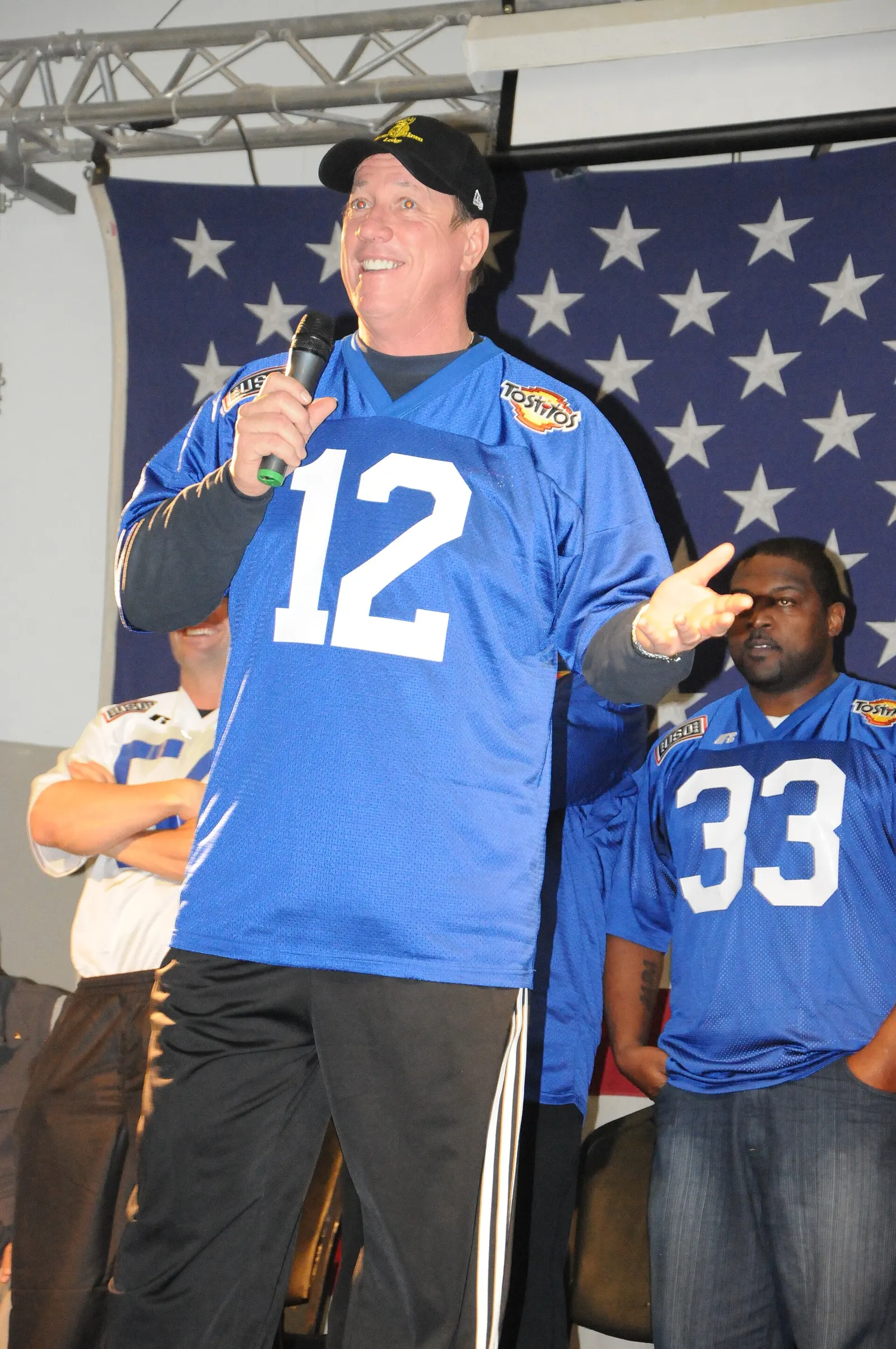
The numbers in this piece kept climbing to the end. Kelly finished his 11 NFL seasons with 2,874 completions in 4,779 attempts for 35,467 yards and 237 touchdowns, Buffalo records all. Counting his two years with the Houston Gamblers of the USFL, he passed for more than 45,000 yards and 320 touchdowns. The four Super Bowls mentioned here were four straight, XXV through XXVIII, from the 1990 to 1993 seasons. The Bills lost every one, and they remain the only franchise to reach four in a row. Buffalo retired his number 12 in 2001, and on August 3, 2002, he went into the Pro Football Hall of Fame in his first year of eligibility.
What the column could not know is that the charity work would become the larger part of his life. On February 14, 1997, his 37th birthday, his son Hunter James Kelly was born. The boy was soon diagnosed with Krabbe disease, a rare and fatal disorder of the nervous system also called globoid-cell leukodystrophy. Kelly founded Hunter’s Hope that same year to push for awareness and research, and with his wife Jill he started the annual Hunter’s Day of Hope, held every February 14. The Hunter James Kelly Research Institute opened at the University at Buffalo in 2004 to study myelin and its diseases. Hunter died on August 5, 2005, aged 8.
At his Hall of Fame induction Kelly dedicated his speech to Hunter. He called the boy the toughest person he had ever met.
Kelly needed that toughness himself. In June 2013 he announced he had squamous cell carcinoma in his upper jaw. Surgery followed, then a bone infection with MRSA in late 2014, then a return of the cancer in March 2018, which meant more surgery to remove it and rebuild his jaw. That summer he received the Jimmy V Award for Perseverance at the ESPYs. On January 18, 2019, he announced he was cancer-free.
The golf tournament the column mentions is still part of the picture. Kelly has hosted the Jim Kelly Celebrity Golf Classic every year since 1987 for his Kelly for Kids Foundation. Thirty-one years after this piece, the line about Buffalo missing his off-field work more than his passing reads less like a compliment and more like a forecast.
Questions readers ask
When did Jim Kelly retire from the Buffalo Bills?
Jim Kelly retired after the 1996 NFL season, his eleventh with the Buffalo Bills, because of injuries. In 1998 he considered an offer from the Baltimore Ravens, coached by his former offensive coordinator Ted Marchibroda, but declined for family reasons. He finished with 35,467 passing yards and 237 touchdowns, and the Bills retired his number 12 in 2001.
What is Hunter's Hope?
Hunter’s Hope is a non-profit organisation founded in 1997 by Jim Kelly after his son Hunter, born February 14, 1997, was diagnosed with Krabbe disease, a fatal disorder of the nervous system. It works to raise awareness and fund research. Hunter died on August 5, 2005, at age 8. The family holds Hunter’s Day of Hope every February 14.
Is Jim Kelly cancer free?
Jim Kelly was diagnosed with squamous cell carcinoma of the upper jaw in June 2013 and had surgery, then fought a MRSA bone infection in 2014. The cancer returned in March 2018, requiring surgery to remove it and reconstruct his jaw. On January 18, 2019, Kelly announced on Instagram that he was cancer-free. He received the Jimmy V Award for Perseverance in 2018.
How many Super Bowls did Jim Kelly lose?
Jim Kelly led the Buffalo Bills to four consecutive Super Bowls, XXV to XXVIII, after the 1990, 1991, 1992 and 1993 seasons, and lost all four. The Bills remain the only franchise to reach the Super Bowl four years in a row. Kelly ran the no-huddle K-Gun offense and was inducted into the Pro Football Hall of Fame on August 3, 2002.