Legal exchange offers getaway to Ireland
An American lawyer takes a continuing education course at University College Dublin, then drives his young family to Cork, Limerick and Wicklow.
As printed in the Celtic Mirror, August 1995
Early in February, I received an invitation to study at University College, Dublin. The Duquesne Law School developed a continuing education program for American lawyers and coordinated this program with the Irish-American Partnership in Boston.
Having been to Ireland on our honeymoon, I was eager to return.
My wife, Anne, needed a bit more prompting due to our 2-year-old daughter, Katie, and our expecting another child later that year.
Nonetheless, we made the decision and made our way to JFK one hot June afternoon.
Aer Lingus could not have been more accommodating, and after a short five-hour flight, we were at Dublin airport, ready to enjoy the Irish experience.
Our taxi driver engaged us in lively conversation on our way to Jury’s, a truly first-class hotel, just a block away from the American Embassy.
My classes started that morning, while Anne and Katie checked into our room. The opportunity to study a familiar subject in a foreign environment should not be missed.
I would like to address this topic in greater detail at another time, but suffice it to say that the Irish legal system is fascinating - no divorce law, no abortion controversy, 16 different systems of laws and currencies when engaged with the neighboring members of the European Community, not to mention the Irish relationship with the United Kingdom.
My classes started very early in the morning, but finished early in the afternoon, allowing us ample time to explore Dublin and the surrounding countryside.
DART (Dublin Area Rapid Transit) and the hundreds of taxis provided us with great mobility and stimulating conversation while touring this beautiful city.
Upon the conclusion of my conference at UCD, we rented a car and headed West, to Cork.
Within a few hours, we were in County Cork, and lunched a few feet from Blarney Castle.
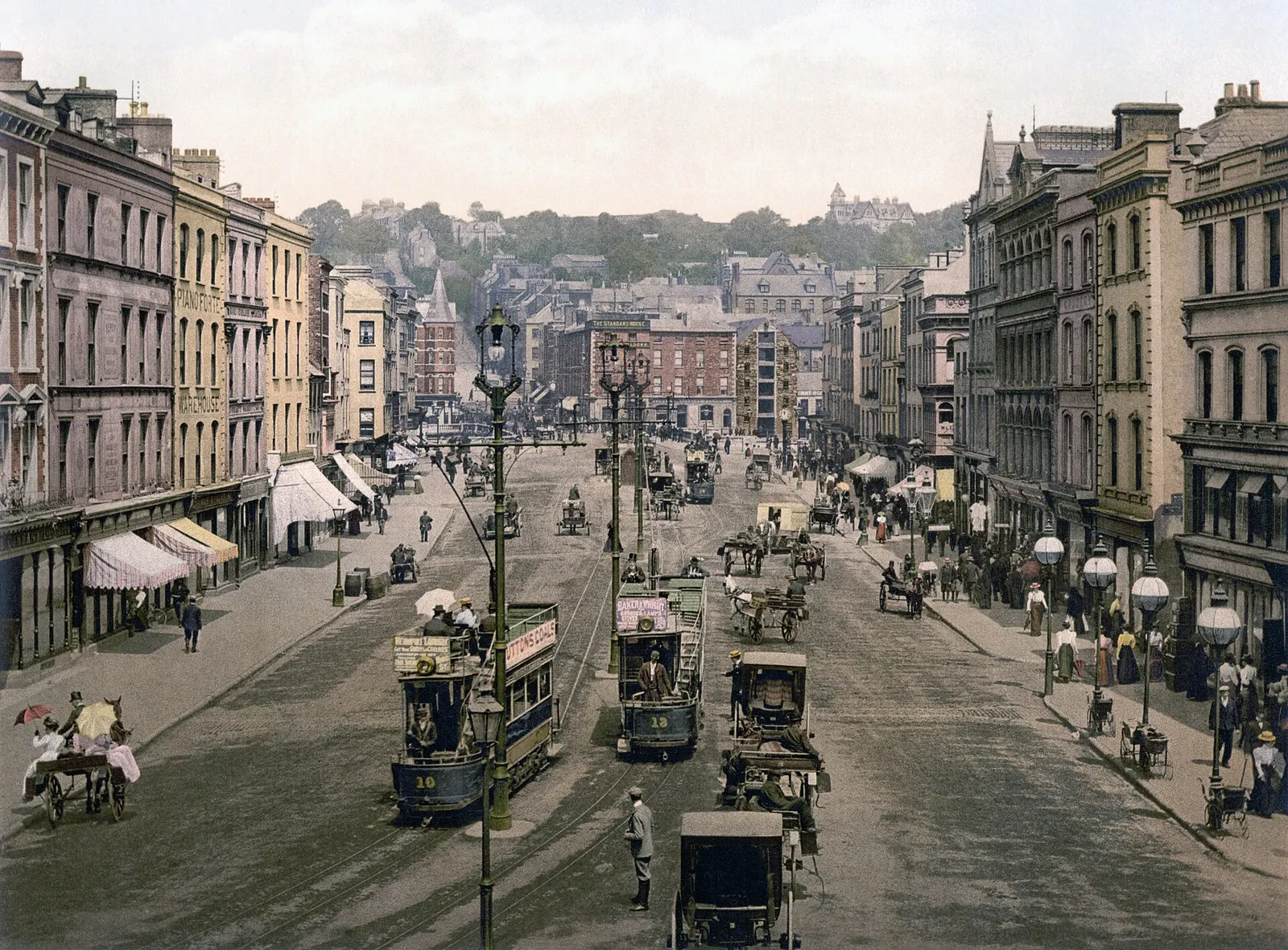
We checked into another Jury’s in Cork, and set out to see the city.
The river Lee divides Cork in half, and downtown is covered with some 16 bridges.
Driving around Cork was easy, despite the left-hand drive and Gaelic road signs. We stayed in Cork until Sunday morning, having attended St. Finbarr’s Cathedral for the 9:15 a.m. Mass.
We left Cork at noon, and traveled to the West Coast.
The west was described to me as “old” Ireland, with the thatched cottages, castles and stark beauty of the rugged cliffs and shoreline.
I noticed a definite language difference (some people only spoke Gaelic to us) and an accent change from that of Dublin or Cork.
We stayed that night in Limerick and spent the next few days enjoying the rugged and beautiful west.
I met with a colleague at Limerick University to discuss a student exchange program with a local university, and then we headed back toward Dublin for our return home.
We spent our last afternoon and night in Wicklow, a small harbor town just south of Dublin.
This was the best experience of our entire trip.
Wicklow reminded me of Martha’s Vineyard, but Irish - really Irish.
The small town harbor was spectacular in charm, beauty, and people.
We stayed at the Grande Hotel in Wicklow - a 19th century hotel.
This hotel was truly an old-world hotel, with canopy beds, dining areas within our room, and a first-class restaurant and pub on the premises.
Our last day started early. Arriving at Dublin airport around 10 a.m., we shopped duty-free awaiting our noon flight home, and touched-down at JFK at 2 p.m. due to the five-hour Irish/American time difference.
JFK and New York come as a culture shock when returning from this old-world experience.
Knowing that I will make many more such trips makes the return more palatable.
The law moved fast
Our correspondent’s quick sketch of Irish law in the summer of 1995, “no divorce law, no abortion controversy,” went out of date almost before the ink dried.
Divorce first. The 1937 Constitution banned it, and a 1986 attempt to lift the ban lost by 63.5 percent to 36.5 percent. On November 24, 1995, five months after this trip, voters approved the Fifteenth Amendment by a whisker: 818,842 votes, just over 50 percent. It was signed into law on June 17, 1996, and the Family Law (Divorce) Act followed on November 27, 1996.
Abortion was never free of controversy; it was simply settled for a time by the Eighth Amendment of 1983. That ended on May 25, 2018, when voters passed the Thirty-sixth Amendment. Services began on January 1, 2019, under the Health (Regulation of Termination of Pregnancy) Act 2018. Same-sex marriage had become legal in November 2015, also by referendum.
The currency tangle he mentions has eased too. The Irish pound was replaced by the euro on January 1, 1999, with notes and coins circulating from the start of 2002. Northern Ireland, across the border, still uses sterling.
The DART he rode is now a 53-kilometre electrified line running from Greystones in County Wicklow to Howth and Malahide, with 32 stations. As for the program that brought him over, Duquesne’s law school in Pittsburgh, founded in 1911, has continued to run summer study abroad in Dublin and Belfast.
Wicklow town is still a harbour town and still a good last night before a flight from Dublin. We could not confirm what has become of the hotel he stayed in, so we leave that to readers who have been.
Questions readers ask
When did divorce become legal in Ireland?
Divorce became legal in the Republic of Ireland after voters narrowly approved the Fifteenth Amendment of the Constitution in a referendum on November 24, 1995. The amendment was signed into law on June 17, 1996, and the Family Law (Divorce) Act was signed on November 27, 1996. An earlier referendum in 1986 had rejected divorce by 63.5 percent to 36.5 percent.
When did Ireland switch from the Irish pound to the euro?
The Irish pound, or punt, was replaced by the euro as Ireland’s currency on January 1, 1999, when the exchange rate was fixed. Euro banknotes and coins did not start circulating until the beginning of 2002, when the old pound notes and coins were withdrawn. Its ISO code had been IEP, and it had broken its link with sterling in March 1979.
Where does the DART go in Dublin?
The DART, Dublin Area Rapid Transit, is an electrified commuter rail line along Dublin’s coast. It runs from Greystones in County Wicklow in the south to Howth and Malahide in north County Dublin, serving 32 stations on 53 kilometres of track. It carries up to 23 million passengers a year and is the core of Dublin’s suburban rail network.
Can American law students study in Ireland?
Several American law schools run summer programs in Ireland. Duquesne University’s law school in Pittsburgh, founded in 1911, has offered summer study abroad in Dublin and Belfast, and in 1995 it ran a continuing education program for practising American lawyers at University College Dublin, coordinated with the Irish-American Partnership in Boston, as described in this article.