Tradition keeps connection to past alive: Dancing, dreams and diversions found
Two great-aunts on the Bandon River, a concertina player’s death notice, and a visitor’s guide to set dancing, Wren Boys and Irish storytelling.
As printed in the Celtic Mirror, August 1995
“It didn’t suit at all, at all, of course,” said the Happy Great Aunt with a wicked gleam in her gray eye. “But it was great fun...”
“Little good it did you - and fond enough you were of it,” said the Sad Great Aunt from behind her “Cork Examiner.”
She went through the death notices like a hawk scanning a valley at lambing time. I was 4 years old, visiting from Dublin and they were over 80, living companionably enough at Ardigeen on the Bandon River in Alice Taylor country. The death notices today had included that of Pad Joe Barry who did things with the concertina that the angels might emulate on their harps.
Pad Joe Barry played music for dancing.
Not the “Fairy Reel” which I practiced after school on Thursdays in Irish dancing class, wearing my heavily embroidered dress, with my hands by my sides and the sort of face on me that might stop a clock.
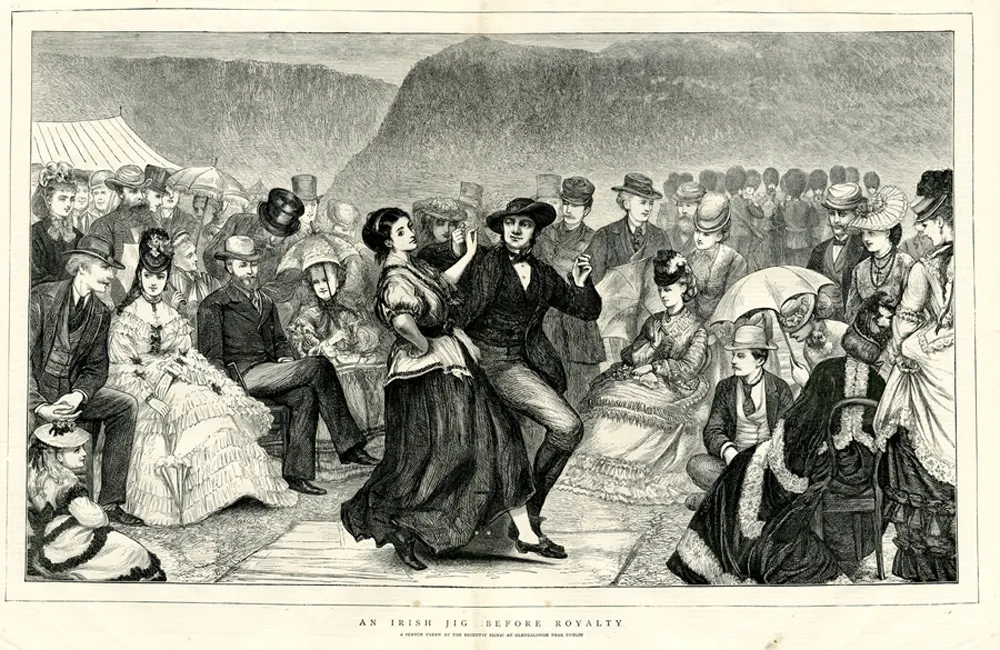
No, Pad Joe Barry played for set dancing - the “Lancers” and the “Caledonian.”
We remembered them - when our feet tapped and our hearts lightened, and now there is hardly a place in Ireland where you would be short of a couple to “make up the set.”
There are classes and sessions everywhere. You can go to Brook’s Academy in Henrietta Street, Dublin and Gerry O’Reilly will start you off on the “pass through, pass back.”
Timmy McCarthy will guide your feet in Cork or Dingle and Connie Ryan will be found in Kilkenny or Lisdoonvarna or Galway itself for the “Connemara Set.”
Drop into Searson’s Pub in Baggot Street and Dolly MacMahon might take you “through the set” and you will remember her light feet and green eyes for the rest of your life.
If you happen to be in Ireland for the Christmas season you might meet the Wren Boys.
They were mostly around Cork and Kerry and Wexford until about 20 years ago when the emigration figures pulled back a bit and the music and the dancing came out from behind the curtains and the back rooms of the pubs and off the stage of the Community Hall.
Stay in an Irish hotel for Christmas now, and there are questions to be answered if the Wren Boys are not battering the door come St. Stephen’s Day, the day after Christmas.
Dressed any old how, with painted faces or heads and shoulders covered in complicated woven straw masks and carrying holly boughs, the Wren Boys play and sing for the “money to bury the wren.”
The wicker cage at the top of the big holly bough is not tenanted by a scared little bird these days, though the roadside hedges are alive with the tiny wren. However, you have to pay the price of a pint or a half one to soothe the singer’s throat and to thaw out the musician’s fingers.
The most notable Wren Boys these several Christmases past, were the Sandymount Wren Boys who were led this year by the Lord Mayor of Dublin City himself, driven in a 1936 Lagonda, no less.
Stories were told as well, as they always are at Christmas time.
Telling tales, spinning yarns, drawing the long bow - all this has gone on in Ireland since the Tuatha De Danann hit the eastern shore of the Emerald Isle.
Now we have a Yarnspinner’s Festival no less.
The third one took place in Dublin in 1993, and the theme was “So What’s the Story?” There were storytellers from all over Ireland and from Trinidad, India and Devon, England.
The Irish Folklore Commission traveled up hill and down dale in the 40s and 50s, garnering the last shreds of what they thought was a dying world.
A hundred thousand tales and still counting are lodged in the Archive in the Department of Irish Folklore at University College, Dublin.
You might make your way to Cape Clear on the southern coast on the first weekend of September to attend the Cape Clear International Storytelling Festival and hear the art of “Storytelling Beside the Fire” or “Ghost Storytelling.”
A blood chilling art, let me tell you, of which the Sad Aunt was mistress. You’d be afraid to go past the first turn on the staircase after twilight, if your knocking knees let you get even that far, when she had taken you through “The Headless Coachman” or “The Black Dog at the Crossroad.”
The organizers include a boat ride round the Fastnet Rock as part of the Storytelling Festival, according to the preliminary program. You’ll go home with a tale to tell, all right!
On your way to Cape Clear, or wherever your Irish journey takes you, you might find yourself tempted to buy a ticket in the multi-thousand pound twice weekly National Lottery, newly sprung up in the past decade.
If John T. Gilbert’s “History of the City of Dublin” is to be credited, the first Irish National Lottery Draw took place in Fishamble Street in 1780 and the winning tickets were drawn from a mahogany drum by two students from the Blue Coat School in Dublin’s Blackhall Place.
The City Fathers built a Town Hall with the proceeds.
Nothing changes, so keep the tradition going, dance a set, sing a song, buy a lottery ticket - plan to visit Ireland - this year.
Reading this in 2026
Most of what Mary O’Sullivan pointed visitors toward is still there, which is not something we can say of every travel column in these files.
The Cape Clear Island International Storytelling Festival still takes the first weekend of September, as she said it would. It had started only the year before she wrote, in 1994, and it has run every year since. Cape Clear, or Cléire, is the southernmost inhabited part of Ireland and an Irish-speaking Gaeltacht. The 2022 census counted 110 residents, against more than 1,000 before the Famine.
The wren hunt itself is finished. Nobody kills the bird any more. Wren Day on December 26 has survived or been revived in a handful of places, mostly in the south, with Dingle in County Kerry the best known. The Wrenboys there parade with a stuffed or fake wren and usually collect for charity or for a Wren Ball.
The archive she mentions has grown into the National Folklore Collection at University College Dublin. The Irish Folklore Commission, set up in 1935, was folded into the university’s Department of Irish Folklore in 1971. Among its treasures is the Schools’ Collection, gathered between 1937 and 1939 by more than 50,000 primary schoolchildren. The Dúchas project has put much of it online, with volunteers around the world transcribing the handwritten pages.
And the lottery she calls newly sprung up: it sold its first scratchcards on March 23, 1987, and launched Lotto in 1988. The state-owned An Post company ran it until 2014, when the licence was sold for 20 years to Premier Lotteries Ireland. The French operator FDJ bought that company outright in November 2023. Last month, for draws from September 5, 2026, Lotto went back to a 6 from 45 format, cutting the jackpot odds to 1 in 8,145,060. The City Fathers would approve.
Questions readers ask
Where can you see Wren Boys in Ireland on St Stephen's Day?
Wren Day falls on December 26, St Stephen’s Day. The old hunt for a live wren no longer happens, but the custom survives or has been revived in a few towns, mostly in the south of Ireland. Dingle in County Kerry is the best known, where Wrenboys parade in costume with a stuffed or fake wren and collect money for charity or a Wren Ball.
When is the Cape Clear Storytelling Festival?
The Cape Clear Island International Storytelling Festival is held every year on the first weekend of September on Cape Clear Island, off the south-west coast of County Cork. It has run annually since 1994. The island, also called Cléire, is an Irish-speaking Gaeltacht and the southernmost inhabited part of Ireland, with 110 residents at the 2022 census.
What is the Schools' Collection in Irish folklore?
The Schools’ Collection is a body of folklore written down between 1937 and 1939 by more than 50,000 children in primary schools across what is now the Republic of Ireland, organised by the Irish Folklore Commission. It is held in the National Folklore Collection at University College Dublin and is being digitised and transcribed online through the Dúchas project, largely by volunteers.
When did the Irish National Lottery start?
The modern Irish National Lottery began on March 23, 1987, when it sold its first scratchcards, under the National Lottery Act 1986. The draw game Lotto followed in 1988. An Post ran the lottery until 2014, when the licence passed to Premier Lotteries Ireland for 20 years. The National Lottery reports raising more than 7 billion euro for good causes.