Travel Guide: Search for ancestry; Return to Ireland to find your roots
A 1995 field guide to tracing an Irish family: write to Kildare Street, quiz the grandparents, read the signposts, and plan the trip as a homecoming.
As printed in the Celtic Mirror, August 1995
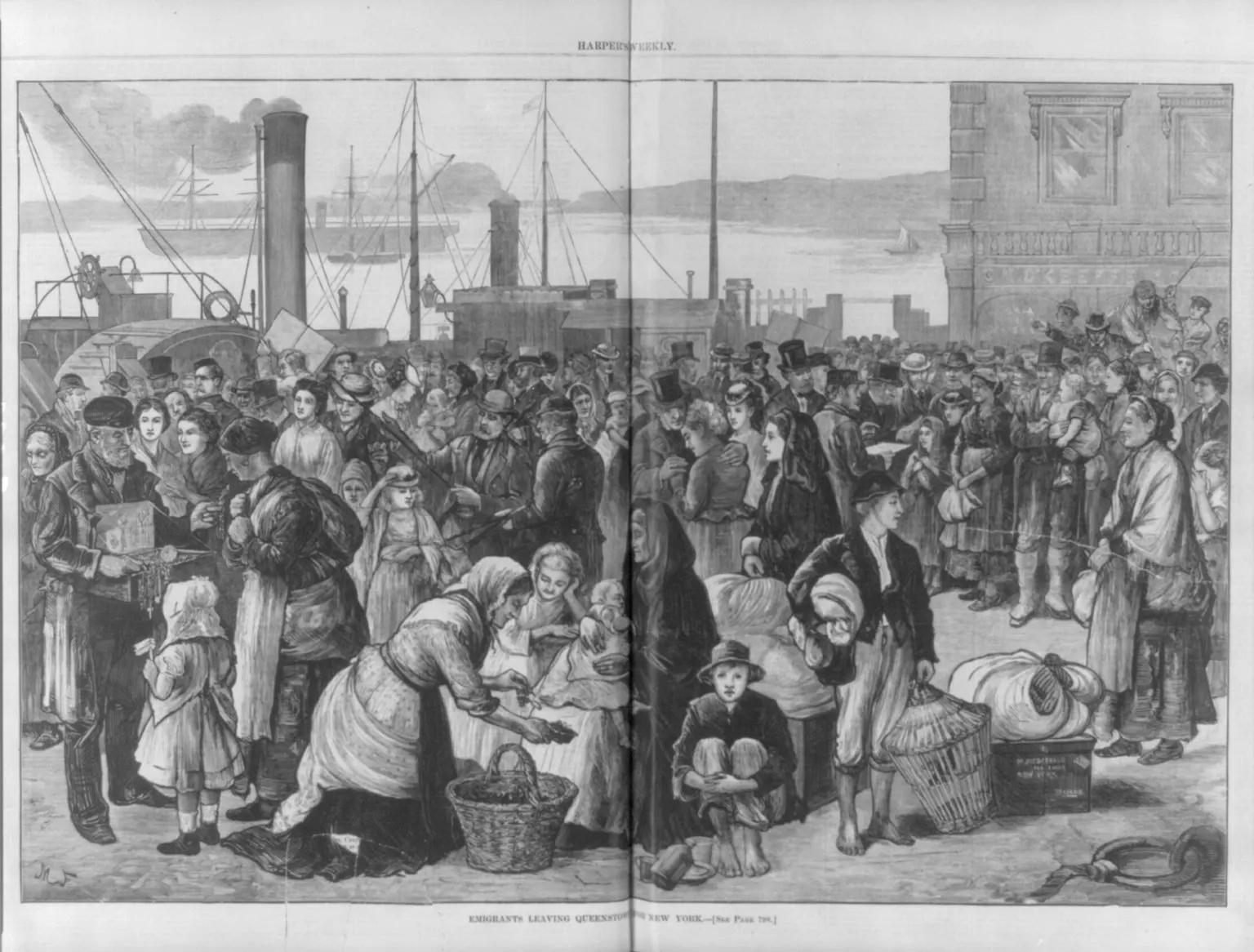
Ireland, with a population of 3.51 million, can lay claim to populating the United States of America with more than 40 million people of Irish descent; 5 million in Canada; 5 million more in Australia; uncounted millions in Britain; hundreds of thousands in South America, plus the present home population continuously on the move all around the globe.
Why do people leave Ireland - this sparkling country with its equable climate and its magnificently varied uncrowded countryside?
Ireland is a nation of individuals. It has always been a roving people. In the 6th and 7th centuries - the Dark Ages of Europe - St. Columba led the Irish missionary saints and scholars who brought Christianity to Europe.
The Irish are outgoing; they blend well in all kinds of places and situations. Peter de Lacy of Limerick reorganized the armies of Peter the Great of Russia. Count Edward Taaffe of Sligo was Prime Minister of Austria. Bernardo O'Higgins was President of Chile. Admiral William Browne from Mayo founded the Argentine Navy. Gavan Duffy emigrated to Australia where he became prime minister of Victoria.
Leopoldo O'Donnell was prime minister of Spain and Patrick McMahon was President of France.
Several immigrants of Irish origin have been presidents of the United States, including Andrew Jackson, James Buchanan, James Polk, John F. Kennedy, Gerald Ford and Ronald Reagan.
The former Prime Minister of Canada, Brian Mulroney, has Irish ancestors.
Today, 52 percent of the population in Ireland is under 28. They are among the best educated in Europe. They travel abroad now to experience wider horizons.
Agriculture is one of the country's prime industries. So is literature.
In this century, numerous literary talents such as George Bernard Shaw, James Joyce, W. B. Yeats, and Samuel Beckett left Ireland, but not its inspiration.
The tradition that began with the bards continues on radio, television, stage and screen.
The Irish feature prominently on British television; Terry Wogan tops the chat shows; traditional music led by The Chieftains; popular music by Bob Geldof and U2, all are on the international circuit.
On concert platform, on screen or stage, Irish actors and musicians are equally at home in Dublin, London, New York and Sydney.
Apart from the itch to travel, what else motivates the Irish? Practicality.
Many want to earn enough to return to their homes to rear children. Irish roots are strong as steel. Take a look at “Irish Families, Their Names, Arms and Origins” written by the pioneer of Irish genealogy, Dr. Edward MacLysaght.
His books should be available in reference libraries.
Follow just one of the thousands of surnames he covers.
Take for example, the MacCarthys of Kerry. Although many followed the 18th century exodus, many remain clustered around their original Kerry territories. Still numerous in County Wicklow, you will find the O'Byrnes and the O'Tooles; in County Donegal the O'Dohertys and the O'Donnells; and the Murphys in Wexford.
With such continuity of place, it is no wonder that Ireland is a focal point where exiles flock like birds homing in on their time-honored roosting places.
In 1943, the Genealogical Office came completely under Irish government control. In 1987, it moved from its cramped quarters in Dublin Castle to more spacious and specially-designed premises at Kildare Street, Dublin.
It is directed by Chief Herald Donal Begley. A very busy office, it is inundated with requests for family histories and pedigrees from all over the world. It had especially heavy demands made on it when John F. Kennedy, and later Ronald Reagan, were appointed to the presidency of the United States of America.
Requested by politicians, besieged by the media, they were able to trace the presidential ancestral roots several generations back to the Kennedys of Dunganstown, County Wexford and the Reagans of Ballyporeen, County Tipperary. A similar search has been undertaken for President Bill Clinton's roots.
Incorporated in the Genealogical Office there is also a Heraldic Museum.
The art of heraldry did not die out with the Crusaders. Church and state, corporations and companies, individuals and clubs all flock to the Genealogical Office to commission suitable armorial bearings specially designed for them.
Making a vivid splash, the Heraldic Museum's walls are adorned with most of the flags of the authenticated, surviving Irish chieftains: O'Brien, O'Callaghan, O'Conor Don, MacDermot, O'Donnell, O'Donoghue, McGillycuddy, O'Grady, O'Kelly, O'Long, O'Morchoe (Murphy), O'Neill, O'Rorke of Breffni.
Ireland was one of the first countries to adopt surnames.
By the 11th century, from being a simple repetition of the father's personal name - i.e. MacEoin, son of Eoin (John), they began to acquire descriptive or occupational characteristics, i.e. MacNamara (in Irish MacConmara) means “son of the sea,” while Smith is a straight translation from the Irish MacGowan.
O'Brien, one of the oldest and most common surnames, honors King Brian Boru who broke the power of the Viking raiders at the battle of Clontarf in 1014.
Mac and O you'll always know / True Irishmen they say, / But if they lack O or Mac, / No Irish men are they.
Only a fanatic would follow that jingle! There are more than 4,000 Irish surnames made up of a medley of Celts, Scandinavian, English, Welsh, French, Normans, Palatines, Quakers, Scots, Jews, Huguenots, Italians and, lately, Indians and Vietnamese.
Mostly their distinctive names remain: Prendergast, Le Fanu, Caprani, Roche, Wine.
Who would suspect that the very Irish, very numerous name, Power, was originally le Poer, the family name of the Marquis of Waterford of Norman descent? Settled in England in their second or third generation, the O'Briens, MacNamaras, Fennessys are as English in England as the Switzers (Palatines), Ushers (Norman) or Goodbodys (Quakers) are Irish.
The Mahonys, Healys, Murphys, Reagans are as American as the stars and stripes. Their roots, however, remain firmly in the land of their ancestors, ready to be explored if they have the urge to go back in time.
In recent years, there has been a remarkable surge of interest in ancestor tracing. Responding to this, the Genealogical Office has set up a consultancy service on ancestry tracing. So now, before you set foot in Ireland, you can begin to lay out your ancestral trail.
The first thing you should do is to write to the Consultancy Service on Ancestry at the Genealogical Office, 2 Kildare Street, Dublin 2, telephone (01) 6618811, (01) 6614877 or (01) 6611626.
For a preliminary consulting fee they will send you a pack which includes the following questionnaire: name of ancestor; date of birth; place of birth (County/Parish/Townland); parents' names; religion (for parish record purposes); occupation or trade; where married; date of departure from Ireland; children's names; and any other information (e.g. burial place, family traditions, etc.).
It is most important that you supply as much information as you can gather, especially the date and place of arrival of your ancestor in your home country, in the United States, Canada, Australia or wherever.
You can get help by contacting, for instance, the United States National Archives. Your local libraries should be able to point you in the direction of a number of sources: army enlistment files; land grant records; birth and marriage registrations; obituaries. These last often give the county of origin of the pioneer ancestor.
Australia and Canada are also very well endowed with civil records of Irish immigration.
You and your family are, of course, the greatest source of information. Grandparents, cousins, letters, diaries, wills, photographs, sporting trophies, certificates of achievements, peculiar family traditions and stories, can all be sources. Similar first names often run in families. Even the name of your house or land might give a clue as to the county of your origin in Ireland.
Like Scrabble, the ancestor game is great fun and you get out of it what you put in.
In Scrabble you have the dictionary, and now scientific progress has given us the computer which has opened up an extended field of genealogical research.
Parish registers and other records are currently being fed into computers under the auspices of the Irish Genealogical Project, which comprises local research centers. These computer databases, when complete, will make research significantly quicker and easier.
But do watch out. Because your name is Mahony, Connor, Sullivan or Kelly does not mean you are related. There are many branches of these numerous surnames throughout the 32 counties.
Some families have died out, their origins remaining obscure.
However, persistence can be rewarding. As a result of the upheaval of history, the records are not altogether comprehensive. For instance, births, deaths and marriages were not officially registered until late in the 1860s.
Armed with as much information as you can possibly glean from your family, both paternal and maternal, if you decide to make a trip to Ireland, it will become not a visit, but a homecoming, and the ancestor trail carries with it a bonus.
The Research Centre in the county relevant to your family can assist you in working out a specialized visitor's trail.
Over the centuries, the Irish were a rural people and the remains of their castles and thatched cottages are landmarks in every county.
Near Shannon Airport in County Limerick, Bunratty Castle and its Folk Park recapture something of Irish life of centuries ago. Plan your ancestral trail to include a sampling of the vast range of approved accommodations in Ireland.
Choose from luxury castle hotels, manor houses, friendly village inns and guesthouses, or spend time with an Irish family in one of the many fine bed and breakfast farmhouses or town and country homes.
Also to be recommended is a visit to one of the historic castle houses and gardens of Ireland (members of Irish Heritage Properties).
One of these, Clonalis House, the home of the O'Conor Don family of County Roscommon, is particularly interesting.
Here, they will show you their kingly inauguration stone symbolizing their long and ancient Kingship of Connacht.
This all-Gaelic family is widely regarded as being the oldest in Europe and it guards an archive of more than 100,000 documents relating to family history.
Look out for signposts. They can point to ancient territories: Ballymurphy (bally means town in Irish), or Ballyconnell or Kellystown and so on. Your very own name on an Irish signpost maybe.
The square tower strongholds and the grand castles of the noble O'Briens are a feature of the landscape in counties Limerick and Clare.
The County Cork coastline is a necklace of O'Mahony or O'Sullivan castles.
And so it is all over this small island, where history can be read in every ancient castle or abbey or cottage by the roadside.
The clan gatherings on ancestral sites increase yearly as the interest in family history spirals.
The O'Mahonys have been gathering in one or other of their County Cork castles without a break for the best part of 37 years.
The O'Malleys of County Mayo are making a regular event of their rally. The O'Neills, long since established in Lisbon, Portugal, have a new chieftain, Hugo, installed in Shane's Castle, County Antrim in June 1991 as The O'Neill of Clannaboy.
A Clans of Ireland office has been established in Dublin to help organize gatherings of the 243 Irish clan names so far researched, and information on the Clans Association is available from: Clans of Ireland; Genealogical Office; 2 Kildare Street; Dublin 2; Telephone (01) 6618811.
With all the resources now available for the unraveling of family pedigrees, visiting Ireland can be a most rewarding experience.
You have a real sense of purpose when you know you will be able to explore that part of Ireland from which your forefathers departed and where you may still find some of your relatives living.
Roots-hunting since 1995
Some of the addresses in this guide still work. Most of the method has changed.
The Genealogical Office never went back to Dublin Castle. After its 1987 move to Kildare Street, beside the National Library of Ireland, it was formally recognised as part of the Library in 1997. The Heraldic Museum mentioned above, which the office housed for years, closed in 2007. Heraldry itself has slowed to a halt: as of 2026 the Chief Herald's website says the office is not accepting new applications for grants or confirmations of arms. Edward MacLysaght, whose surname books the guide recommends, was the first Chief Herald when the office was created in 1943.
One date in the article needs a gloss. Civil registration of births, deaths and all marriages in Ireland began on 1 January 1864; Protestant marriages had been registered from 1 April 1845. Those are the records most searchers start with now, and many can be read online. The bigger gap is older. Most returns from the 1821 to 1851 censuses were destroyed when the Public Record Office at the Four Courts was blown up on 30 June 1922, during the Civil War. The 1901 and 1911 household returns survive for all 32 counties, and the National Archives puts them online free of charge, arranged by townland and street.
The numbers at the top of the guide have moved too. The 1995 piece counted 3.51 million people at home. The 2022 census found 5,149,139 in the Republic, and the Central Statistics Office estimated 5,458,600 in April 2025, driven largely by immigration. In the United States, more than 36 million people now name Irish as their primary ancestry.
Clonalis House is still there in Castlerea, County Roscommon, and the family archive and library of the O'Conor Don, some 100,000 volumes, is still kept in the house. The advice about grandparents, letters and the name of the old farm holds up best of all. No database has replaced the aunt who remembers the townland.
Questions readers ask
When did civil registration start in Ireland?
Civil registration of all births, deaths and marriages in Ireland began on 1 January 1864. Protestant marriages had already been registered from 1 April 1845. Before those dates, family historians rely mainly on church registers, land records such as tithe and valuation books, and the few surviving fragments of early nineteenth-century censuses.
Why are so many Irish census records missing?
Most original returns of the 1821 to 1851 censuses were destroyed on 30 June 1922 when an explosion wrecked the Public Record Office in Dublin's Four Courts during the Irish Civil War. The 1861 and 1871 returns had been destroyed soon after collection. The 1901 and 1911 returns survive for all 32 counties.
Are the 1901 and 1911 Irish census records free online?
The National Archives of Ireland publishes the 1901 and 1911 household returns for all 32 counties online with no charge for viewing. Returns are arranged by townland in rural areas and by street in towns and cities, so knowing where a family lived around 1900 makes a search much faster.
Where is the Genealogical Office in Dublin?
The Genealogical Office, home of the Chief Herald of Ireland, was based in Dublin Castle until 1981 and moved in 1987 to Kildare Street, beside the National Library of Ireland. It was formally recognised as part of the National Library in 1997. Its State Heraldic Museum closed in 2007.
How many Americans have Irish ancestry?
More than 36 million Americans name Irish as their primary ethnicity, and estimates of people with some Irish descent worldwide run to about 80 million. The Republic of Ireland itself counted 5,149,139 residents in the 2022 census, so the diaspora outnumbers the home population many times over.