From the mouth of the lion: Culloden - graveyard of the clans
Alex Campbell traces the road to Drummossie Moor, where the Jacobite army broke on 16 April 1746, and finds his own clan on the government side.
As printed in the Celtic Mirror, June 1998
While the warm blood bedews my veins, / And unimpaired remembrance reigns, / Resentment at my country's fate / Within my filial breast shall beat; / And, spite of her insulting foe, / My sympathizing verse shall flow: / "Mourn, hapless Caledonia, mourn, / Thy banish'd peace, thy laurels torn."
- Tobias Smollett, "The Tears of Scotland" (1746)
Recently, a special issue of the Celtic Mirror/an Scathan, "Flight of the Celts," featured my story about Scotland's infamous clearances. While my doing so is akin to putting the horse behind the cart, I tell now of the events that led up to that most tragic era in the history of Scotland.
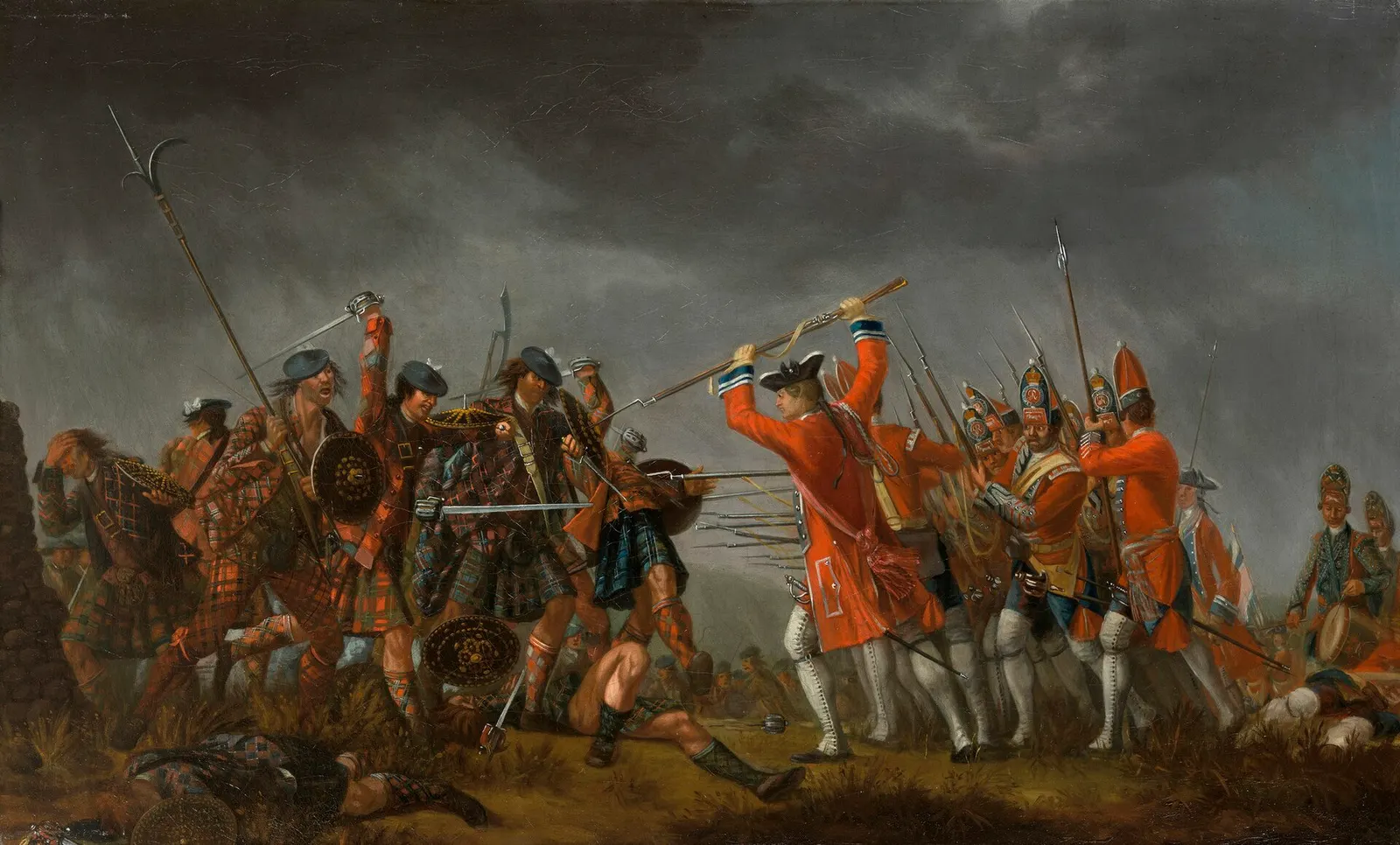
The Battle of Culloden took place April 16, 1746, on desolate Drummossie Moor, about five miles east of the town of Inverness, which is located at the northern end of Scotland's fabled Loch Ness. It was the last battle fought on the soil of Great Britain, and was one of the bloodiest and most vicious conflicts in the long and violent history of that tumultuous island. The battle marked the end of the power of the Highland clans, and wrote finis to the thousand-year struggle for Scotland's independence. It was named for its proximity to Culloden House, seat of the Chief of Clan Forbes, who was Lord President of the Court of Sessions.
At first glance, one might perceive the Battle of Culloden to be the last-ditch struggle of Scotland's clans against the British government, but a careful study of the battle itself, and the events that preceded it, reveal an incredibly complicated tale. It is often said - and indeed truly said - that politics makes strange bedfellows. Mix in bitter religious differences, ancient clan feuds and traditional clan rivalry, and the population of the bed can become stranger still. In assimilating the various accounts of Culloden, I found mixed emotions on my part to be the order of the day, as I learned that my ancestral clan was lined up with the forces of the British government! Nor were the Campbells alone in that alliance; several other powerful clans fought to prevent Catholic Prince Charlie from regaining the throne of Scotland, a Protestant country. Most clans took no part in the conflict; scarcely a quarter of the clans actually supported the young pretender in his attempt to regain the crown for the Stuarts, and some of those clans sided with Bonnie Prince Charlie solely because of their hatred, and envy, of the Duke of Argyll and his clan, the Campbells.
The clans that supported the government forces - the Campbells, Sutherlands, Macleods and Grants - did so because of their staunch belief in, and support of, Presbyterianism. The ascendancy of Catholic Prince Charles would almost certainly have meant a renewal of religious persecution and eventually another civil war in troubled Scotland. The Scottish Parliament had outlawed the practice of Catholicism and established the Presbyterian faith as Scotland's official religion in 1690.
Before the introduction of the principal character in this epic, a brief resume of Scottish history is in order. In the years prior to the Jacobite uprising of 1745, Alba was wracked by famines, political unrest, religious differences, failure of a vast colonial venture on the Isthmus of Panama and union with England in 1707. This latter event, driven by the economic disaster of the Darien Venture, as the Panama project was called, was passed by the Scottish Parliament on Jan. 16, 1707, in the midst of bitter opposition to the union, which had the nation in an uproar. Charges and countercharges of bribery and corruption were hurled back and forth by supporters and opponents. When the Treaty of Union was passed, and accepted by the English government, the separate Scottish and English Parliaments ceased to exist, and the Parliament of Great Britain was born.
The aforementioned Darien Venture was a maximum effort on Scotland's part to become a rival to England in mercantile affairs. The venture, brainchild of brilliant but erratic entrepreneur/promoter William Paterson, was inspired but sadly premature. His proposal was to build two trade centers/ports, one on the Caribbean coast and one on the Pacific coast of Panama. The ports were to be connected by a road across the narrow isthmus (presaging the Panama Canal) over which ships' cargoes could be transshipped to eliminate the hazardous and life-threatening voyage around the South American continent. The losses sustained in the ill-fated project were truly staggering: more than 2000 lives, a dozen ships, and most of the £400,000 raised to underwrite the venture - nearly three-fourths of all the money available in Scotland at that time! The failure of the project, primarily caused by awful weather, oppressive heat, raging yellow fever and hostile Spanish troops, was a terrible blow to Scotland and her economy. It was probably worse, in its final effects, than her bloody defeat at the Battle of Flodden in 1513, when Scots King James IV and the cream of Scotland's nobility and clergy perished.
Prince Charles Edward Louis John Sylvester Maria Casimir Stewart, or Bonnie Prince Charlie as he was generally (and more conveniently) called, was cast as the star of this unhappy drama. Born in Italy in 1720, he was the son of exiled James III and the grandson of James II, the Catholic king who was deposed by William of Orange (English King William I) in 1685, and sent into exile. Ironically, William was the son-in-law of James II, married to the sister of James III! So much for family ties and loyalty. James II died in exile and his son James, who would have been James III had he been crowned, attempted to regain his throne in 1715, landing in Scotland to rally a force to support his ambition. The effort failed dismally, and the Old Pretender, as James was called, went home and abandoned his hopes for the throne.
Bonnie Prince Charlie was well suited to the role in which history cast him. He was tall, attractive, extremely charming and persuasive; fairly well educated, he spoke fluent English, French and Italian (he did not have the Gaelic). He was also a good horseman and skilled in the use of weapons. His claim to the throne of England and Scotland was as good as anyone's, if you believed in the hereditary monarchical system, and probably better than that of the man who sat on the throne of Great Britain, German George II.
Charles first set foot on Scottish soil on the Isle of Eriskay in the Hebrides, in July 1745. Finding scant support from the islanders, he sailed to the mainland, raised a small army of Highlanders, and struck south. His forces took the town of Perth with little difficulty, and his initial success brought reinforcements as Lowland Scots flocked to his service. The army, now grown to 2,500 men, occupied Edinburgh almost without opposition; not long after, following his defeat of British forces at Prestonpans, Charles found himself master of Scotland. Flushed with success, he decided to invade England, where he expected support from Jacobite sympathizers and the French. (The term "Jacobite" is derived from the custom of kings named James of signing their names in Latin, "Jacobus Rex.") When Charles' forces reached England, they waited in vain for the promised help; it never materialized.
Despite considerable dissension in his circle of advisors, occasioned by the absence of the anticipated support, Charles marched south and occupied Manchester, England, again with little opposition. At this point, Charles' staff urged caution and persuaded him to return to Scotland to regroup and consolidate his resources. The return to Scotland was perceived by many to be a retreat, and many fair-weather supporters quickly abandoned Charles and his cause. The perceived retreat became a real one, as the British forces under the command of the very able Duke of Cumberland, younger son of George II, took up the pursuit of the dwindling army of Jacobites. The British were aided by the excellent network of roads and bridges that had been built in Scotland by English General Wade after the 1715 uprising.
The prince and his army continued their northward retreat, fighting rearguard actions along the way, winning some, losing some. At dawn on Wednesday, April 16, 1746, the Jacobite forces limped into their battle line above Culloden House. Once a much greater army, they now numbered fewer than 5,000 men, hungry and exhausted from their long retreat. A savage gale drove sleet into their gaunt faces, and only Charles thought they could hold the ground on which they had taken their stand - sadly, the last for many of them. A few miles to the east, the English transports and men-of-war stood by in the Moray Firth; the government forces, about 9,000 in all, advanced toward Culloden from the coastal town of Nairn, some ten miles to the northeast. The British army consisted of 16 battalions of foot soldiers, one militia battalion, three regiments of cavalry and one artillery company. Three of the regular battalions were manned by Lowland Scots; one battalion and the militia were largely Campbells.
The battle ended before noon, the issue never in doubt. The exhausted clansmen, cold and hungry, fought savagely but were overwhelmed by superior numbers and weapons. The battle became a rout; the Duke of Cumberland ordered that the wounded and prisoners be slain on the spot, thus earning him the sobriquet by which he has been known to Scots ever since: Cumberland the Butcher. It is a recorded fact, one that I find comforting, that the Campbells, thoroughly disgusted by Cumberland's thirst for blood, were the only ones to show mercy to the defeated Jacobites. The utter ferocity and cruelty of Cumberland the Butcher was beyond comprehension. He was no hardened veteran or mercenary, but a pampered prince; the people who were his victims were the subjects of his father, not some foreign invaders. In fact, technically the '45 uprising was a civil war!
Bad as it was, the brutality that took place on the battlefield by the Duke's orders was exceeded by events following the battle. The next day British troops scoured the nearby countryside, searching for wounded Highlanders who might have escaped the battle and hidden themselves. One group of 19 wounded officers was found on a plantation on the moor; they were either shot or clubbed to death. Another group of 40 wounded Highlanders was located in an abandoned farmhouse; the British troops set fire to the hovel and burned them to death. Returning to London, Cumberland was welcomed as a hero; a grateful Parliament awarded him an additional £25,000 a year added to his income.
Bonnie Prince Charlie, unscathed in the savage struggle, managed to escape, fleeing westward toward the Hebrides Islands, where he had first landed in Scotland. The British Government offered the enormous sum of £30,000 (today's equivalent would be about $2,500,000) for his capture; although hundreds of Highlanders knew his whereabouts, no one turned him in. Reaching the west coast after many narrow escapes, he was taken in a boat manned by Highlanders to South Uist in the Outer Hebrides. At that point, Flora MacDonald, daughter of a government officer, helped him reach the Isle of Skye by dressing him as her maid. The prince's long flight as a fugitive ended finally when a French ship picked him up on Sept. 19, 1746, and took him home. Bitter and disillusioned at the shattering of his dream, Charles descended into alcoholism and wife beating. As for Flora MacDonald, she was briefly imprisoned; after her release, she emigrated to America and married, eventually returning to Scotland.
There was great irony in the makeup of the forces on both sides; some clans were turned out for Charles by the wives of clan chiefs while the chiefs were leading British troops in other parts of the world. Members of prominent families split, one brother supporting the Jacobite cause, another opposing it. Most clans abstained from the battle; of all the Highland clans, about 125 at that time, fewer than 30 backed Prince Charles. Many individuals rallied to one side or the other, depending on personal convictions or alliances.
Perhaps the supreme irony was that the Battle of Culloden had been predicted long before it actually occurred. One of Scotland's most famous mystics, Kenneth the Sallow (Gaelic "Coinneach Odhar"), generally called the Brahan Seer, was born in the Highlands in the 17th century. Traveling across Scotland, he found himself standing on the barren heights that became the actual battlefield and said, "This bleak moor, ere many generations have passed, shall be stained with the best blood of Scotland. Glad am I that I will not see that day!" Fortunately for posterity and authenticity, his prediction was recorded on the spot by his companions.
Kenneth made many other predictions that ultimately came about, but one forecast so angered the object of the prediction that the Brahan Seer was burned to death in a barrel of tar, by order of the person he had offended, the Countess of Seaforth. Before he died, however, he predicted a string of incredible misfortunes for generations of Seaforths to come, as well as the eventual end of their line, and every word came true.
And so Culloden was the last gasp in the thousand-year struggle of the Scots to remain free and independent of their powerful and avaricious neighbor to the south. The British government followed up its victory with incredibly vicious actions aimed at crushing the power of the clans once and for all. The Highlanders who escaped the slaughter on the battlefield were pursued relentlessly; when caught, they were shot or hanged immediately without a semblance of a trial. The infamous Act of Proscription was passed in an effort to eliminate all traces of the Highland culture, banning the pipes, weapons, tartan and the kilt. An entire generation of Scots grew up in the 36 years that elapsed before the act was repealed, deprived of the essence of their Scottishness, save for the Scottish regiments that retained the kilt and the pipes.
On the moor today
Alex Campbell's account has worn well, though two dates need fixing for anyone checking. James II was deposed in November 1688, not 1685, and his son-in-law and nephew reigned as William III, not William I. The 36 years of the dress ban do add up: the Dress Act took effect in August 1746 and the Use of Highland Dress Act repealed it on 1 July 1782. The penalty had been six months in prison for a first offence and seven years' transportation for a second.
The Brahan Seer story deserves a shrug. He is known in Gaelic as Coinneach Odhar, and historians are not sure he lived in the century the legend puts him in, or at all. William Matheson found a writ of 1577 for the arrest of a Coinneach Odhar on witchcraft charges, and some of the famous prophecies first turn up in print only in the nineteenth century, in Hugh Miller's book of 1835 and later in Alexander Mackenzie's collection.
The moor itself has changed more since 1998 than in the two centuries before. The National Trust for Scotland opened a new visitor centre in December 2007 and has worked to return the ground to something like its state on 16 April 1746. The 20-foot memorial cairn and the clan grave stones, both put up by Duncan Forbes in 1881, still stand, along with Leanach Cottage from about 1760.
Archaeologists have been surveying the site since 2001. Musket balls and broken muskets show how close the fighting came. In 2024 a dig recovered a dense spread of grapeshot and musket balls in a patch of about 60 square metres, and in October 2025 a complete 17.5 lb mortar shell turned up, the first whole piece of ordnance found there. The cost of the day is now put at 1,500 to 2,000 Jacobites killed or wounded, against about 50 government dead. The graves of roughly 60 of those government soldiers have never been located. Somebody should keep looking.
Questions readers ask
Where was the Battle of Culloden fought?
Culloden was fought on 16 April 1746 on Drummossie Moor, a few miles east of Inverness in the Scottish Highlands. The site, now managed by the National Trust for Scotland, has a visitor centre opened in December 2007, a 20-foot memorial cairn raised by Duncan Forbes in 1881, and headstones marking the mass graves of the clans.
How many people died at the Battle of Culloden?
Estimates put Jacobite losses at 1,500 to 2,000 killed or wounded, with 376 taken prisoner. The Duke of Cumberland reported about 50 government soldiers killed and 259 wounded. Many Jacobite wounded were killed on the field and in the days after, which is why Scots remember Cumberland as 'the Butcher.'
When was the kilt banned in Scotland?
The Dress Act, part of the Act of Proscription of 1746, made it illegal for men and boys north of the Highland line to wear Highland clothes, including the plaid, the little kilt and tartan. Highland regiments in the army were exempt. The Use of Highland Dress Act lifted the ban on 1 July 1782, some 36 years later.
Who was the Brahan Seer?
The Brahan Seer, Coinneach Odhar or 'Dark Kenneth' in Gaelic, is a figure of Highland legend said to have foretold the Battle of Culloden and the fall of the Seaforth Mackenzies. Legend says Lady Seaforth had him burned in a tar barrel at Chanonry Point. Historians doubt the details, and a writ of 1577 names a Coinneach Odhar accused of witchcraft.
What was the Darien scheme?
The Darien scheme was Scotland's attempt to found a trading colony on the Isthmus of Panama, promoted by the financier William Paterson. The Company of Scotland raised £400,000 within weeks in the 1690s, but the colony collapsed by 1700 and more than 80 percent of the settlers died within a year. The losses fed the pressure that led to the 1707 union.