Making the Book of Kells: ...But before they could start
Before a line was painted, calves had to become vellum. A 1995 sidebar on the skins, and on a $6,250 set of licensed Kells prints.
As printed in the Celtic Mirror, September 1995
Paper was not a commodity when Christian monks were planning to write what would become one of the most celebrated manuscripts of all time. If one wanted to write, one had to make the paper - and not from trees.
“It was made on vellum,” Luis Porretta of County Cork said of the Book of Kells, a medieval Celtic manuscript now in the safekeeping of Trinity College in Dublin.
“Calves, 185 calves were killed, and they were skinned. After they were skinned, the skin was submerged in either lime or even excrement to get all the hair off. Then, the hair was scraped with a round-shaped knife. After that, it had to be stretched and dried.”
The whole process took years.
“We know that they must have been planning something extraordinary with the Book of Kells because a lot of the other manuscripts of the age were done on sheep's vellum, which is much more coarse. So calves' vellum was the best you could get basically,” Porretta said.
Knowing that modern conveniences and technologies - such as paper and the printing press - were not even a consideration back then makes it easy to understand why there is but one Book of Kells.
After the vellum preparation process had ended, the monks spent many more years drawing, painting and writing the manuscript.
Porretta's Heritage Resources Co. Ltd., Cork, and Trinity College in Dublin have jointly undertaken The Book of Kells collection, a set of three illuminated folios reproduced as a limited edition set.
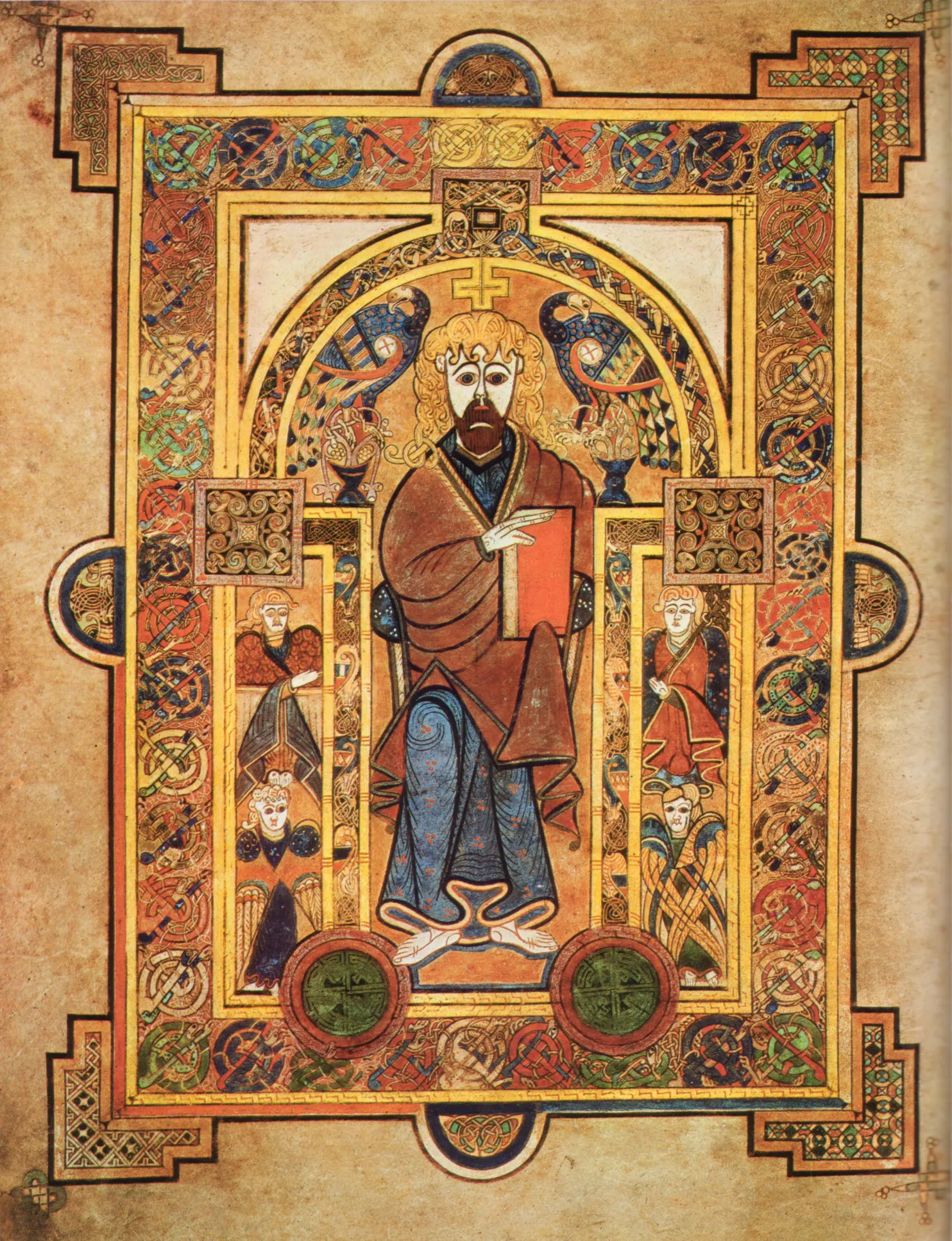
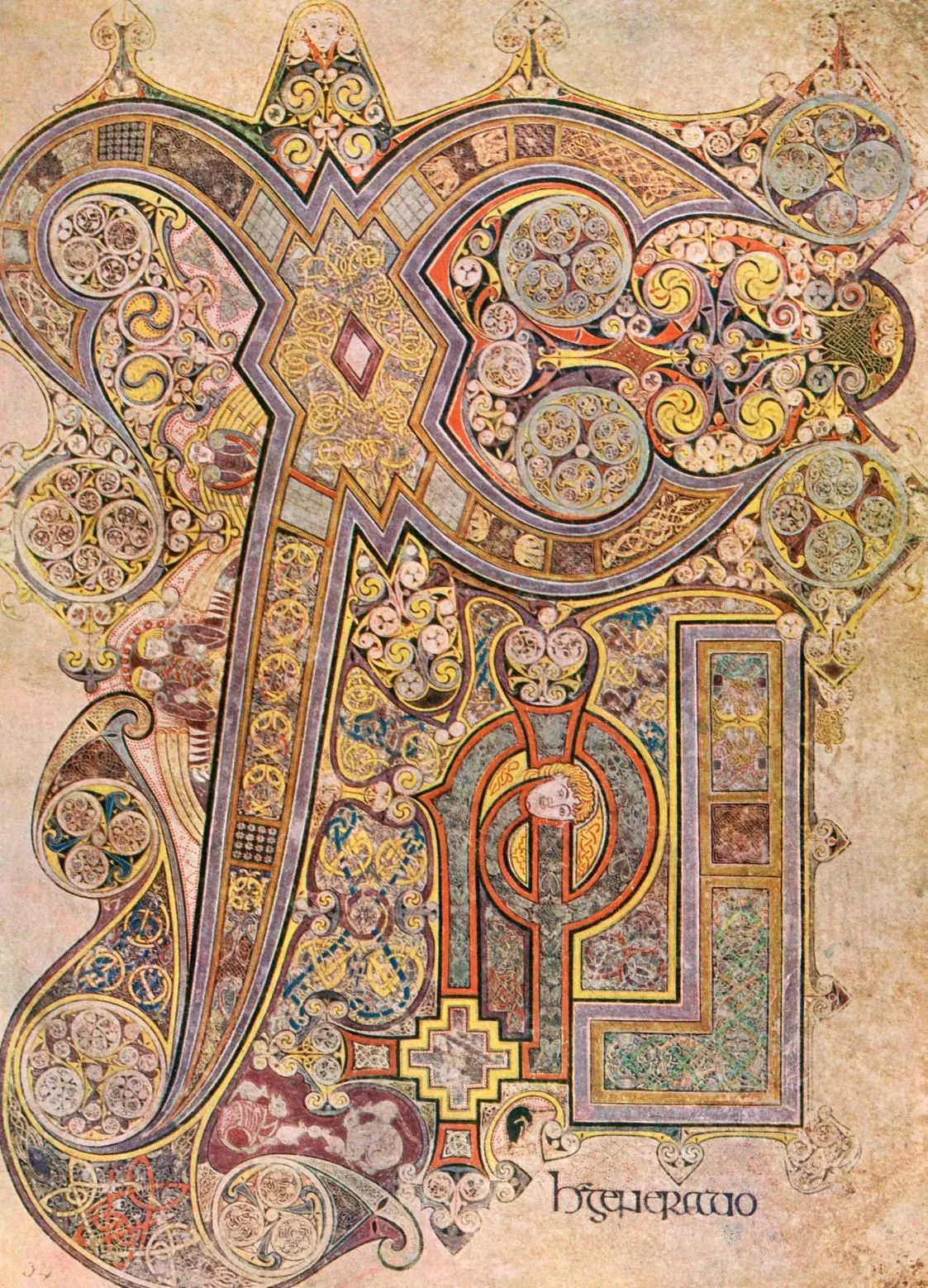
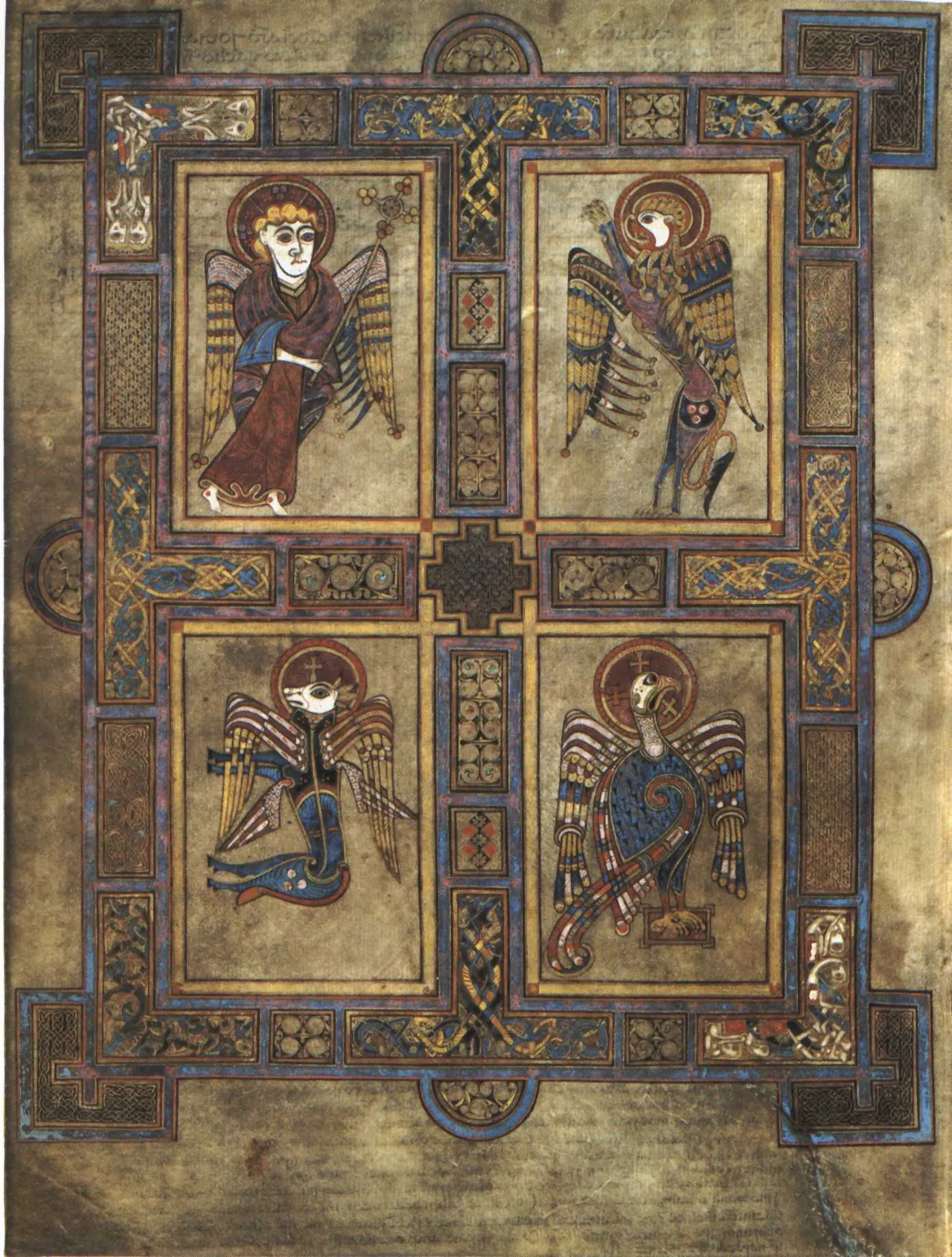
Trinity and HRC agreed upon reproducing the three illuminated pages of the manuscript they found to be most appealing: “Portrait of St. John with the Tools of a Scribe,” “The Chi-Rho” page and “Symbols of the Four Evangelists.”
The prints, each measuring 14 x 18 inches, are photographic serigraph silk-screen prints rendered in 30 colors on conservation rag mould paper.
In sum, 3,000 sets will be made.
HRC spent more than two years, including 63 days of proofing, to make the prints faithful to the originals, Porretta said.
“The printing will finish in December. After every 500 sets, the old screens are totally destroyed and new ones are made,” he said.
The company is sparing no expense to market the prints, a set of which costs $6,250 US dollars, to corporate America.
In August, Porretta spent a week at the Waldorf-Astoria in New York City, inviting guests and the media to talk with him about the Book and the prints.
Porretta explained how his company persuaded Trinity College to allow the project.
“Well, we'd be liars to say that we were the first people that have knocked at the door with a suggestion of doing something with the Book of Kells,” Porretta said.
“In fact, the librarian will tell you that probably 20 times a week, people are knocking at the door.
“But, I just asked for the opportunity to collect together a team of professionals and make a presentation to show what we would like to do if we got the opportunity.”
He said months of “delicate” negotiations led to the agreement to make the prints.
“What they understandably were really worried about was the book would become demeaned by the commercial element of it. And, we've really taken great pains to make sure that this has been done in the right way.
“We've not scrimped or saved on any of our designing or brochures or anything like that, because we want to keep the integrity of that book intact.
“We want this to be viewed as something precious. A lot of people don't appreciate the major influence in the arts that came from Ireland all those years ago, and is still coming from Ireland.
“What we're doing is we're trying to take a bit of Ireland and to bring it to a wider audience. How could you disagree with that?”
Porretta said his company and the college have agreed to this being the only reproduction project that will be done on the Book of Kells.
“Between us, we have worked out the consequences of doing this again, and Trinity is not interested. So, we've got a lifetime agreement, really. Once done,” he said.
Copies before and after
This sidebar ran beside our longer piece on how the Book of Kells was made. Two of its claims are worth setting against the record.
The vellum first. The leaves are high-quality calf vellum, as Porretta said, and there are 340 of them today, 680 pages in all. The figure of 185 calves is his, and we have not found it in the standard accounts, so we leave it in his mouth. What is certain is that the leaves were never a standard size to begin with; they were cut down to their present 330 by 250 millimetres during a 19th-century rebinding, which cost some illustrations their edges.
Then the copies. Porretta was right that people had been knocking on Trinity's door for a long time, and some had been let in. The Swiss publisher Urs Graf Verlag of Bern produced the first facsimile in 1951, mostly in black and white with 48 colour plates. Thames and Hudson published a partial facsimile under licence in 1974, with a study by Françoise Henry. In 1979 Faksimile-Verlag Luzern asked to photograph every page in colour. Trinity first refused, fearing damage. By 1986 the firm had developed a way to hold each leaf flat with gentle suction so it could be photographed without being touched, and the full colour facsimile came out in 1990 in two volumes. One copy is kept by the Anglican church at Kells, on the site of the old monastery.
So the 1995 print set was not the first licensed reproduction, and it was not the last. Trinity issued a digital copy on DVD-ROM in 2006, priced at about 30 euro and since discontinued. The Faksimile-Verlag photographs are now online through the college's Digital Collections portal, which means anyone with a screen can study the three pages HRC picked, the Chi-Rho on folio 34r among them, at a magnification no monk on Iona could have imagined.
We could find no later public record of Heritage Resources or of how many of the 3,000 sets were sold. The price, $6,250 a set in 1995, survives only here.
Questions readers ask
What is the Book of Kells written on?
The Book of Kells is written on high-quality calf vellum, prepared skin rather than paper. The 340 surviving leaves, 680 pages, now measure about 330 by 250 millimetres because they were trimmed during a 19th-century rebinding. Since 1953 the manuscript has been bound in four volumes at Trinity College Dublin.
Is there a facsimile of the Book of Kells?
Several exist. Urs Graf Verlag of Bern made the first in 1951, Thames and Hudson issued a partial facsimile in 1974, and Faksimile-Verlag Luzern published a full colour facsimile in two volumes in 1990, after developing a suction method to photograph each page without touching it. A copy of the 1990 edition is kept at Kells.
How was the Book of Kells photographed without damaging it?
Trinity College refused Faksimile-Verlag Luzern's first request in 1979 because of the risk. By 1986 the publisher had built a system that used gentle suction to hold each page flat for the camera without contact. Every page was then checked against a single-page proof before the 1990 facsimile went to press.
Which pages of the Book of Kells are most famous?
The Chi-Rho monogram page on folio 34r, the symbols of the Four Evangelists on folio 27v and the portrait of St John on folio 291v are among the best known. The book has ten full-page miniatures, and folio 7v holds the oldest surviving image of the Virgin Mary in a Western manuscript.