The Celts: The people history forgot
A long, opinionated 1998 tour of Celtic Europe, from the sack of Rome and the Druids to Hadrian's Wall and Ireland, the one place Rome never reached.
As printed in the Celtic Mirror, April 1998
A numerous race, and fierce, as fame reports them, Were thy first colonists, Britain, Chief of isles; Natives of a country in Asia, and of the region of the Grafia, A people said to have been skillful; but the district is unknown That was mother to this progeny, these war-like adventures on the sea. Clad in the long dress, who could equal them? Celebrated in their skill, they were the dread of Europe. (The Pacification of Lugh, Celtic sun god)
Prominent among history's forgotten people are the Celts. Secondary-school textbooks on ancient history barely mention them, except as a footnote to Roman history. The Celts twice invaded Rome, and Julius Caesar defeated the last Celtic army in Gaul (France) in 57 B.C.
What the history books ignore is that the Celts dominated virtually all of Europe for hundreds of years and had a high level of civilization despite their warlike proclivities. Their sophisticated culture, the La Tene, perished with the last of the Gauls, but the Celts left their stamp all across Europe and the British Isles. It is not inappropriate to call them the "fathers of Europe."
Those of us who are descendants of Scottish, Irish, Welsh, Cornish, Breton or Manx ancestors (the remnants of the great Celtic peoples) often refer to our Celtic heritage and its preservation, but how many of us have any realistic idea of the identity of the Celts, or their origin, or their impact on world history? And just what is our "Celtic heritage"? (You will learn later on that some parts of that heritage might better be swept under the rug of history and forgotten!)
I must confess that my personal knowledge of this subject was exceedingly limited until I ingested the contents of half a dozen weighty tomes; I will attempt to share this information with you without going into the incredible detail that characterizes scholarly research and tends to make one's eyes glaze o'er. Ergo, what now ensues is a broad and rapid overview of the Celtic peoples and their tumultuous history.
About the Celts: Many questions, few answers
The reader should bear in mind that our knowledge of the Celts rests in part on information that is often controversial and conjectural, but from which inferences have been drawn and assumptions made. Even though we have much solid data based on archeological research, it is certain that there are many questions to which we will never know the answers.
We are also heavily indebted to the classical writers of ancient Greece and Rome for much of the information we have, as well as to the Celtic oral tradition, to the Irish Christian clergy of the 5th and 6th centuries who wrote down much of that tradition, and to archaeology, especially recent work that tells us about surviving artifacts and structures and confirms or negates the classical writings and oral traditions.
Information drawn from Roman writers is sometimes heavily biased, as they were writing about a formidable foe and much of the writing is less than flattering to the Celts.
Where they came from, where they went
The Celts were one of a number of peoples, called "Indo-European" and sometimes "Aryan," who "originated" in an area bordering on the Black Sea that comprises present-day Romania, Hungary and Ukraine. How they got there is anybody's guess, but most authorities agree that a group of people, loosely organized in tribes, emerged as a recognizable ethnic division, sharing language, religion and customs, that was called Keltoi by the Greeks and Galli by the Romans; hence the interchangeable terms Celt (pronounced KELT) and Gaul.
They began to migrate early, mostly to the west, ostensibly in search of the home of Lugh, their sun god; some went east and south, possibly invading northern India as "Aryans" (not to be confused with the Nazi use of the term).
It is thought by some that these Aryans became the top caste of Indian society, calling themselves Brahmins and constituting the intelligentsia and priests of India. While this possibility has little bearing on our immediate discussion, it will be relevant to a later discussion of Celtic religion.
The time frame for the origin and migrations is somewhat loose. Older estimates of the Celts' emergence as a cohesive people dated it from 1,000 B.C. to 500 B.C. Recent excavations in France, however, indicate a Celtic presence there as early as 1,200 B.C., and other authorities now subscribe to much earlier dates, even as early as 2,000 B.C., for the Celtic origins. This earlier dating is supported by the strong Irish tradition holding that the Celts migrated to the British Isles as early as 1,000 B.C.
The Celts spread across Europe in vast waves that eventually covered most of the continent north of the Alps and south of Scandinavian-Finnish lands, even into Spain, where they apparently mingled with and absorbed a race called Iberians. By the 3rd century B.C., they occupied central Europe, France, Spain, most of Germany, the British Isles, half the Italian boot and, in the Near East, an area south of the Black Sea called Galatia, now Turkey.
The farmers and the warriors
Recent discoveries indicate that there were two distinct Celtic groups. The earlier one was agrarian in nature. As they moved westward across Europe, they founded lake dwellings in the Danube Valley, Switzerland and France, and mingled in relative peace with the previous occupants of these areas.
These early Celts burned their dead rather than bury them. They were skilled metalworkers, using gold, tin and bronze with equal facility.
The second group of Celts was a military aristocracy, reputed to love fighting for the sheer joy of combat itself. They had a very distinct caste system, with the warriors and priests (Druids) sharing the top level.
Renowned for their chivalry and dauntless bravery, these Celts balanced their martial traits with an unusual level of sensitivity to music, poetry and philosophy.
According to St. Patrick, the Celts adhered closely to a code of conduct laid down by the Druids: "Truth in the heart, strength in the arm, honesty in speech."
These people buried their dead with elaborate ritual and rich grave furnishings, and they believed in an immortal soul - a widely radical idea for the times, and one shared by the Brahmins of India.
The warrior Celts (along with the Brahmins) also believed in reincarnation, a belief that made them utterly fearless in battle. In addition to being highly aggressive and fond of war, they were eloquent in speech, boastful, volatile and high-spirited. Fastidious in appearance, they loved jewelry and brightly colored clothing. These traits combined to make them unbearable in victory and demoralized in defeat.
Celts in Galatia
Galatia, referred to earlier, has little to do with this discussion, but there is an interesting sidelight. A large group of Celts - the remnant of the huge Celtic army numbering perhaps as many as 20,000 (half of them warriors) that invaded the Oracle of Delphi - perhaps moved to this area at the request of the King of Bithynia (in present-day Turkey), who needed military help to fend off his rapacious neighbors. It's an old story in history: The Celts disposed of Bithynia's enemies and in less than 100 years were permanently settled in their country, called Galatia in honor of their Gaulish origins.
Their descendants were the people to whom the Apostle Paul addressed his Epistle to the Galatians, circa 53 A.D., and there need be no doubt that the reproving lecture handed them was well-deserved. At that time, Christianity had made only limited inroads into the riotous, hard-drinking brawl that was their lifestyle.
Celtic languages and nonliterate traditions
The Celts spoke ancient Celtic, one of the main Indo-European tongues; related languages were Italic (which evolved into Latin), ancient Greek and Eastern languages such as Hittite and Sanskrit.
During their migration across Europe, the old Celtic gave way to two offshoots: Goidelic (or Q-Celtic), which became Irish and Scots Gaelic, and Manx; and Brythonic (or P-Celtic), which became Briton (Welsh), Cornish and Breton. Some authorities list a third branch of the old Celtic, the Gaulish language, but most believe Gaulish was basically P-Celtic and much like Welsh.
The Celts were nonliterate, preserving their history, knowledge, traditions and legends orally, using poetry as a mnemonic device. This system continued well into the Christian era. Because of their reliance on the spoken word, the Celts placed heavy emphasis on eloquence and oratory, and even operated schools to teach these skills to non-Celts - so great was their reputation in this art.
There exists today only one artifact of the Celts prior to the 5th century A.D. that bears writing. It consists of fragments of a large bronze plaque detailing the Celtic calendar in the Gaulish language, using Roman letters and numerals. This plaque, originally 5 feet by 3 1/2 feet, is called the Coligny Calendar. Dating from the 1st century B.C., it shows a cycle of 62 lunar months.
Against this scant evidence of literacy, there is considerable information indicating that the Druids, despite their aversion to writing down their considerable knowledge, were actually quite literate.
The early Celts were pagans (naturally) and were referred to by the Greeks as "barbarians." The reader should know, however, that the original Greek word, barbaros, simply meant someone who didn't understand Greek - in short, a foreigner. The derogatory connotations of the word came about in much later times.
Their warring, warring ways
The Celts were a hero-oriented warrior society, depending primarily on the possession of great herds of cattle and sheep for food, wealth and prestige. Farming, even though it was carried out quite efficiently by the peasant class, was of much less importance.
Early in their development, the Celts made weapons and tools of bronze, but quickly adapted to the use of iron well before 500 B.C. and became highly skilled as armorers and smiths. The Celts are credited with the first use of iron plows, and they developed the art of shrinking iron rims onto wooden-spoked wheels - a major step in the evolution of wheeled vehicles.
It appears that some of the most skilled weapons makers were members of the priesthood. These Druid smiths were reputed to produce magical swords, creating a semisteel weapon far superior to an iron blade. They in fact tempered their blades in blood, and it has been speculated that the phosphorus content of blood produced the desired temper, but it is more likely that the improvement in the quality of the metal was due to the hardening effect of quenching a hot blade in a liquid. Nowadays, quenching is done more prosaically with water or oil.
Because cattle raids and intertribal warfare were a way of life, emphasis was placed on the production of weapons. Oddly enough, these warlike people never used the bow and arrow to any extent, although they were familiar with such weapons. They seemed to prefer more personal implements of mayhem and death, such as the spear, the slashing sword and the battle-ax.
Protection against such weapons was afforded by helmets of bronze or iron, often decorated with horns, and long shields of wood reinforced with iron or bronze.
Celtic social structure
Socially, the Celts were tribal, although there is evidence of clan or family grouping within the tribe, much like the American Indian social order. Each tribe was ruled by a chief or king, with two upper classes dominating the rank and file: the priests, or Druids, and the warrior aristocracy. These two groups seemed equal in status and power, although there were times when the Druids seemed more equal.
Certainly no one ruled without the Druids' approval. The rulers of the tribe were elected, usually by a council of warriors and priests.
What they looked like, what they wore, how they acted
The Celts were considered by their neighbors - who were also usually their foes - to be generally tall, of strong physique and imposing mien. They were usually long-headed (dolichocephalic), as are many of their descendants, and tended to look down on people with round or "cat heads," as the Celts scornfully referred to them.
It is claimed by some modern writers that many people of Celtic descent fall into blood group O (as this writer does), so these same authors assume that the Celts of old were also mainly type O, although that would be virtually impossible to prove.
Many Celts were blond or red-haired, but the practice of dressing their hair with a sort of lime-water mixture produced a stiff mane that was white or bleached in appearance. Men were generally mustached but beardless. Hand-to-hand combat was the order of the day, and beards made wonderful handles for the enemy. Druids and tribal elders were bearded, but they were exempt from military service.
The Celtic priests reputedly sported very strange hairdos in which the portion of the scalp forward of the ears was shaved clean and the remaining hair allowed to grow long. (In early Christian times, the Celtic monks were said to affect the Druidic hairstyle. This became a point of argument with the Roman clergy, who wore the tonsure, shaving the top of the head and growing the rest of the hair in a fringe. Of course, the Roman style prevailed.)
The mustaches of the Celtic fighters were of the "soup strainer" variety and became a recognizable Celtic trademark.
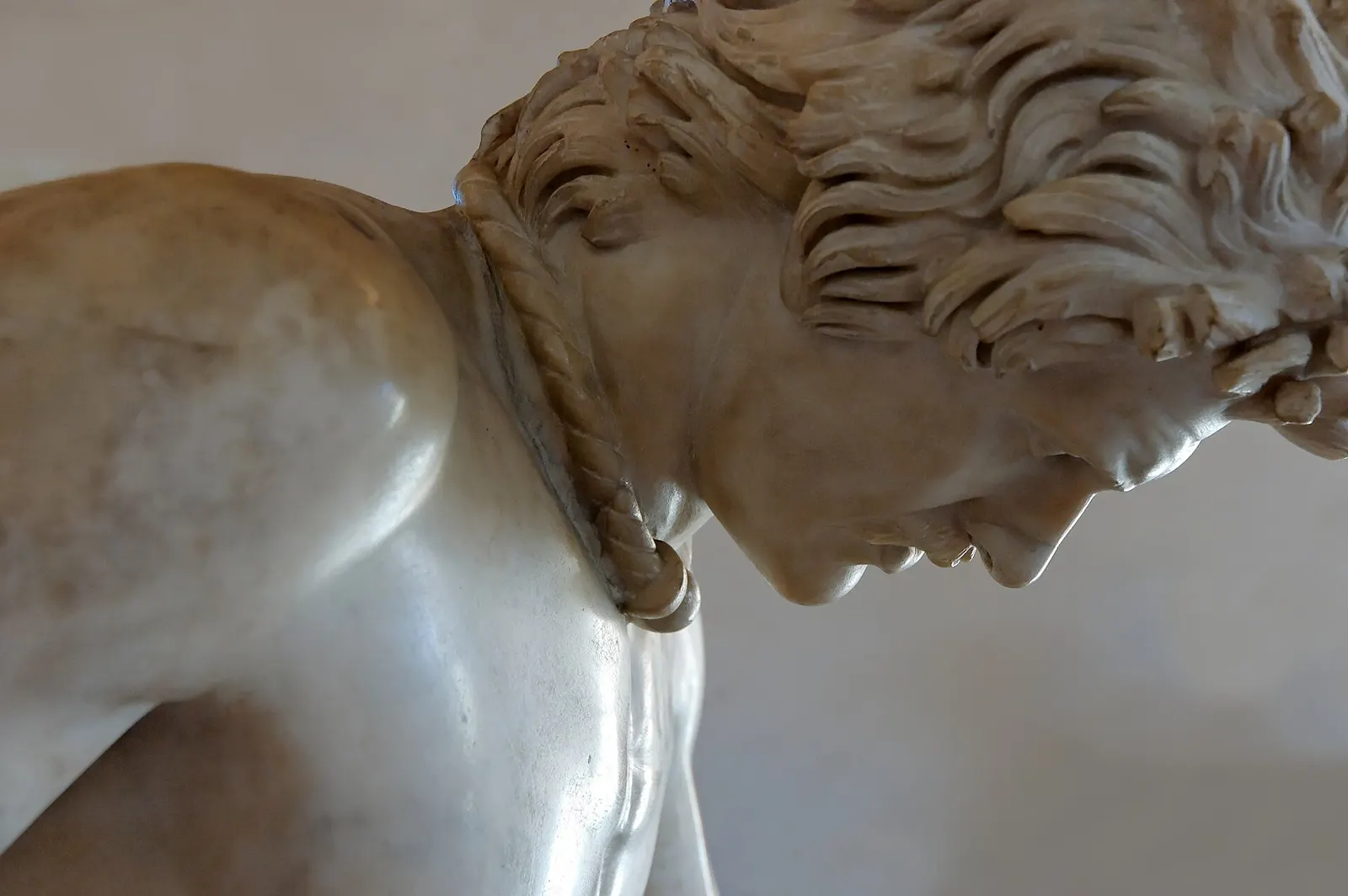
Both men and women wore heavy ornaments of bronze, silver, gold or electrum (an alloy of gold and silver) with intricate designs cut or engraved into the metal. The usual male ornament was the torc, a heavy neck circlet of gold or silver that was usually not removable. There is much speculation as to how torcs were put on the wearer, as existing torcs appear too heavy to bend easily.
If you have ever seen a picture or a copy of a statue called "The Dying Gaul" (which, though it was long labeled "The Dying Gladiator" and may well have represented one, was definitely that of a Celt), you may have noted that the torc on the warrior's neck is very evident, as is also the heavy mustache and stiff-looking hair. You will remember that the figure is naked, the torc being the only thing worn on the body. Unafraid of injury or death, these ferocious fighters went into battle unclad, to the consternation - and perhaps the distraction - of their enemies.
On the domestic scene, woodworking, pottery making and weaving were highly developed. The people apparently dressed simply, the women in long sacklike dresses, the men in tunics and breeches. In cold weather, both sexes wore long, enveloping cloaks fastened at the neck with large, decorative brooches. The woolen material was dyed in contrasting colors in a pattern of checks and stripes - a very strong argument for the antiquity of the tartan.
The Celts, despite their somewhat casual lifestyle, placed a high value on cleanliness, so much so that the bath-oriented Romans were sufficiently impressed to note that "no man or woman, however poor, could be seen dirty or ragged."
Other facets of the Celtic mode of life, however, were less admirable. Sexual promiscuity was fairly common, and the warriors spent much time in riotous feasts that featured heavy drinking, exaggerated boasting and gloating, and fights to the death over things as trivial as the best cut of meat from the carcass roasting on a spit. It is no exaggeration to say that such feasts often ended with blood running out the doors. And it wasn't from the roast.
'Off with their heads and on with the show!'
The Druid's altar and the Druid's creed, We scarce can trace, There is not left an undisputed deed Of all your race, Save your majestic song, which hath their speed, and strength and grace; In that sole song, they live and love and bleed - It bears them on thro' space. (From "The Celts," by Thomas D'Arcy McGee)
Now we must face the aspects of the Celtic heritage in which no pride can be taken: The Celts were headhunters, often nailing the skulls of defeated opponents to the walls and doorposts of their homes. In later times, they displayed the grisly war trophies in niches in their temples.
In their defense, however, it must be noted that the Celts, who were after all a primitive people, believed that the head was the receptacle of the soul, hence the importance attached to the taking of heads. It is possible that severing the head from the body was meant to prevent any magical revival of the slain foe by the Celtic god of healing, Diancecht, who could supposedly restore to full health any warrior, "unless his head be cut off, or the membrane of his brain or spinal marrow be severed."
In addition to this extreme surgical procedure, the Celts practiced human sacrifice - not excepting children - in the grim ceremonies of Druidism. They also indulged, at least to some degree, in ritual cannibalism, feasting on the brains of their enemies.
But honestly, folks, we shouldn't be too shocked by these gruesome habits. After all, the Romans, who professed to be the elite of the civilized world, did not outlaw their practice of human sacrifice until 97 B.C., and untold thousands perished in the Roman arenas to entertain the populace in their brutal and mislabeled "games." And let us not forget the multitudes who suffered agonizing deaths in the incredibly cruel and agonizing method of execution called crucifixion. Moreover, we civilized moderns have perpetrated not a few horrors of our own.
Invasion, conquest - and failure to cooperate
Let me elaborate a wee bit on a subject mentioned above: the Druidic belief in reincarnation and an immortal soul. The Celts believed that the human soul, after the death of its mortal temporary owner, would undergo a period of purification in the Underworld (the Land of the Dead) and eventually pass into another human being. There was also a chance that the soul might turn up in an animal or a bird, depending on how the person had lived.
This belief, firmly held by the Celts, made them ferocious fighters, for they were utterly contemptuous of death in combat. In fact, the reckless and unbridled savagery of their fighting inspired the Romans to coin a new word to describe such a state - furor.
Both the Greeks and the Romans experienced that furor on their own ground in pre-Christian times as Celtic armies sacked and burned Rome itself around 390 B.C. and the Oracle of Delphi (the Shrine of Apollo) in 279 B.C. The sacking of Rome occurred when a Celtic force estimated at 30,000, led by a chief called Brennus, routed the Roman army on the banks of the Tiber River and burned the city. The Capitol area held out, and after a long siege, the Celts agreed to leave provided the Romans paid a heavy ransom in gold.
According to the Roman historian Livy, the Romans protested that the Celtic scales were dishonest. It is said that Brennus, angered by the arrogance of the Romans, shouted Vae victis ("Woe to the vanquished") and dropped his heavy sword on the Celtic side of the scales.
The Celtic invasion of Greece, more than a century later, was led by a chief also called Brennus (probably a title rather than a name, brenin being the Welsh word for "king"). The invasion proved to be disastrous for the Celts. As they left the Oracle, laden with the great treasures, they were decimated by a series of natural - or supernatural - disasters: earthquakes, landslides, blinding snowstorms, avalanches and floods. Part of that army wound up in present-day Turkey, where they established the Celtic nation of Galatia.
A second Celtic invasion of Rome even reached the island of Sicily, and Celtic raiders menaced the Romans in northern Italy for many years. Perhaps the Celts were prevented from overrunning the entire known world only by their own stubborn trait that persisted into historic times - the refusal of one tribe to accept, even temporarily, the domination of a leader from another tribe in order to present a united front to a common foe. Think of how radically different world history would have been had the Celts conquered the Romans and stayed in Italy.
This same attitude unfortunately prevailed among the Scottish Highland clans, resulting in senseless feuds and almost complete disunity against English invaders.
Despite this lack of unity and common purpose (with a few exceptions), the Greeks and Romans feared the wild northerners - and rightly so.
The Celts used horses in farming and warfare. They apparently acquired their knowledge of domesticating and breeding horses from their early neighbors, the Scythians, who lived north of the Black Sea. The Celts fought in pairs from two-wheeled battle chariots of advanced design, drawn by two horses. One man handled the team with great skill; the other wielded sword and spear as the chariot careered through the enemy's ranks. Like the chariots in "Ben Hur," if you've seen that movie, the chariots of the Celts are said to have been equipped with scythe-like blades that cut a swath through the opposing army like a reaper through a field of wheat. The whole assemblage was indeed fearsome.
It is thought that horses were used to pull chariots because they were then too small to be ridden effectively in combat, although in later times, as larger horses were bred, the Celts did use them as cavalry.
Time out for art and culture
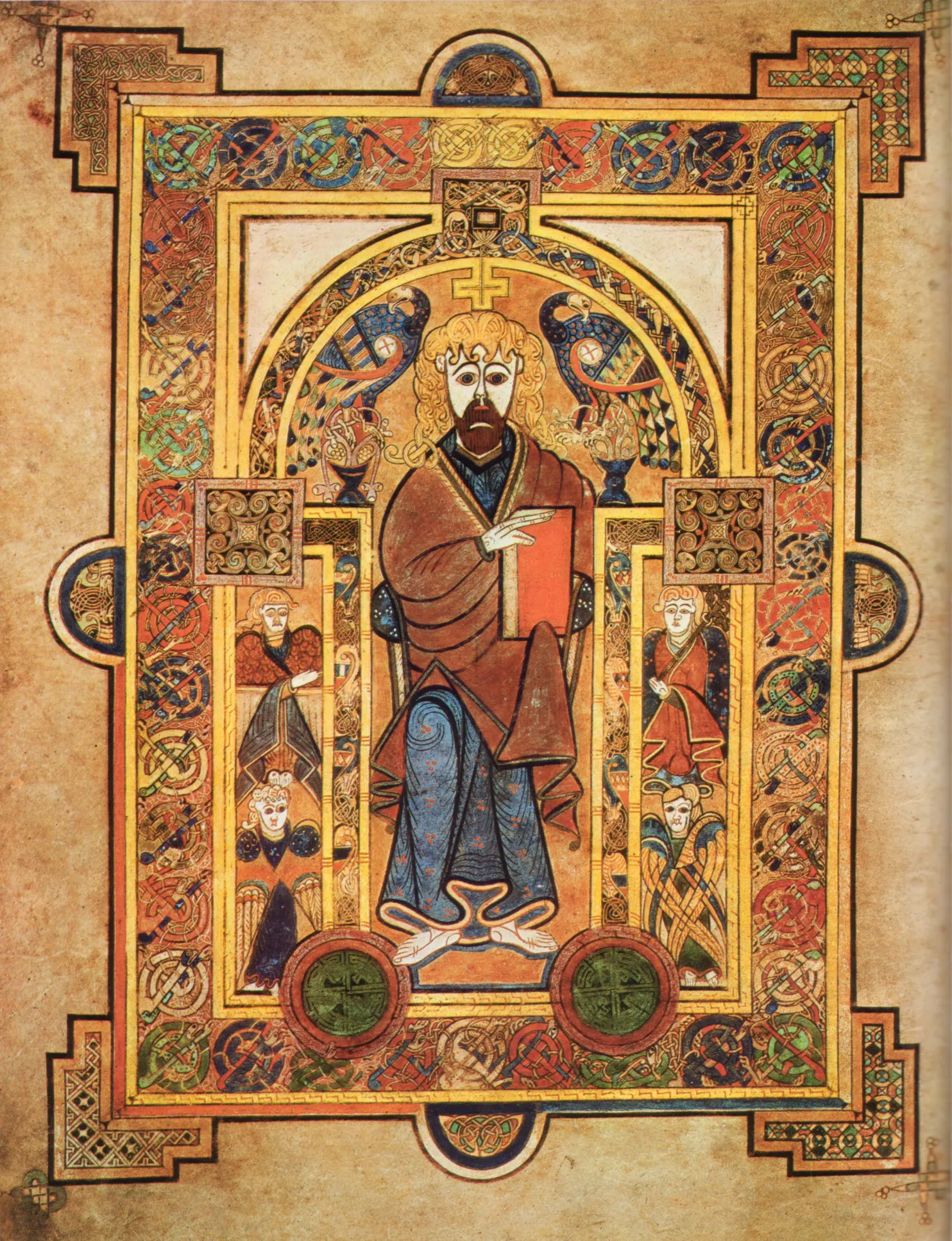
The Celts reached their social apex in the La Tene culture, which lasted for several centuries and produced highly distinctive art forms. At first, they borrowed heavily from their neighbors, but eventually evolved a unique style that reached its peak in Ireland. Perhaps the best-known example is the Book of Kells. This technique featured an almost abstract style in which writhing tendrils, resembling some supervine, intertwined in complex and intricate designs, bursting forth here with buds and leaves, there with strange-looking heads and animals that appear at first glance to be almost natural and yet are totally unrealistic.
Celtic artisans worked in gold, silver, bronze and electrum, studding their work with precious and semiprecious stones, engraving designs, and inlaying with colored enamels. Some of their finest work was lavished on implements of war, not surprising in a martial society; some beautiful examples of their artistry still exist in the form of lavishly decorated ceremonial swords and scabbards.
The decline and fall of the Celts
In the end, the superior organization and discipline of the Romans prevailed against the wild and volatile Celts. Their domination of Europe and the La Tene culture perished together when Gaul, the last stronghold of European Celts, was at last conquered by Rome's legions in 57 B.C.
The Romans were superbly led, of course, by that figure so well known to Latin students, Gaius Julius Caesar, whose tremendous military genius was exceeded only by his ability and productivity as a writer. Having subjugated virtually all of Europe, Caesar decided to move west, and led two probes into Britain in 55 and 54 B.C., but took no further action at that time. His death at the hands of assassins in 44 B.C. ended Roman expansion for nearly a century. Not until A.D. 43, during the reign of crippled Emperor Claudius - unlikely survivor of the wave of assassinations that decimated Roman aristocracy - did Rome again turn her attentions to the British Isles.
Caesar's earlier expeditions into Britain had been armed reconnaissance missions, but now the intent was to conquer Britain and expand the Roman Empire, mainly to acquire the considerable wealth of the British tribes. Several of these tribes, the Cantii of Kent, the Trinovantes of Essex and the Iceni of East Anglia, were amenable to Roman occupation and ready to become client states of Rome, but most were unwilling to give up their independence and resisted fiercely. The Roman task was eased by the actions of Cartimandua, Queen of the Brigantes of northern Britain. She conspired with her lover to hand over her husband to the Romans and accept their domination. Betrayed by this early female version of our century's Quislings, the Brigantes were handily beaten by the Romans.
In A.D. 61, the Roman general Suetonius Paulinus destroyed the seat of Druidic power in Anglesey, an island close to the north coast of Wales. He had barely completed this task when the Iceni tribe, led by their awesome Queen Boudicca, rose in rebellion, and Paulinus was forced to march his troops posthaste to the east to quell the revolt. This he succeeded in doing, but with great difficulty and at high cost to his legions as Boudicca inspired her warriors to great heights, leading them into battle like a fabled Amazon. It is said that she took poison and died rather than submit to the hated Roman conquerors.
By A.D. 71, England was firmly under the iron heel of Rome, and the legions now turned their attention northward to what is now Northumbria and Scotland. The Roman general Julius Agricola, who had the good fortune to have as his son-in-law the historian Tacitus, completed the conquest of the Brigantes and pushed into the eastern fringe of the Scottish Highlands - present-day Perthshire. Here, the Romans constructed a huge fortified camp of some 50 acres, called Pinnata Castra, to serve as winter quarters for the troops.
The legionnaires never penetrated any deeper into the Highlands, a venue grim enough to daunt even the battle-hardened veterans of Rome's wars of expansion, but they did march eastward and up the coast as far as present-day Aberdeen. As they marched east, they met a "vast array" of Caledonians (one of the two main tribes of Picts), and there ensued a "tremendous battle" in an area called Mons Graupius by Tacitus, who recorded the battle. No one today knows the actual location of the battle - or even whether it actually occurred. Again according to Tacitus, the Romans won, inflicting heavy losses on the Picts. Despite allegedly having been beaten by the Romans, the Caledonians continued to wage guerilla warfare, and by the year A.D. 100 had isolated or destroyed Pinnata Castra and other Tayside forts.
Alarmed at this turn of events, the Romans sent their entire Ninth Legion, perhaps 6,000 to 8,000 first-line troops, to relieve the isolated garrisons. The Ninth, considered to be more than a match for any Pictish army, disappeared from the pages of history without a trace, in what must have been a massacre resulting in total annihilation of the Romans. All Roman troops were withdrawn from Scotland soon after this disaster, and the pragmatic Latins abandoned the idea of controlling the inhospitable country where death lurked behind every tree.
The Emperor Hadrian himself went to Britain in A.D. 117 to personally quash a rebellion in Northern England; soon after, the decision was made to abandon the area completely. But the southern provinces still needed protection against the marauding Picts, and the famous Wall of Hadrian was constructed from coast to coast across northern England (the name "England," it should be understood, is used only to help orient the reader). Hadrian's Wall consisted of more than 70 miles of stone walls and forts, most of it built by the legionnaires themselves, with some native help.
About 20 years later, a second barrier, basically a ditch-and-earthwork structure, was built across the narrow neck of Scotland in the present Glasgow-Edinburgh corridor, at the command of Emperor Antoninus Pius. For more than 40 years, battles raged around this Antonine Wall as its forts were lost to the Picts, retaken, and lost again. Finally, the exhausted and battered legionnaires abandoned their northern bulwark and withdrew behind Hadrian's Wall near the end of the 2nd century A.D.
In A.D. 208, the Emperor Severus decided to show the Picts who was boss. Thirsting for revenge, he landed a punitive army at the Firth of Forth to carry out a campaign of blood and fire that reached the Valley of the Tay. Although Severus defeated several tribes, capturing or executing their leaders, he could not pacify the land; the Romans again retreated to the haven of Hadrian's Wall. Although the Romans probably never realized it, Hadrian's Wall came to clearly symbolize the northern limit of Roman expansion.
By the end of the 4th century, the Roman Empire was writhing in its death throes, and the legions went home to fight over the remains of the huge carcass. By A.D. 410, the Britons were on their own, facing the combined onslaught of the Irish, Picts, Franks, Angles, Saxons and Jutes. Eventually, the British Celts, under the inspired leadership of the great warlord Arthur, son of Briton King Uther Pendragon (the Welsh word for "chief" is pennaeth, often shortened to pen when combined with a name), defeated the most powerful intruder, the Saxons, at the Battle of Badon in 518. Peace broke out for a period that may have been as long as 30 years.
However, Arthur's death at the Battle of Camlan, along with that of his foe (and possible kinsman) Mordred, ended the peace. The Saxons forced the Britons southward into Wales; the Britons took their Arthurian legends with them. Other British Celts, also driven south by the Saxons, fled across the English Channel to a section of France then called Armorica. Here they settled, apparently peacefully, imposed their Brythonic language and customs on the area, and renamed the land Brittany; these are the Bretons of today.
Ireland: Celtic redoubt
Let me now look westward, as Roman general Agricola is said to have done from a high point on the southwestern coast of Scotland (Ayrshire), optimistically calculating that he could take Ireland with a single Roman legion and a moderate force of Roman-trained British auxiliaries. There is strong evidence that he intended to carry out such a plan, as he kept a renegade Irish chieftain close at hand. Agricola undoubtedly planned to make use of the chieftain's knowledge in the invasion he contemplated. But destiny decided otherwise, and Rome never invaded Ireland, despite the constant assaults on Britain's western shores by Irish raiders.
Thus, Ireland remained an inviolate stronghold of the Celtic people. Their La Tene culture, which was ruthlessly stamped out in Europe by the tyranny of Rome, flourished undisturbed in Ireland until Christianity entered the picture. Some historians refer to this uncontaminated continuation of Celtic culture into historic and literate times as a "fly in amber," much as ancient insects are perfectly preserved in that fossilized resin of extinct pine trees. So it is that in Ireland we find the purest form of the original Celts - albeit somewhat diluted by Viking blood - and probably one of the oldest languages still spoken. With the coming of St. Patrick to the Auld Sod in the 5th century, writing entered the scene, and the Irish clergy began to record much of the ancient oral tradition that enriches the Celtic culture.
It is remarkable that the pagan Irish, after centuries of polytheism, embraced Christianity almost without resistance, making the transition from a vast array of Celtic gods and goddesses to monotheism more easily than most societies. Many writers feel that part of the transitional process was the reduction of the old gods to miniature size so that the people could cling firmly to the tradition of the hidden underworld of the "little people" - leprechauns, elves and fairies - a tradition that has lasted 1,500 years.
We Americans, with a culture that sneers at such beliefs, should not be too smug. After all, we still celebrate two of the major Celtic holidays, Beltain and Samhain, though we call them May Day and Halloween. And our December 25th celebration of Christmas corresponds closely to the celebration that followed the Celtic "Five Dark Days" - the winter solstice and the two days preceding and two days following, when the life-giving sun almost vanishes in the high latitudes of the British Isles. Not to mention that every time we hang up the mistletoe at Christmas, looking for a free kiss, we unknowingly keep alive the use of a plant that was sacred to the pagan Celts, who attributed powerful aphrodisiac powers to the parasitic evergreen.
What the scholars say now
Alex Campbell was honest about his sources: half a dozen weighty tomes, read by a curious amateur. Much of what he wrote is still standard. Some of it has shifted under the ground, quite literally, since 1998.
The biggest change is in the question of where the Celts came from. The Black Sea homeland and the march west toward the sun god were never more than one reading. For most of the twentieth century the mainstream view tied the first Celtic speakers to the Urnfield and Hallstatt cultures of central Europe, named after the grave field that Johann Georg Ramsauer dug at Hallstatt in Austria from 1846. La Tène, the site that gave its name to the art style Campbell admires, was found in Switzerland in 1857. Since then John T. Koch and Barry Cunliffe have argued for 'Celtic from the West', with the languages rising along the Atlantic coast of Iberia, Gaul, Britain and Ireland. In 2020 Patrick Sims-Williams proposed a middle course, 'Celtic from the Centre', placing the origin somewhere in Gaul. Most scholars now use 'Celt' first of all as a linguistic label.
Ancient DNA has added its own evidence. Bronze Age men buried on Rathlin Island between 2000 and 1500 BC carried the same paternal lineage, R-L21, that is commonest today among the Irish, Scots, Welsh and Bretons.
Several details in the article need a footnote. The Coligny calendar was found in 1897 near Lyon and survives in 73 fragments; it is now usually dated to the end of the second century AD, not the first century BC, though its system is much older. It lays out a five-year lunisolar cycle and is held at the Gallo-Roman Museum of Lyon-Fourvière.
The lost Ninth Legion has partly reappeared. Tile stamps and other inscriptions of Legio IX Hispana turned up at Nijmegen in the Netherlands, suggesting that at least part of it was there around AD 120, after its supposed massacre in Scotland. Mons Graupius is still dated to AD 83 or 84 and still has no agreed site, which is why Historic Environment Scotland leaves it off its inventory of battlefields.
And Arthur remains a question. Gildas, writing around 543 to 547, describes the British victory at Badon but names no commander. The name Arthur first appears in the ninth-century Historia Brittonum. The date of 518 given here is one guess among several.
Questions readers ask
Where did the Celts originally come from?
There is no settled answer. The traditional 'Celtic from the East' view links the first Celtic speakers to the Urnfield and Hallstatt cultures of central Europe from about 1200 BC. John T. Koch and Barry Cunliffe argue instead for 'Celtic from the West', with the languages emerging along the Atlantic coast. In 2020 Patrick Sims-Williams suggested an origin in Gaul during the second millennium BC.
What happened to the Roman Ninth Legion in Britain?
The Ninth Legion, Legio IX Hispana, was long thought to have been wiped out in northern Britain soon after AD 108, its last securely dated inscription in Britain. Later finds at Nijmegen in the Netherlands, including tile stamps dated between 104 and 120 and a medal pendant, suggest that at least part of the legion served there around AD 120. It had ceased to exist by about 197.
What is the Coligny calendar?
The Coligny calendar is a bronze plaque inscribed with a Celtic lunisolar calendar in the Gaulish language, written in Roman letters and numerals. It was found in 1897 at Coligny, near Lyon, and survives in 73 fragments, about 40 percent of the original. It sets out a five-year cycle of twelve lunar months with intercalary months, and probably dates to the end of the second century AD.
Was the Battle of Badon a real battle and did King Arthur fight there?
Almost all scholars accept that the Battle of Badon happened in the early sixth century, a British victory over the Anglo-Saxons. The earliest source is Gildas, writing around 543 to 547, who says he was born in the year of the battle but never mentions Arthur. Arthur's name is first linked to Badon in the ninth-century Historia Brittonum. Its date and location remain uncertain.