Nine who counted: Would they do it all again?
Tommy Symons retold the pub-wall tale of nine Irish rebels condemned in 1848 who rose to high office abroad. We checked it against the record.
As printed in the Celtic Mirror, April 1998
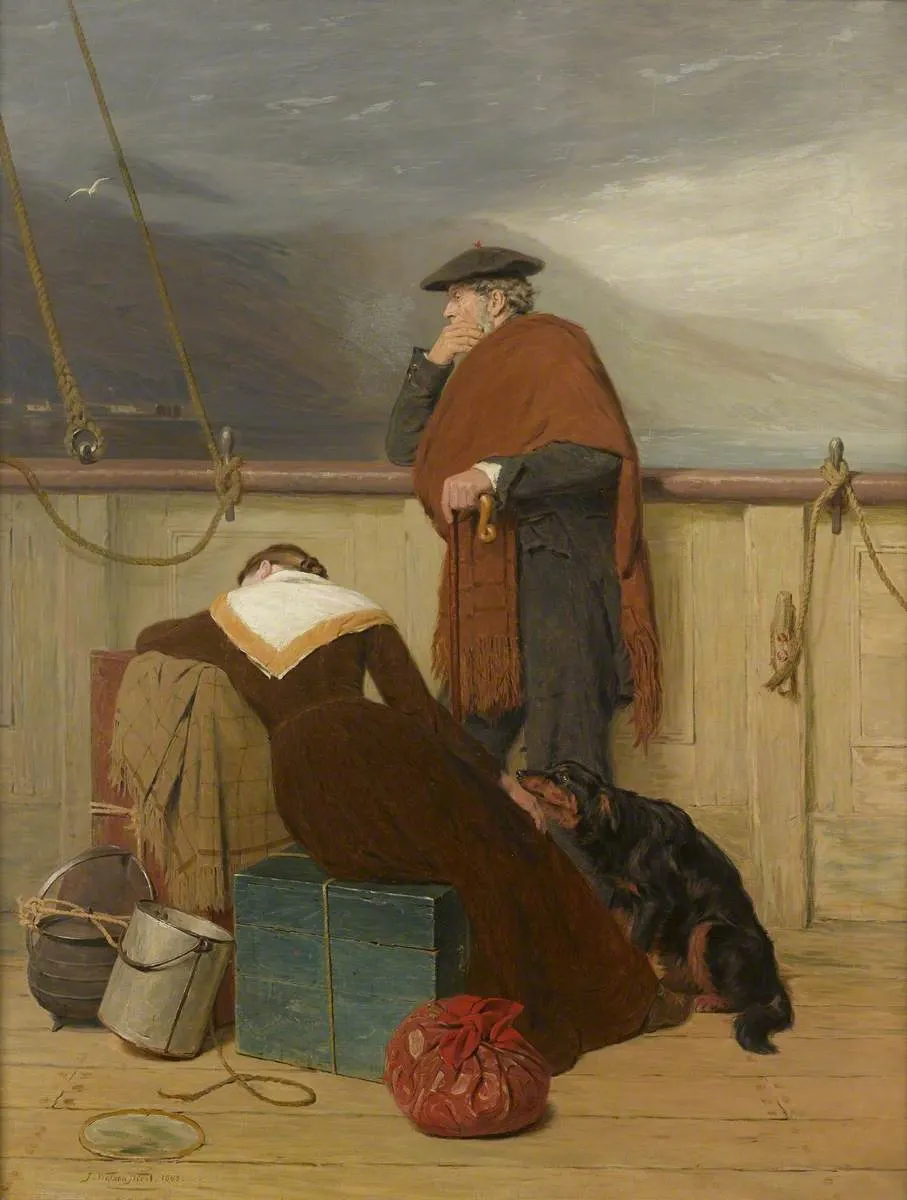
The Irish diaspora, or the dispersion of the Irish people around the world, was caused by many factors - religious persecution, economics, famine, politics, to name a few. A word that comes to mind is relocation: to pick up and move from one area to another. Doesn't seem like an awfully big deal. But look at the possible synonyms for relocation in various senses: removal, liquidation, elimination, eradication, purgation, riddance. That is when the scheme of things seems to fall into place.
Up until the time of the Revolutionary War, the "colonies" served as a destination for many an Irishman of which England wished to rid its population. Crimes, real or imagined, ranging from forgery or pickpocketing to murder or treason, could be a reason for "transportation," the term by which sending one off to another land as punishment was known.
When the new nation of America would no longer accept these prisoners, the British Empire was forced to look elsewhere, and Australia, or Van Diemen's Land, proved to be the answer. Transportation proved beneficial to that colony in many ways, providing a constant and fresh supply of laborers - and settlers when their sentences eventually ended.
Around the time of the Famine, nine individuals were sentenced by a judge in Ireland to be hanged, drawn, and quartered for crimes against the Queen - treason. High-ranking members of the aristocracy petitioned the courts and the Queen herself for clemency for the nine, and their sentences were commuted to imprisonment in the Australian penal colony. In 1848, they were transported to Australia, half a world away. Around 1873, approximately 25 years later, the Queen realized that Sir Charles Duffy, then prime minister of Australia, was one of those nine convicted criminals.
But to what end had the other eight come?
Morris Lynn and Michael Ireland were attorneys-general in the penal colony. Richard O'Gorman was the governor general of Newfoundland; Thomas Magee was Canada's second in command. Terrence McManus and Patrick Donahue attained the rank of brigadier general in the United States Army, as did Thomas Meagher, who went on to be appointed territorial governor of Montana. James Mitchel was the grandfather of John Purroy Mitchel, mayor of New York City at the time of the 1916 uprising.
Nine men sentenced to die, but filled with the will to be free and to succeed, went on to take distinguished places in history. Of the millions who were forced to leave or who were banished from their homeland, these are nine of the many who had an effect.
Their story lives on in a ballad written by Bob Rogers, of Scranton, Pa., and recorded by the Irish Balladeers on the "Last Barnesville Waltz" album. The ballad is called "Nine Fine Irishmen." Bob told me in a recent interview that around 1967 he was dining at the John Barleycorn in New York and saw the story on a menu. Realizing what potential it had for a song, he stored it away for future reference.
Twenty years later, as the group was recording the album on which it appears, the idea came back to him, and the song came together in one night. He also pointed out that this was not an isolated incident, that many countries became home to those fleeing or forced from their native soil. France, along with other European countries, boasted many high-ranking officials who were native-born Irish.
Many thanks to Bob Rogers and the Irish Balladeers for their help with this article, and their preservation of history through song and story.
Checking the menu story
Bob Rogers found this tale on a New York restaurant menu around 1967, and that is roughly where it belongs. The "Nine Famous Irishmen" story still hangs in bars, on beer mats and on gift-shop prints. Most of it does not survive contact with the record. Re-reading the column in 2026, we owe readers a correction sheet.
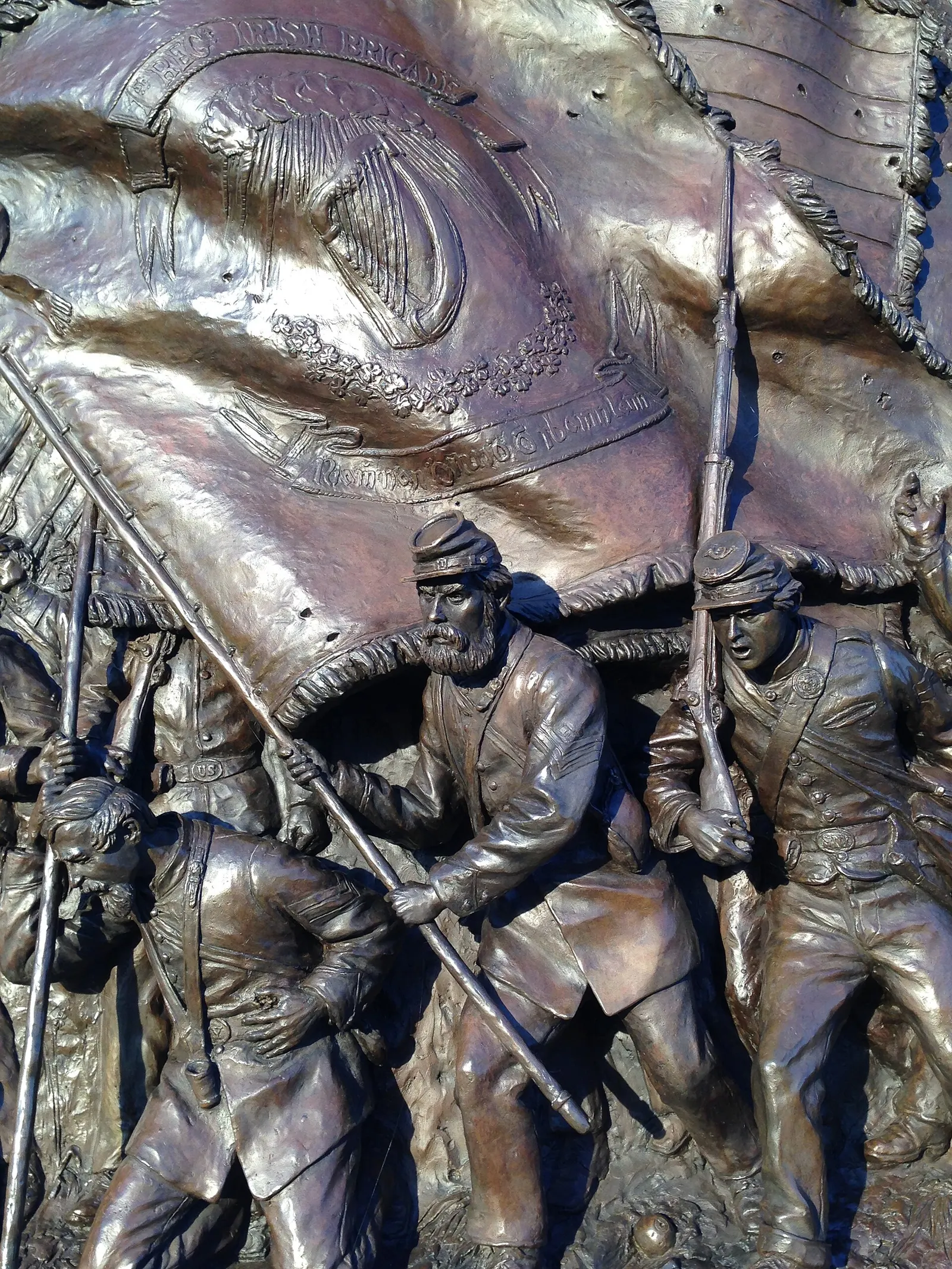
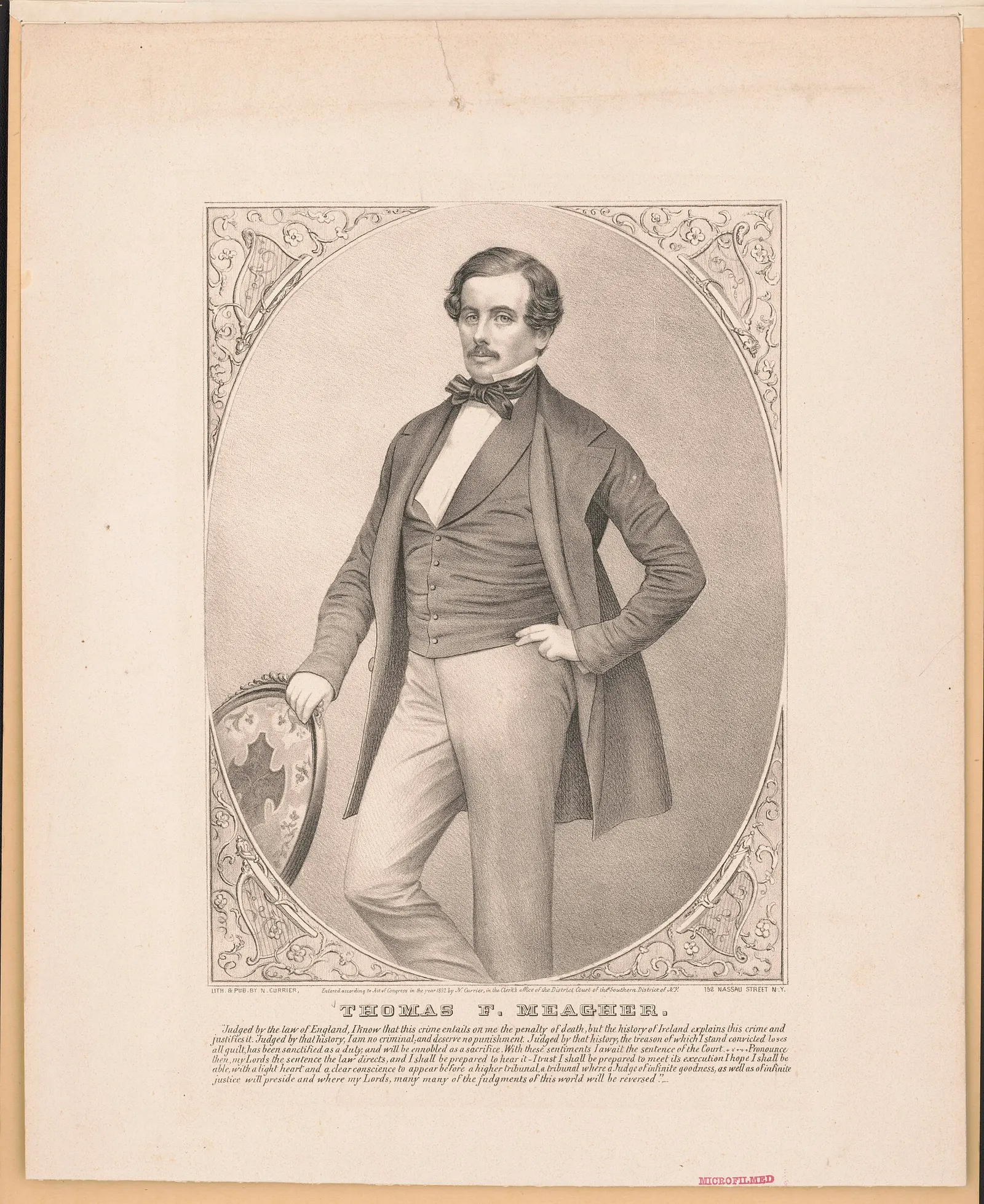
Some of it is true. After the failed Young Ireland rising at Ballingarry in the summer of 1848, Thomas Francis Meagher, William Smith O'Brien, Terence MacManus and Patrick O'Donoghue were convicted and sentenced to be hanged, drawn and quartered. Public pressure won commutation to transportation for life, and in 1849 they were shipped to Van Diemen's Land, now Tasmania. Meagher escaped to the United States in 1852, led the Irish Brigade in the Civil War as a brigadier general, and served as acting governor of Montana Territory from 1865 to 1866. He went over the side of a steamboat into the Missouri near Fort Benton on 1 July 1867. His body was never found.
The rest wobbles. MacManus escaped too, but he settled in San Francisco, never wore a general's stars, and died there on 15 January 1861; his Dublin funeral that November became a Fenian show of strength. Charles Gavan Duffy was never convicted at all. He went through five trials, was freed after the last, and emigrated to Australia of his own accord in 1856. He was Premier of the colony of Victoria from June 1871 to June 1872, not prime minister of Australia, and was knighted in 1873. Thomas D'Arcy McGee was never transported either: he slipped out of Ireland disguised as a priest, later became a Canadian minister and a Father of Confederation, and was shot dead in Ottawa on 7 April 1868.
John Mitchel was transported and did escape. His grandson John Purroy Mitchel really was mayor of New York, from 1 January 1914 to the end of 1917, so the Easter Rising did fall in his term. Richard O'Gorman became a New York lawyer and judge, not a governor of Newfoundland. As for Michael Ireland, IrishCentral's 2018 check found no Young Irelander or attorney-general of that name. He seems to have been invented with the rest of the menu.
Rogers wrote a good song. The history behind it is smaller and more interesting.
Questions readers ask
Is the Nine Famous Irishmen story true?
Only in parts. Thomas Francis Meagher and three companions were sentenced to death after the 1848 Young Ireland rising and transported to Van Diemen's Land in 1849, and Meagher did become acting governor of Montana Territory. But Charles Gavan Duffy was never convicted, several careers in the tale are wrong, and one figure, Michael Ireland, appears to be invented.
Was Charles Gavan Duffy prime minister of Australia?
Duffy was Premier of the colony of Victoria from June 1871 to June 1872, decades before Australian federation in 1901 created a national prime minister. He was never transported as a convict. After five trials over the 1848 rising he was released, and he emigrated with his family in 1856. He was knighted in 1873.
What happened to Thomas Francis Meagher?
Meagher was sentenced to death in 1848, saw it commuted to transportation, and reached Van Diemen's Land in 1849. He escaped to New York in 1852, commanded the Irish Brigade as a Union brigadier general, and was acting governor of Montana Territory from 1865 to 1866. He drowned in the Missouri River near Fort Benton on 1 July 1867.
Was John Purroy Mitchel related to the Young Irelander John Mitchel?
John Purroy Mitchel was the grandson of John Mitchel, the Ulster-born Young Irelander who was transported and later escaped. The younger Mitchel served as mayor of New York City from 1 January 1914 to 31 December 1917. He died on 6 July 1918 in a training flight accident in Louisiana while serving in the Army Air Service.