Martin Dillon: Intimate of terrorists
Weeks before the Good Friday Agreement, the Belfast author of The Shankill Butchers and God and the Gun talked to us about killers, clergy and the coming deal.
As printed in the Celtic Mirror, April 1998
Martin Dillon, author of the riveting book "God and the Gun," speaks of terrorism as one may speak of a casual acquaintance - and with good reason. An author of international renown, Dillon carved his reputation as a reporter covering the Northern Irish conflict for more than 20 years. In that time, the native of Northern Ireland exhibited a propensity for unbiased journalism that would become his trademark.
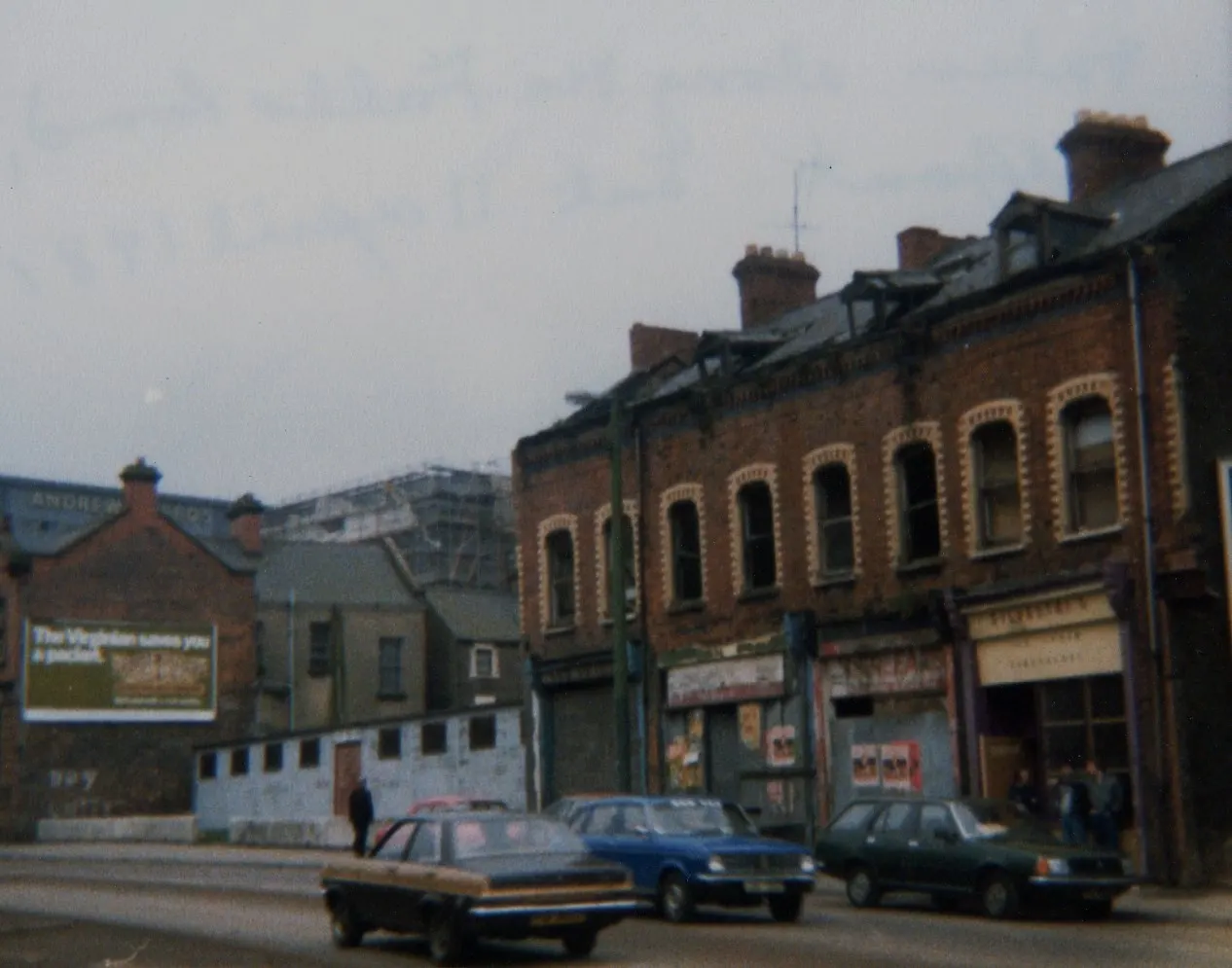
A reporter with the BBC for more than 18 years, Dillon was "on the ground" in Belfast when shops were devastated by bombs. At times, he has had to cling desperately to the brick walls of houses and crawl on his belly to safety in the face of a hail of gunfire between British troops and IRA gunmen.
"I did features for the BBC, exclusives on Northern Ireland, the political strife and the terrorism and the killings," Dillon explained in an interview with this reporter. "I always felt that my job, my objective was to explain what was going on, to examine it, while not taking sides. There was too much reflex journalism - it didn't provide the coverage which was needed. I believe that I eventually gained the respect of many embroiled in the conflict because of the fact that I did not take sides."
Dillon also staked his reputation on a trait too often absent in today's journalism - a tireless and dogged determination to authenticate any sensitive information in his possession before going to print.
His professional determination that his stories be steeped in truth would ultimately lead, however, to his leaving the BBC. "We parted company because I had several run-ins with the BBC. I felt that there were certain influences at play there. There were people within who I felt had an agenda which was not unbiased ... so I left."
It was after his tenure at the BBC that Dillon would exhibit his true brilliance on the theme of Irish terrorism. Reflecting on his experiences through the years, he put them on the pages of his books in the form of historical and social examinations of the conflict.
There are seven such books in his bibliography to date, and the topics he has examined cast a brilliant light on the dubious nature and residual effects of a war spanning 30 years.
"The Dirty War" is a look at the surreptitious mechanism of the publicity war that has raged in Northern Ireland, where disinformation and spin have often been weapons as formidable as guns and bombs.
The Troubles have spawned some chilling assassins - individuals who have tortured and executed people in the most heinous ways. As a collector of the images and information surrounding such people, Dillon, in his career as reporter and author, has often found himself in the company of men with dark and sinister souls.
In two books, "Stone Cold" and "The Shankill Butchers," he depicts some of these people with wisdom and riveting clarity. Both books are concerned with loyalist assassins. "Stone Cold" is about Michael Stone and his rampage at Milltown. "The Shankill Butchers" deals with the notorious Lenny Murphy and his aptly named gang, who went on a murderous spree in which more than 20 Catholics were savagely tortured and killed.
The books are at present unavailable in the United States, but Dillon plans to release them here shortly. "For many people in the United States, they have primarily heard of only the IRA, in reference to the violence. In the Bush-Reagan years, things were restricted in the free flow of information, and there was not as balanced flow of information," Dillon said, indicating that his books would give Americans the opportunity to examine both sides of the conflict.
If the subject matter of his sensational works has been often gruesome, then the reaction to some of his writing has on occasion put him at great risk. Dillon recalls, for instance, a time when he was engaged in conversation with a contact on the Shankill Road and a particularly unsavory character stuffed a pistol in his mouth.
For a period after the release of "The Shankill Butchers," Dillon and his family moved to France due to security concerns. "I was tipped by a decent guy in the U.V.F. that ... if I stayed in Northern Ireland ... there were people who were threatening to slit my throat. These are very dangerous people, and my books tried to explore ... their feelings. Was there indignation or condemnation when they killed? What were their ideals? Did they feel justified?"
In the past, one aspect of the turbulent conflict in Northern Ireland - the role of religion - has never been adequately examined by any writer. That has changed with the publication of Dillon's latest book, "God and the Gun," which is as introspective as it is harrowing.
One chapter recounts vividly the experiences of a Catholic priest who was summoned by the IRA in the middle of the night to perform the sacrament of last rites prior to an execution, and the resultant equivocation felt by that priest: Should he have intervened - even though it would have been sure to cost him his life?
In another chapter, Dillon calls on past interviews with slain loyalist killer Billy Wright. Dillon delves into the psyche of the self-proclaimed preacher, eliciting an apparent moral rationalization for his actions, which have included several killings.
In the opinion of this writer, "God and the Gun" is Dillon's finest work to date and is a must read for any who has even a casual interest in Northern Ireland.
When queried as to his feelings on the present prospect for peace, Dillon declares, "In the history of Ireland ... it is dangerous to make predictions." He does offer, however, astute assessments of the difficulties facing the quest for peace, specifically in regard to some of the recognizable figures and their respective tasks of embracing the settlement sure to be solidified by mid-April.
Saying that Gerry Adams will have a voice in the potential brokering of acceptance or denial within the republican movement, he also observes that Adams will only be one voice. "They [Adams and McGuinness] have been very prominent in furthering the peace process. And they are trusted by the organization ... but eventually it will come down to a vote. The IRA will inevitably call a convention and vote on whether or not they will accept the settlement."
Dillon points to a recent statement made by Adams in which the Sinn Fein president said, "We are looking for the halfway house." According to Dillon, Adams is presumably speaking of a negotiated settlement as being symbolic of reaching the halfway point in progress to the longtime republican goal of a united Ireland. "'What will the republicans gain from the settlement?' is the question. But ... you can be sure that the public statements are not what is being said in private."
In David Trimble, Dillon sees a figure who is faced with opening a Pandora's box, due to the broad complexities of unionism. "It is the nature of unionism - there are so many different strands of unionism. When Trimble stood with Billy Wright [at Drumcree], it was a vehicle for mobilizing the voice of unionism. But yet he has to watch his back. You have to realize that he has a lot of strands to straddle."
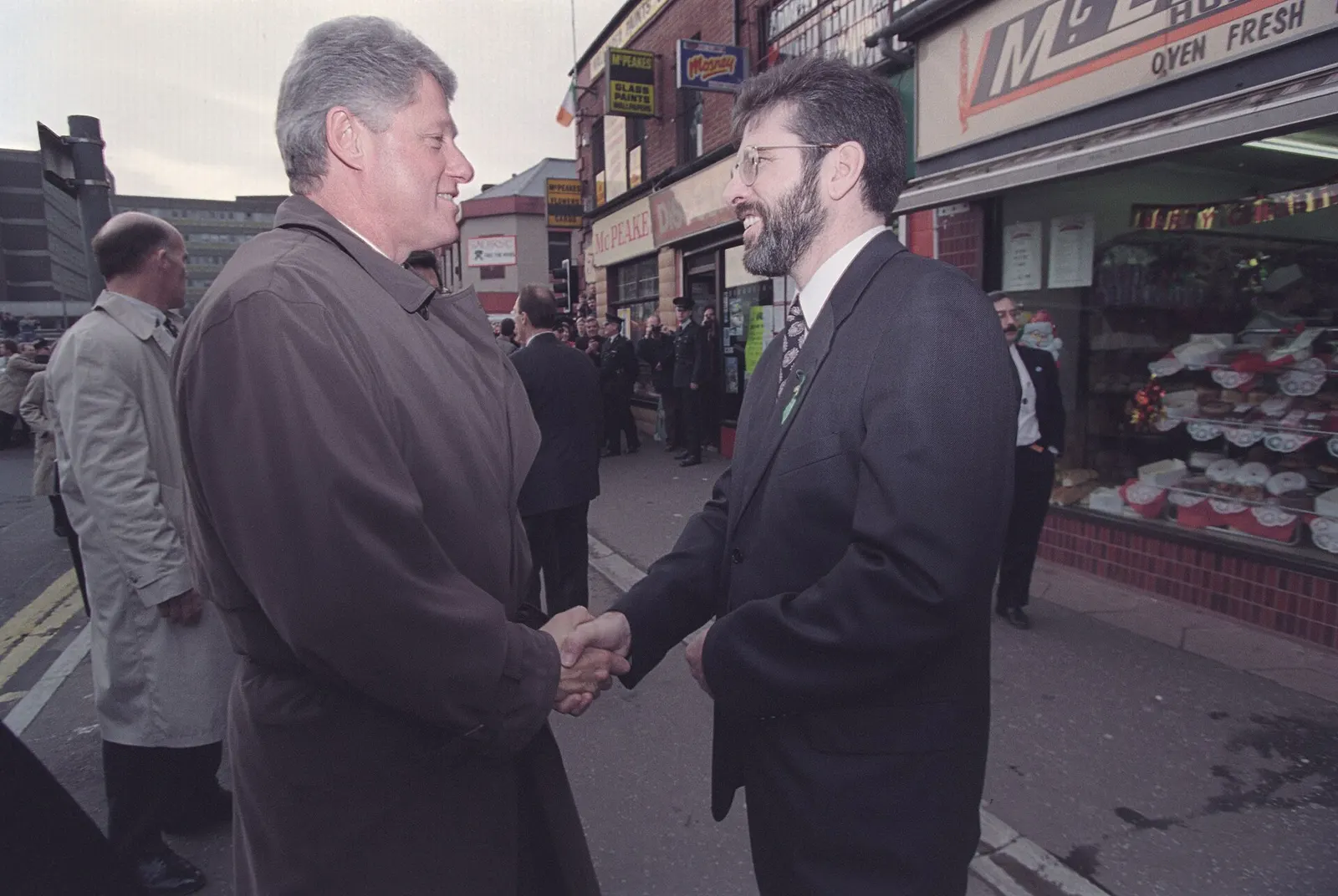
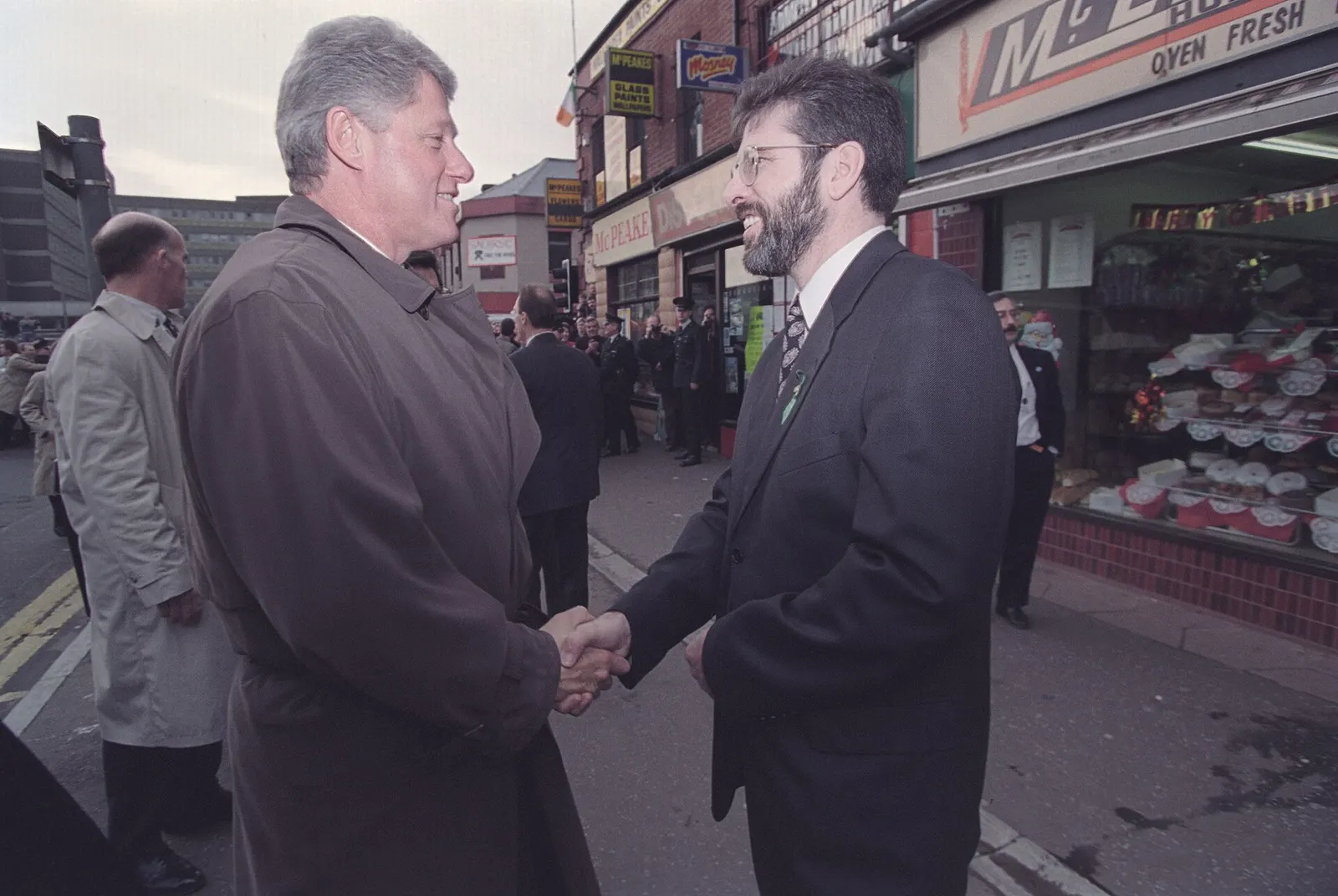
Asked if the symbolism of a ritual handshake with Gerry Adams on Trimble's recent stateside visit would have caused irreparable damage to his stature within unionism, Dillon replied, "I would have to say that, yes, if he shook Adams' hand he would be in trouble."
Indeed, Dillon views the periphery of any settlement as being mined with difficulties. "Progress is difficult because the historical memory is very real - so it is difficult to move forward."
Indicating that the question of ascertaining sole responsibility in the conflict is difficult because of its complex nature, Dillon points to "the successive British governments since 1921. They have in the past been guilty of the politics of expediency, an unnatural fear of Ireland." Yet he notes that "Tony Blair has provided an extra dynamic, and the Clinton administration has encouraged the IRA to come in from the cold."
Martin Dillon is at present formulating the material for a book on global terrorism, and is traveling in the United States, giving lectures in support of "God and the Gun." "My plans are to live and write in the United States, and perhaps take up a fellowship at a university."
"God and the Gun: The Church and Irish Terrorism" is published by Routledge Press and is available in select bookstores. The price is $25.
After Good Friday
Dillon told us it was dangerous to make predictions in Irish history, then made a good one. The settlement he expected by mid-April was signed on Good Friday, 10 April 1998, and approved by referendums North and South on 22 May.
The men in his books did not fade quietly. Billy Wright, interviewed for God and the Gun, was already dead when this issue went to press: INLA prisoners shot him inside the Maze on 27 December 1997. Michael Stone, the subject of Stone Cold, was released on 24 July 2000 under the early-release terms of the Agreement, took up painting, and on 24 November 2006 was arrested trying to enter Parliament Buildings at Stormont with an imitation pistol, a knife and a viable bomb. His lawyers later called it performance art.
The politicians Dillon sized up had long careers after the deal. David Trimble became First Minister on 1 July 1998 and shared the Nobel Peace Prize with John Hume that October; he died on 25 July 2022. Martin McGuinness served as deputy First Minister from 2007 and died on 21 March 2017. Gerry Adams handed the Sinn Féin presidency to Mary Lou McDonald in 2018, after 35 years in the post.
Dillon himself, born in the Lower Falls in 1949, kept writing. Since this interview he has published The Assassination of Robert Maxwell: Israel's Superspy (2002), written with Gordon Thomas, and The Trigger Men (2003), which returned to Wright, Stone, Johnny Adair and the British agent Brian Nelson. His memoir, Crossing the Line: My Life on the Edge, appeared in 2017, covering the BBC years and the death threats that pushed him out of Northern Ireland. The Dirty War, mentioned here, is now remembered as one of the first books to expose the IRA's practice of secretly burying some of its victims, the people later known as the Disappeared.
Questions readers ask
What books has Martin Dillon written about the Troubles?
Martin Dillon's best-known books on Northern Ireland form a trilogy: The Shankill Butchers (1989), The Dirty War (1990) and God and the Gun (1997). He also wrote Political Murder in Northern Ireland (1973, with Denis Lehane), Killer in Clowntown (1992), Stone Cold (1992), The Enemy Within (1994) and The Trigger Men (2003). His memoir Crossing the Line was published in 2017.
Who were the Shankill Butchers?
The Shankill Butchers were a loyalist gang, many of them Ulster Volunteer Force members, based in the Shankill area of Belfast and led by Lenny Murphy. Active from 1975 to 1982, they killed at least 23 people, kidnapping and torturing random civilians they took to be Catholics. Martin Dillon's 1989 book The Shankill Butchers: A Case Study of Mass Murder told their story, and threats after it was published led him to move his family to France.
What happened to Michael Stone after the Milltown Cemetery attack?
Michael Stone killed three people at an IRA funeral in Milltown Cemetery, Belfast, in March 1988 and was given a life sentence. He was released on 24 July 2000 under the Good Friday Agreement. On 24 November 2006 he was arrested at Parliament Buildings, Stormont, carrying an imitation pistol, a knife and a viable bomb, and at his 2008 trial he called it performance art.
Why did Martin Dillon leave the BBC?
Martin Dillon worked for the BBC for about 18 years, creating Radio Ulster programmes such as Talkback and Behind the Headlines. He clashed with management over the BBC's narrow interpretation of balance in coverage of Northern Ireland, and after a year on a Timewatch series about the Troubles he resigned in 1992 with a financial settlement to concentrate on writing and terrorism analysis.