MacBride passes in House: expected to pass in Senate
March 1998: the House votes the MacBride fair-employment principles into a foreign affairs bill, and Father Sean McManus wonders whether President Clinton will sign.
As printed in the Celtic Mirror, April 1998
On March 26, the United States House of Representatives approved a bill that incorporates the MacBride Principles. Passage of the bill was widely expected, and the bill will now move to the Senate, where it is expected to be treated likewise.
Father Sean McManus of the Irish National Caucus praised the passage, saying, "This is the second time that it has passed [in the House], and hopefully the Senate will do the same. It furthers the acceptance of the principles, it certainly pushes it to the mainstream, and it stabilizes the principles."
McManus, who wields considerable clout in the Irish-American community, has been instrumental in exerting pressure on Capitol Hill to embrace the MacBride Principles. The Fermanagh native, who was profiled in An Scathan in 1996, remarked that "it now is almost Congressional principle, almost a rite of passage to pass MacBride. It certainly promotes the campaign."
Commending the efforts of U.S. Rep. Ben Gilman (R-NY), McManus said, "For 25 years, Ben Gilman has had an unparalleled record of effective and courageous leadership on human rights, justice and peace in Ireland. Irish-Americans owe him an enormous debt of gratitude."
The MacBride Principles are at present contained within the Foreign Affairs Reform and Restructuring Act of 1996, and that bill requires that recipients of any funds from the International Fund for Ireland in Northern Ireland comply with MacBride. The principles, which are named after Nobel peace prize winner Sean MacBride, are guidelines meant to ensure fair labor practices in Northern Ireland.
In the past, Catholics in Northern Ireland have been almost four times as likely to face unemployment as were Protestants.
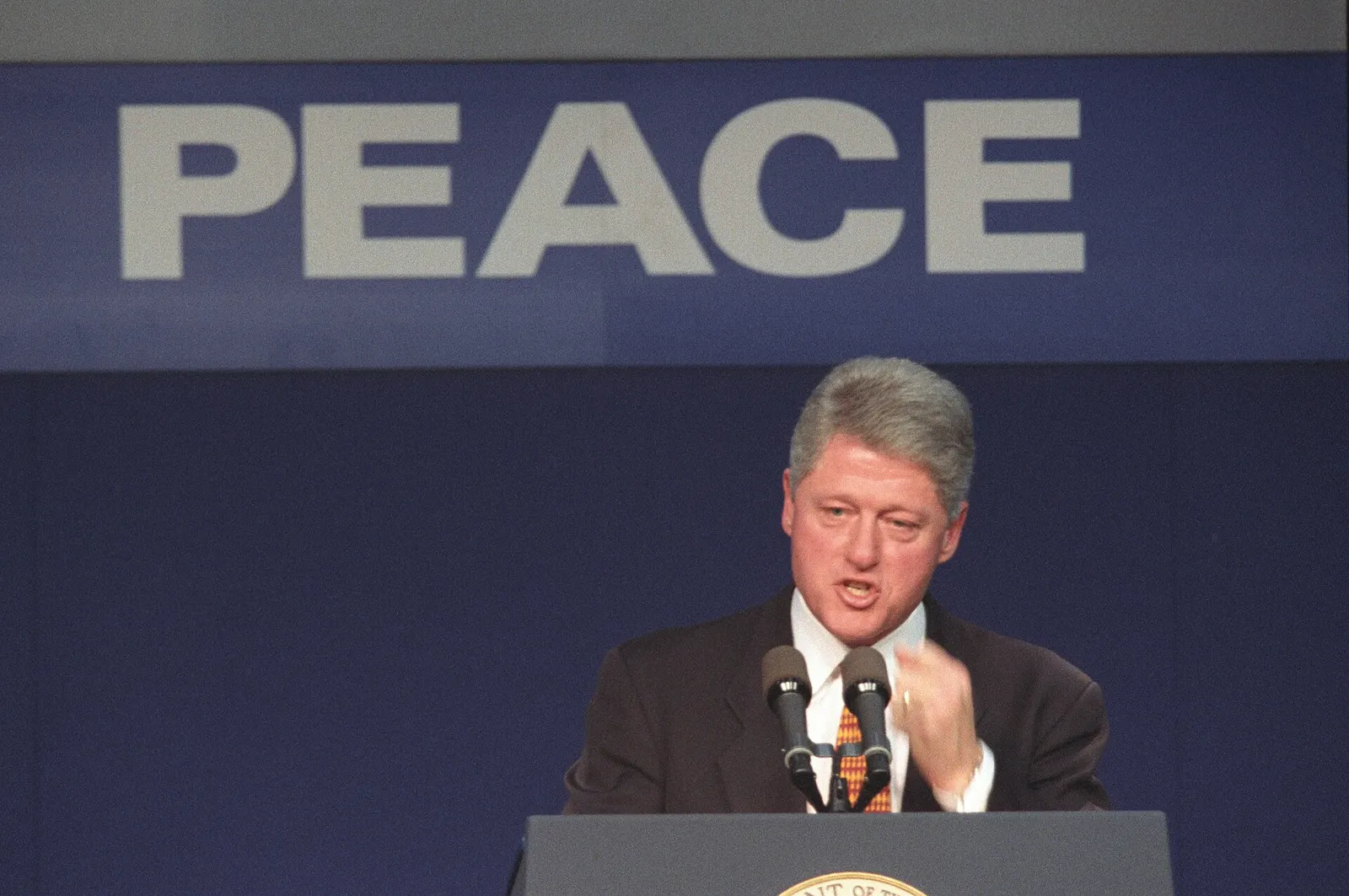
Following the expected passage of the bill by the Senate, the final hurdle will be whether or not President Clinton will sign the bill into law. Regarding this expectation, McManus is quite specific, saying, "I very much hope that it is passed. I do not know if the president will sign it, but if he does not, it will not be because MacBride is contained in the legislation."
Concluding, McManus said that in the event the bill is not enacted into law at this time, it will be a priority of the Irish National Caucus to see that the MacBride Principles are appended to a bill that will bring the principles to fruition.
How MacBride became law
Father McManus got his outcome, though by a side door. The MacBride Principles became United States law in October 1998, when the House and Senate folded them into the Omnibus Appropriations Act for fiscal year 1999 and President Clinton signed it. The law requires anyone receiving American contributions to the International Fund for Ireland to comply with the principles. Washington had been putting roughly $19.6 million a year into the fund since 1986, so the condition had teeth.
The principles themselves were older than the campaign that made them famous. New York City Comptroller Harrison J. Goldin drew them up in the early 1980s and launched them for the city in November 1984. They were endorsed by four Irish public figures, two Catholic and two Protestant; the best known was Seán MacBride, a founder member of Amnesty International and winner of the 1974 Nobel Peace Prize, whose name they took. The nine points ask employers to recruit from under-represented religious groups, protect minority workers going to and from work, ban provocative emblems on the shop floor and report annually on progress. Eighteen states and more than forty cities adopted them.
The other players in this story kept at it. The Irish National Caucus, which Father McManus founded at a meeting of the Ancient Order of Hibernians on 6 February 1974, issued a report in 2003 arguing that Catholics in Northern Ireland were still more likely to be unemployed and less likely to hold managerial jobs. Ben Gilman, the New York Republican McManus thanked here, chaired the House Foreign Affairs Committee from 1995 to 2002, left Congress in January 2003 after redistricting broke up his district, and died on 17 December 2016, aged 94.
Northern Ireland's own law moved in the same years. The Fair Employment and Treatment Order 1998 took effect in 1999, and complaints now go to the Equality Commission for Northern Ireland.
Questions readers ask
What are the MacBride Principles?
The MacBride Principles are nine fair-employment guidelines for US companies doing business in Northern Ireland, aimed at ending discrimination against Catholics and other under-represented groups. They cover recruitment, workplace security, the banning of provocative emblems, fair layoffs, training and annual reporting. Drawn up by New York City Comptroller Harrison J. Goldin and launched in November 1984, they are named after Nobel laureate Seán MacBride.
When did the MacBride Principles become US law?
The MacBride Principles became US federal law in October 1998, as part of the Omnibus Appropriations Act for fiscal year 1999, which President Bill Clinton signed. The law requires recipients of US contributions to the International Fund for Ireland to comply with the principles. Earlier that year, on 26 March 1998, the House had approved them as part of a foreign affairs reform bill.
Who was Seán MacBride?
Seán MacBride (1904 to 1988) was an Irish republican activist, politician and diplomat, Minister for External Affairs from 1948 to 1951, a founding member of Amnesty International and the son of Maud Gonne and Major John MacBride. He was awarded the Nobel Peace Prize in 1974 and the Lenin Peace Prize for 1975 to 1976. He was one of four Irish figures, two Catholic and two Protestant, who endorsed the fair-employment principles that carry his name.
Which US states have adopted the MacBride Principles?
Eighteen states have passed MacBride Principles legislation: California, Connecticut, Florida, Illinois, Kentucky, Maine, Massachusetts, Michigan, Minnesota, Missouri, Nebraska, New Hampshire, New Jersey, New York, Pennsylvania, Rhode Island, Texas and Vermont. More than forty cities have also passed or endorsed them. The state laws typically steer public pension investments toward companies that endorse the principles.