Reflections on seeking peace
Three weeks before Good Friday 1998, a columnist watches Clinton fail to get Trimble and Adams to shake hands, then turns to a death in his own family.
As printed in the Celtic Mirror, April 1998
Now that the fine cutlery in the banquet halls has been washed and polished, it is money time for the peace process in Northern Ireland.
The week of St. Patrick's Day saw a plethora of Irish politicians descend upon American soil for various purposes. Pitching their policies for peace, lobbying for support and soliciting United States dollars, members of Sinn Fein, the Social Democratic Labour Party and the Ulster Unionist Party toured Washington and some other East Coast cities. All the power players, with the exception of Tony Blair, were stateside in what likely will be their final visit until after a settlement is realized. And as all who have cared to follow the development of the process well know, the stakes are enormously high.
While in Washington, Martin McGuinness remarked that the next six weeks may be the most important in Irish history, and the Sinn Fein lead negotiator cannot be off the mark with that assessment. Now that the Irish and British governments have earmarked Easter as the deadline for a settlement, the coming weeks are sure to be chock-full of high drama in Belfast.
Yet it is hard to imagine this precarious process, in which so many have sacrificed risk and effort, as culminating positively when one man will not shake the hand of another.
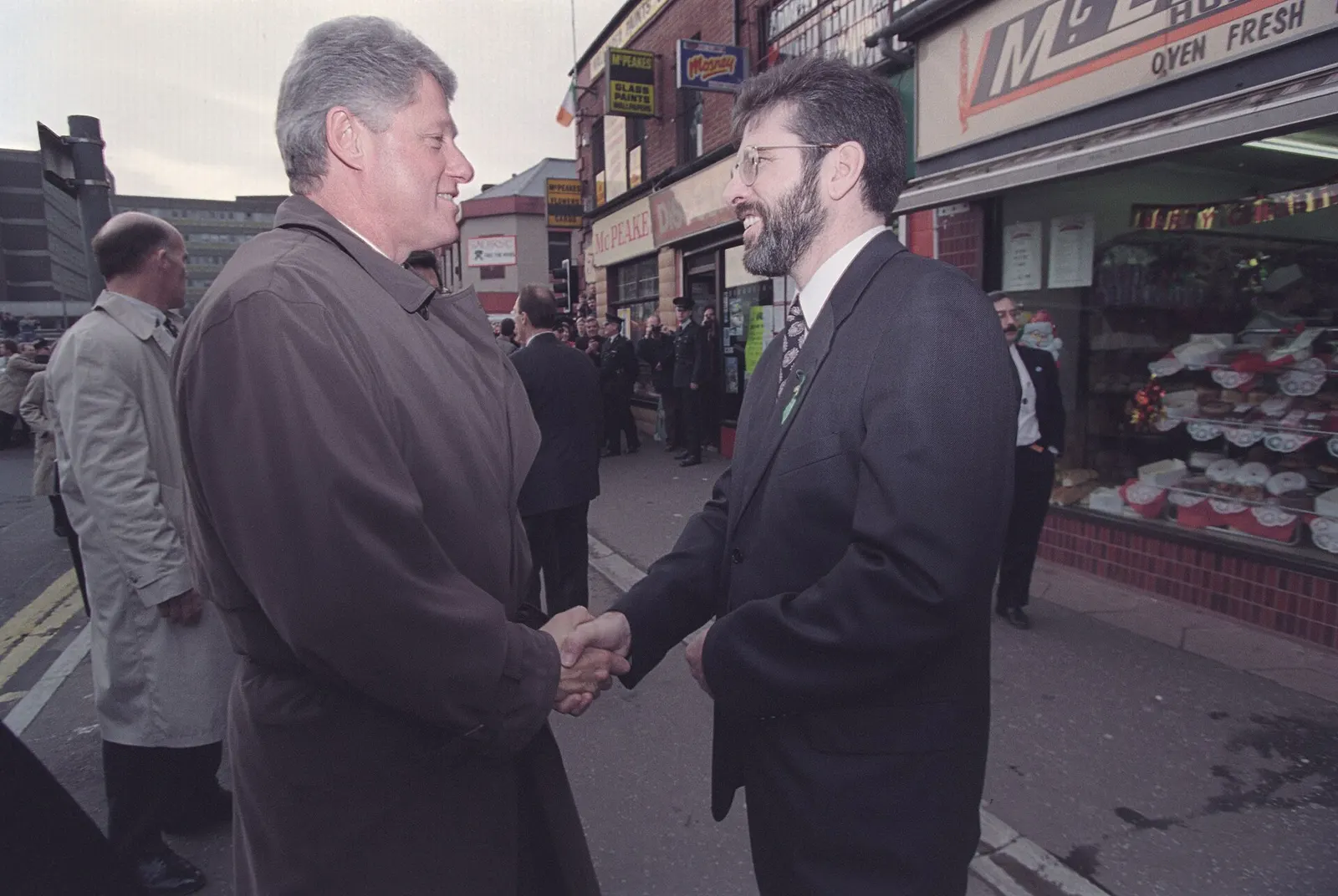
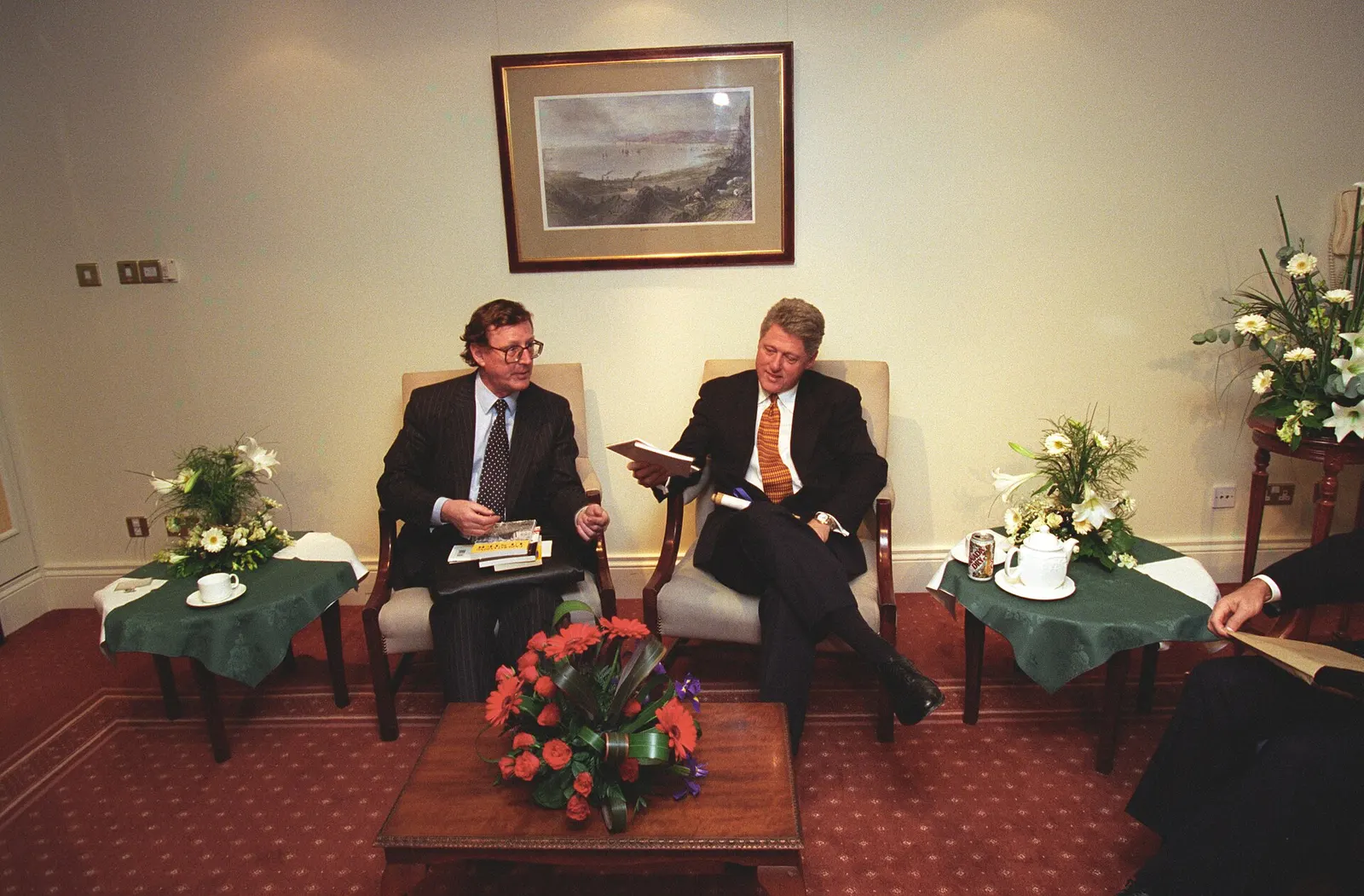
Such were the high jinks that played out in the White House on March 17, as President Clinton tried mightily to cajole David Trimble into shaking the hand of Gerry Adams. On three separate occasions, Clinton saw to it that the leaders of the UUP and Sinn Fein were not just at the same social events, but in close proximity to one another. All was in place for a dramatic moment as the media hovered close, waiting to pounce if a palm exchange of monumental proportions went down.
Yet it was all for naught. Though Adams and Trimble were an arm's length apart, they did not even exchange trite pleasantries, let alone an emphatic high five.
One can only imagine the number of blown strobes in that room if Adams and Trimble had shimmied close to one another, set down their cups of punch, and executed a perfect high five.
I do not mean one of those banal, pallid pops - one of those deals we see in football games or, better yet, in performances by members of the World Wrestling Association. I mean leaps into the air, with forearms to chests to show solidarity, and a little shake of the hips and duck walk as they went their separate ways!
If that had happened, the recent efforts of Kofi Annan would have been given some serious competition by those of William Clinton when it came time to fire up the engraver to scribe a name on the Nobel peace prize.
Oh, well, back to reality - and it is a reality that the hearts and wishes of Irish America so desire a peace in the tortured North of Ireland. As evidenced by the overwhelming support of American citizens during the visits of Irish politicians, the ever-present and growing Irish-American lobby and the consideration that the Clinton administration has given the Irish question, there can be no denying that many of the mechanisms for peace are in place.
And while it is "now or never," it is my belief that the visionaries in Ireland will triumph over the reactionaries. Gerry Adams, John Hume, David Ervine and now Tony Blair - they will provide the impetus for a permanent change that is fair to all.
The word out of the White House is that Clinton leaned hard on Trimble during the rounds of meetings with the leaders of the respective parties - and well he should have. While there are reasons aplenty for Trimble's refusal to negotiate with the republicans, the time and reality of the moment beg for Trimble to take that radical step. It is incumbent upon him, as the leader of the largest Protestant party in Northern Ireland, to show a willingness to compromise. The Adams-McGuinness faction did so beginning years ago when they began to implement the dynamic for the republican movement to consider an alternative to the armed struggle.
Sooner or later, Trimble will have to jump into the sea of conflict with his convictions in tow, and sink or swim.
The next few paragraphs concern a personal matter. Any who make use of the pen or the keyboard know well that there are certain times in one's life when events necessitate such expressions. Call it chicken soup for the writer's soul.
"Life is too short." If I only had a quarter for every time I've heard that said, I guarantee I would not be tooling around in a 1993 Dodge. Why, if I had a little silver for every time my Dad spoke those words to the brothers McCormick on Walnut street, I wouldn't be writing this right now. I'd be pulling on Mickey's ears in the land of Disney - permanently.
Recently, I learned that Dad was right. Yes, it is humbling sometimes to admit to these things. I recall times when my parents would be chastising us for this or that, and I would defiantly swear that I was gonna be a cool parent when I had children. Yeah, right! So you know, when my girls are doing the two-step on the coffee table and I tear into the room full of parental admonitions - I get drilled with a seismic shot of total recall. Where previously have I heard these words that now tumble so effortlessly from my mouth? A dash to the closest mirror is warranted on occasion.
Back to the point, prior to my digression.
My wife's mother passed away suddenly on March 16. This loss I have dreaded, for more than the obvious reasons of the accompanying grief that manifests itself in our lives when we lose a loved one.
It would be a vast understatement to call my wife's relationship with her mother a close one. At times that relationship - I must admit - was a source of chagrin in our house.
Every night at 9:30, like clockwork, my mother-in-law would phone our house to speak with Millie. If the line was busy, then hell had no fury like a mother-in-law pounding the redial for 15 minutes. The ensuing interrogation, if I was lame enough to answer the next ring - which would come 1.25 seconds after the plastic hit the cradle - would make Kenneth Starr seem like a barfly.
So it was that, weather permitting, my wife would visit her mother every day. She had been a widow for the last 13 years, and Millie left no stone unturned in ensuring that "Mommy" was okay. Every day.
Somewhere in the witnessing of this relationship was born a fear, which dwelled inside of me like a cobweb. I was quite frightened that when the day came that my mother-in-law passed from this world, Millie would not be able to cope. The fierce love she had for her mom, I had decided, would render her incapable of coping with that loss.
I was wrong.
If it is possible - if it can be possible - to stuff the mystifying lesson of how to handle death into a shell, then my wife has done so with a remarkable poise that is rooted in love and dedication, and the volumes it speaks for those who take the time and effort to exercise such. Leave it on the shelf for too long, and time will assure that something will grow stale.
The passing of "Big Millie" will leave a void in our lives that cannot be filled. Memories are not meant to be replaced. They are inspirations of what someone has left us - that being the indelible imprint left on our lives by the presence of that someone.
Yet these words, spoken late one night recently, are to me worth their weight in gold: "I loved my mom with everything I had ... and she knew that I did. Because I told her so ... every day."
No regrets. I guess the only assurance we have in life is that we get only one shot. These last two weeks have made me realize that I am a lucky man indeed. And as I tried to grasp a leaf, a singular thought that would express my feelings, I kept returning to the U2 song "One." It is a song written to symbolize the emptiness of a life without love and relationship - a moving testament to the sustenance they give us if we take the time to nurture them.
It speaks of love between parent and child, between spouses or lovers, between close friends. It is when we dispense with the trivial matters that sometimes beckon our souls and turn to others. Only then are we whole.
Easter came
Martin McGuinness was right about the six weeks. The Easter deadline held, just. The multi-party agreement and the British-Irish agreement were signed in Belfast on Good Friday, 10 April 1998, and on 22 May voters approved them in two referendums: 71 percent in favor in Northern Ireland on an 81 percent turnout, 94 percent in the Republic.
Our columnist's joke about the Nobel engraver turned out half right. The 1998 Nobel Peace Prize went in October not to Bill Clinton but to John Hume and David Trimble, the man he wanted to see jump into the sea. Kofi Annan got his own three years later, in 2001, shared with the United Nations.
Trimble did jump, and the water was cold. He was elected First Minister on 1 July 1998 and spent the next years fighting his own party over IRA decommissioning; he resigned as First Minister on 1 July 2001 over the delay, though he was later re-elected. The anti-Agreement DUP overtook his Ulster Unionists in the 2003 Assembly election. In 2005 he lost his Westminster seat in Upper Bann to the DUP and resigned the party leadership. He took a life peerage in 2006 and died on 25 July 2022. The IRA, for its part, declared its arms beyond use in September 2005.
Of the visionaries named here, John Hume died in Derry on 3 August 2020, after years with Alzheimer's disease. David Ervine, the loyalist who had helped deliver the 1994 loyalist ceasefire, died in January 2007. Martin McGuinness, who later served as deputy First Minister beside Ian Paisley, died in 2017. Gerry Adams stepped down as Sinn Féin president in 2018.
We have printed the column's personal closing as written, apart from the U2 lyrics it ended on, which belong to the band and not to this archive. Readers know the song.
Questions readers ask
When was the Good Friday Agreement signed?
The Good Friday Agreement, also called the Belfast Agreement, was signed in Belfast on Good Friday, 10 April 1998. It combined a multi-party agreement among most Northern Ireland parties with an agreement between the British and Irish governments. Voters approved it in referendums on 22 May 1998, with 71 percent in favor in Northern Ireland and 94 percent in the Republic of Ireland.
Who won the Nobel Peace Prize for the Northern Ireland peace process?
The 1998 Nobel Peace Prize was awarded jointly to John Hume, leader of the SDLP, and David Trimble, leader of the Ulster Unionist Party, for their efforts to find a peaceful solution to the conflict in Northern Ireland. The Norwegian Nobel Committee recognized Hume as an architect of the Good Friday Agreement. Hume died on 3 August 2020 and Trimble on 25 July 2022.
Why did David Trimble resign as First Minister in 2001?
David Trimble, elected First Minister of Northern Ireland on 1 July 1998, resigned on 1 July 2001 because the IRA had not met his demands to decommission its weapons, which he said all parties had committed to in the Good Friday Agreement. The office had already been suspended from February to May 2000 over the same issue. He was later re-elected, and the IRA completed decommissioning in 2005.
When did the IRA decommission its weapons?
The Provisional IRA carried out rounds of decommissioning in October 2001, April 2002 and October 2003, announced the formal end of its armed campaign in July 2005, and on 26 September 2005 it was announced that its whole arsenal had been put beyond use. The Good Friday Agreement had set May 2000 as the target for full paramilitary disarmament, a date that was missed.