Symons Says: Is there an easier way to get to cyberspace?
Tommy Symons weighs up buying a computer, then turns to what he really cared about: the Molly Maguires, the coal towns and the friends keeping their story alive.
As printed in the Celtic Mirror, November 1995
As much as I hate to admit it, me tinks I need a computer.
Now, I'm not one to quickly jump on the bandwagon of every new-fangled contraption that comes out. Why, I still have 8-track tapes and a player sitting around, but I think this would be a good move.
In the past month, I have talked to more people who are expanding their horizons through the wonders of cyberspace.
When I stop in the offices of An Scathan, I can usually con Hugh Dougherty into entertaining me with a display of his wizardry on the keyboard.
There are a few things that confuse me though. Megabyte. Isn't that what the teacher of your young lad talks about in the note she sent home?
"Your son really took a megabite out of Joey's arm today!"
What about a gig? I thought that's what a band did when they played music. Let's not forget E-mail. That's what you say at the end of the month when the bills come in. "Eeee-mail!" I still don't know what a sloppy disk is, and I'm trying to get rid of a mouse all summer. Why should I go out and buy another one?
Oh well, maybe I can wait a bit longer yet, the yard sales start up again in the spring.
I have some Molly Maguire news to pass along to you this month. I recently spoke to Mike "Mickey" Doyle of Danville, Cal., and he is starting an Internet World Wide Web page on the Mollies.
He tells me he has received requests from all over the country for information concerning descendants and other history.
Good luck on this venture, Mick, we can't let this be forgotten.
Originally from Mahanoy City, he welcomes anyone to contact him.
On October 28th, Innisfree Productions staged its play, "Spirit of the Molly Maguires," at the Opera House in Jim Thorpe, Pa. to a full house. Dealing primarily with the Carbon County "Mollies," this play gives you an insight into the mood of the region in that era along with how the families suffered and managed to keep going through the good times and bad.
Eric McGeever, author of "Tales Of The Mine Country," who attended that evening, calls the play "deeply moving... and would be of keen interest to anyone with ties to the history of mining."
There are plans being formulated to present a Schuylkill rendition in the summer of 1996 in the Pottsville area. Hats off to Genia Miller, playwright/director/actress on a job well done.
In a related matter, Eric McGeever is currently in the process of securing a date for a "National Miners Day." Pennsylvania celebrates it on Labor Day, but there is currently none set aside nationally. Stay tuned for more information on this.
I received a letter from a Mr. Paul Quigley of Wynnewood, Pa. asking for help in locating some of his ancestors. He is looking for relatives of James Larkin, a miner who lived in Branch Township, Schuylkill County, at the time of the 1850 census. His wife was Bridget Cavanaugh.
A tip of me shillelagh to Tobyhanna Township in Northeast Pennsylvania for adopting the MacBride Principles. Thanks to the efforts of Councilman Terrence Patrick Rielly, Pottsville, Pa., cities across the commonwealth are becoming aware of the Principles and the legislation passed in Pottsville this past March.
It's one step at a time, but it will all add up in the end.
Congratulations to an old friend, Tom Slattery, who was honored recently with the Tir na nOg Award from the Bucks County Irish Center. Tom was very influential in convincing me to pursue writing along with helping "Flash" and myself in the beginnings of the "Orange And Green Radio Show."
A great storyteller, a good wit, and a better friend would be hard to find anywhere. Once again, congratulations, Tom.
A special hello to a new reader of this column, Peter Malloy, down in Jacksonville, Fla. I'm looking forward to speaking with you soon.
As usual, when I get to this part of me column, I rack me brain to think is there anything I forgot. It's like leaving on a 300-mile trip, getting halfway there, and wondering did you turn the stove off. I'm going to stop, get another cup of coffee, and have a smoke. I'll be right back.
Ahh! That did it! I call this my seventh paragraph stretch. (How many of you went back to count the paragraphs? I did.)
Before I close, I wanted to thank each and every reader who sent back their An Scathan reader survey cards. I'm honored by some of the comments and hope to continue to entertain you for many an issue. Thanks again.
Until next month, have a happy Thanksgiving, go easy on the turkey, enjoy the family get-togethers, and safe home from wherever you travel. God bless.
A note on the column
Tommy Symons wrote from the anthracite country of Schuylkill County, and his column was a noticeboard as much as an essay: who was ill, who had a play on, who was looking for a great-grandmother in the 1850 census. We print it as he wrote it, minus a home address and an e-mail account that belonged to a private reader thirty years ago.
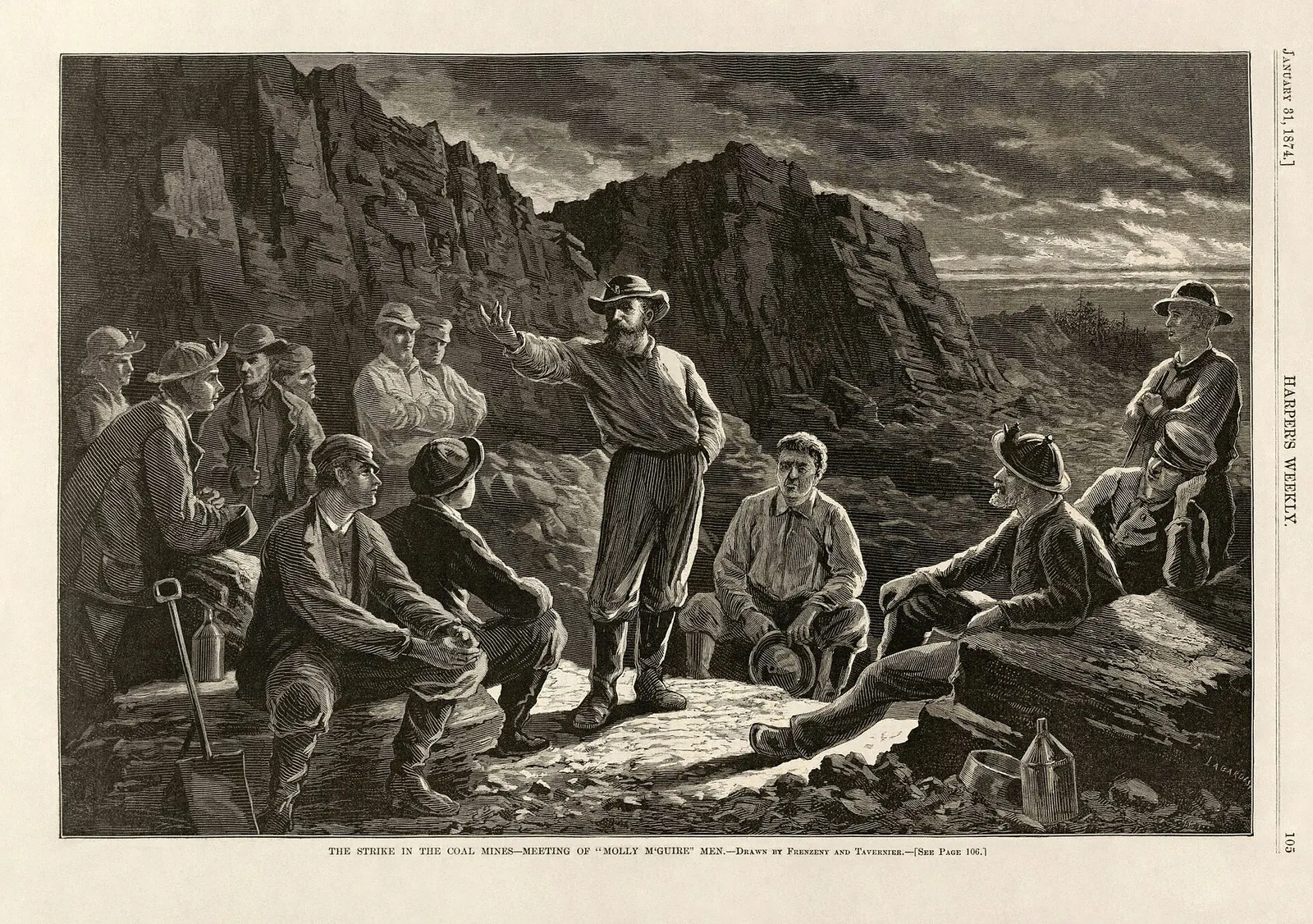
The joke about megabytes has aged into a period piece. The subject underneath it has not. The Molly Maguires were the reason Symons kept writing, and the history behind them is grim and well documented. After years of violence in the coal fields, twenty men accused of belonging to the society were convicted and hanged. On 21 June 1877 six were executed in the prison at Pottsville and four at Mauch Chunk, the Carbon County seat that renamed itself Jim Thorpe in 1954, which is why the 1995 play could be staged so close to the old jail.
The best-known name among them, John "Black Jack" Kehoe, protested his innocence to the end. In 1979, after a descendant asked for a review, the Pennsylvania Board of Pardons examined his trial and Governor Milton Shapp granted him a posthumous pardon. Hollywood had already found the story: The Molly Maguires, released in 1970, starred Sean Connery as Kehoe and Richard Harris as the Pinkerton agent James McParland.
The other cause in this column did better than Symons might have guessed. The MacBride Principles, nine fair-employment rules for American companies operating in Northern Ireland, were passed by eighteen states, Pennsylvania among them, and by more than forty cities. In October 1998 Congress wrote them into federal law in the omnibus appropriations act for fiscal 1999, tying American contributions to the International Fund for Ireland to compliance. One step at a time, as he said.
We could not confirm from a reliable source whether Eric McGeever's national Miners Day campaign ever produced a fixed date, so we leave it as he left it: stay tuned.
Questions readers ask
Who were the Molly Maguires in Pennsylvania?
The Molly Maguires were an alleged Irish secret society active among Irish immigrant coal miners in the Pennsylvania anthracite fields, linked to violence during bitter labor disputes of the 1870s. Twenty suspected members were convicted of murder and other crimes and hanged in 1877 and 1878, ten of them on 21 June 1877. Testimony from Pinkerton agent James McParland helped send ten men to the gallows. Historians still debate the facts.
Was Jack Kehoe of the Molly Maguires pardoned?
John "Black Jack" Kehoe, hanged as a leader of the Molly Maguires, received a posthumous pardon in 1979 from Pennsylvania Governor Milton Shapp. The request came from one of his descendants, and the Pennsylvania Board of Pardons recommended it after reviewing his trial and the circumstances around it. Kehoe had maintained his innocence until his execution. Sean Connery played him in the 1970 film The Molly Maguires.
Where were the Molly Maguires hanged?
On 21 June 1877, six men were hanged in the prison at Pottsville, Schuylkill County, and four in the Carbon County jail at Mauch Chunk, the town now called Jim Thorpe. Ten more executions followed over the next two years at Mauch Chunk, Pottsville, Bloomsburg and Sunbury. Militia with fixed bayonets surrounded the prisons on the first day, while miners' families walked through the night to be there.
Are the MacBride Principles federal law?
The MacBride Principles became US federal law in October 1998, when Congress included them in the Omnibus Appropriations Act for fiscal year 1999 and President Clinton signed it. The law requires recipients of American contributions to the International Fund for Ireland to comply with the nine fair-employment principles. Eighteen states, including Pennsylvania, New York and California, and more than forty cities have also adopted them.