Sinn Fein leader accuses British of missing opportunity for peace: IRA arms issue stumbling block
Eleven months into the IRA ceasefire, a young Tyrone republican told a Pennsylvania AOH hall that London was stalling over guns, prisoners and talks.
As printed in the Celtic Mirror, August 1995
With the first anniversary of the IRA cease-fire in Northern Ireland and subsequent peace negotiation approaching on Aug. 30, top Sinn Fein officials are stepping up efforts to fully join the peace process.
“The British are squandering a unique opportunity for peace in Ireland,” said Barry McElduff, Sinn Fein peace monitor and legal executive, in a straightforward address to a packed crowd of listeners at the Pottsville, Pa. AOH headquarters.
McElduff said the peace process in Ireland is an Irish nationalist creation and accused the British government of begrudging that process.
McElduff is currently in the United States with a visa for a speaking tour throughout the Northeast. He is one of several Sinn Fein representatives to visit this side of the Atlantic Ocean since fund-raising efforts by the party were permitted in March.
Karen Clifford, with Sinn Fein's Washington office, said since the office opened, several party officials have visited the United States including party President Gerry Adams.
Martin McGuinness, Sinn Fein's top negotiator in the Northern Ireland peace process, is scheduled to visit the United States in September, according to published reports.
A visit had been scheduled for earlier this summer, but was postponed.
McElduff said the British government continues to militarize Northern Ireland in spite of his party's quest for peace.
“When the IRA called the cessation, there was no forgetting the sacrifice of 25 years - the IRA was an undefeated IRA. They were saying ‘get on with it. Go about your business building peace in Ireland,’” he said.
McElduff said the British government was not ready for peace when the cease-fire was called.
“When the IRA put out its statement and stunned a lot of people, the British government wasn't happy,” McElduff said. “They said they wanted to hear the word permanent.”
He said the IRA would only call the cease-fire permanent when Britain leaves Ireland.
He accused the British government of stalling the process by insisting on the decommissioning of arms and explosives by the IRA.
“The reality is there won't be any unilateral unarmament,” McElduff said.
However, top British officials have said Sinn Fein would not be allowed to participate in all-party talks on the future of Northern Ireland unless the IRA disarmed.
According to one top British official, all guerrillas must relinquish their weapons, otherwise the mainstream Protestant political parties will boycott all-party talks.
McElduff said Sinn Fein does want to remove the guns from Irish politics, but quoted an Irish priest: “Why should the Irish give guns and explosives to the British government when they have enough already?”
McElduff said the important fact for now is that the guns are underground and have been silent for the past 11 months.
McElduff said his party believes peace in Ireland is not just the absence of IRA gunfire, but the removal of injustices as well. “That's what we're about. We are not about a phony peace. We are about a real, durable lasting peace,” he said.
McElduff said the status of republican prisoners needs to be addressed.
There are more than 600 IRA political prisoners jailed in Ireland and England, according to McElduff.
He said the prisoners are being held in deplorable and deteriorating conditions that have gotten worse since the cease-fire.
British officials said all prisoners have been fairly tried and convicted and must serve the sentences handed down.
The Irish government has released IRA prisoners, and has urged the British government to do the same.
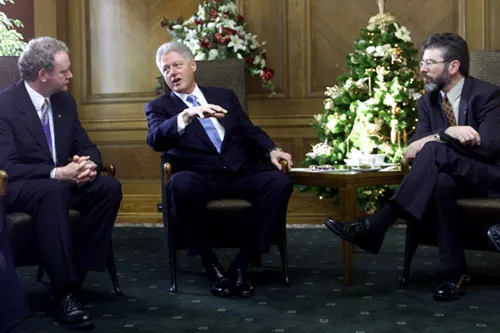
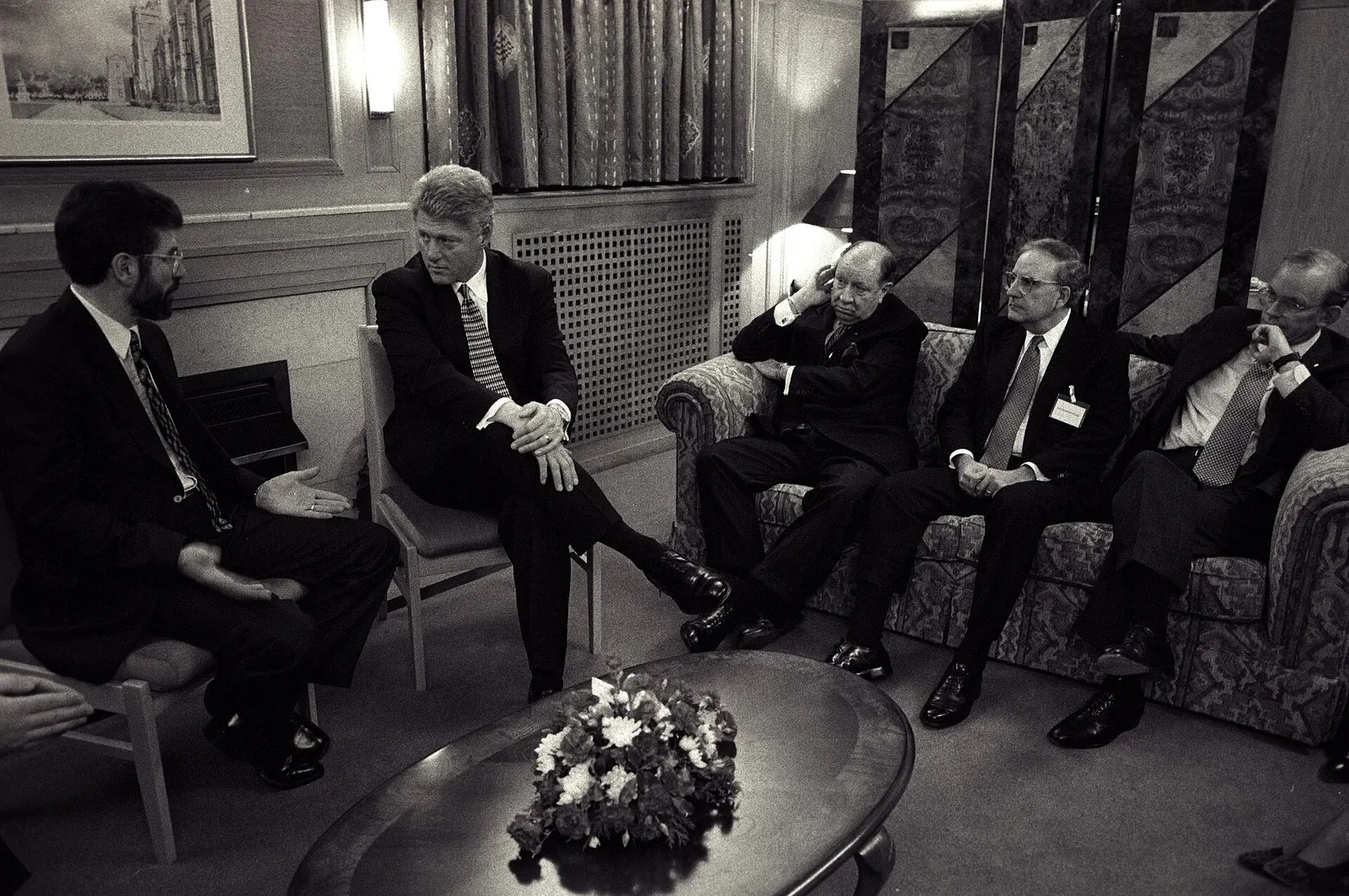
The White House is also pressuring the British to release IRA prisoners and include Sinn Fein in all-party talks.
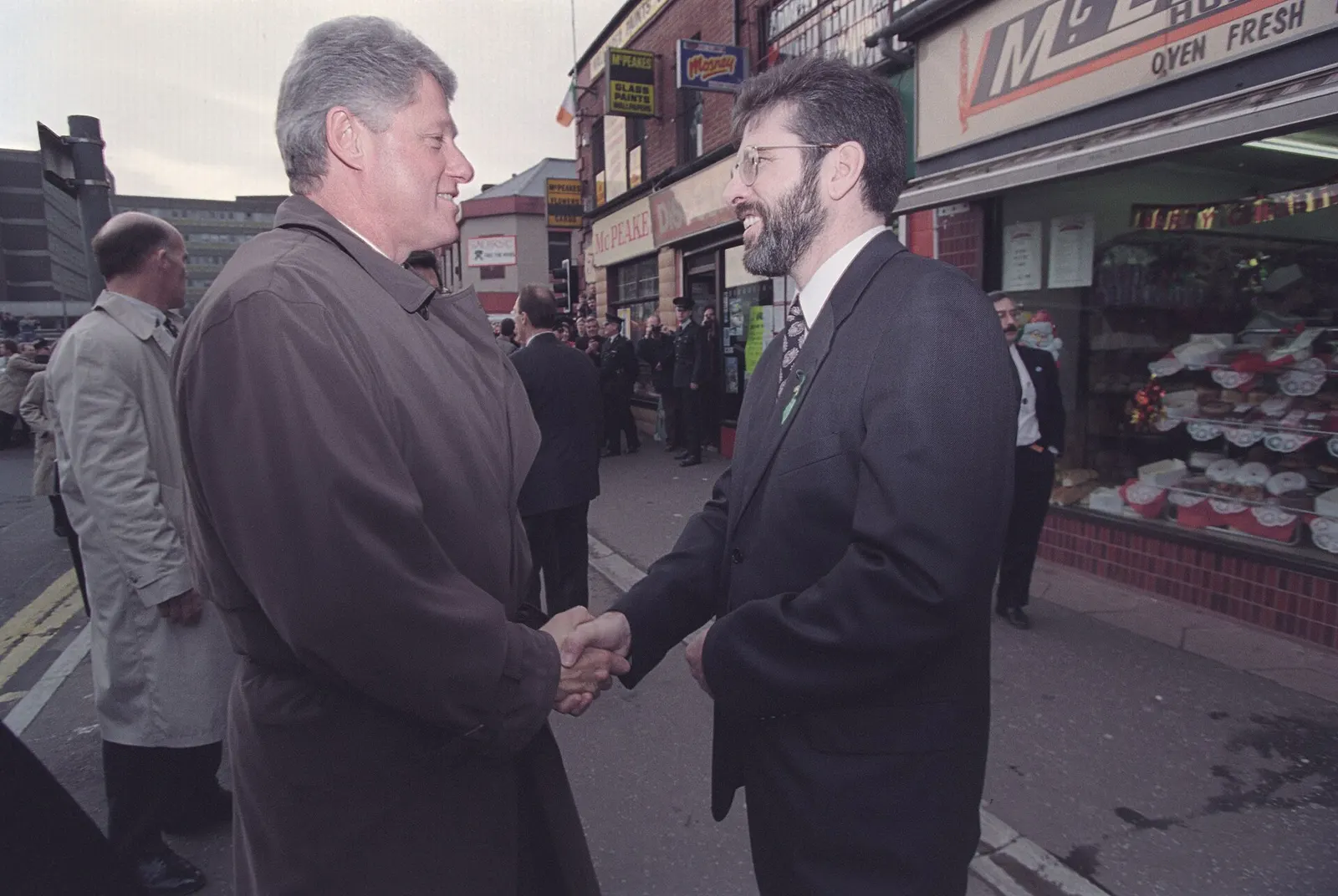
President Bill Clinton said that releasing political prisoners is “a way of helping the process of healing and reconciliation.”
Clinton is scheduled to visit Ireland, Northern Ireland and Britain in December. In an interview with the Irish Times newspaper, he said: “Naturally I would be pleased if talks were underway by the time I visit Northern Ireland and I know that the Irish and British governments are committed to finding a way to remove any impediments.”
In describing the atmosphere in Northern Ireland, McElduff accused the Royal Ulster Constabulary police force of “living in the dark old days” of storming houses with heavy arms, and bullying the people.
“When the RUC are kicking in your door there is no stigma; there is a badge of respect and follow-up by neighbors to see if everything is OK,” he said. “The community knows what the RUC is about. We hold political prisoners in the highest esteem.”
He said police authorities continue to use plastic bullets and are expanding barracks.
“The Brits are seeking our surrender. Surrender is something the Brits will never ever get from Irish republicans. We are determined to get peace in Ireland, but it will be a peace with dignity and justice, an honorable peace settlement. The IRA has fought for 25 years against the military and economic targets.”
McElduff said his main reason for touring the United States is to encourage U.S. citizens to lobby officials to support the peace process in Northern Ireland.
He said that maximum pressure needs to be exerted through President Bill Clinton on the British government for all-party peace talks.
“We demand constitutional change and an end to legal partition of our country,” McElduff said.
He said the Unionist majority should not have the right to block progress.
However, he said the Unionists should have a significant say in the shape of a new structure.
“The door is ajar for Unionists. We are doing everything in our power to encourage Unionists to take their place at the conference table,” he said.
After the ceasefire
The deadlock McElduff described in Pottsville did not hold, and it did not break cleanly either. Clinton came earlier than this story expected: on 30 November 1995 he spoke at a rally outside Belfast City Hall in support of the process. In January 1996 the Mitchell Report set out six principles that parties would have to accept to join all-party talks, a way around the demand for weapons first.
It was not enough. On 9 February 1996 the IRA announced the end of its ceasefire and, an hour later, bombed London Docklands. The cessation was restored on 20 July 1997, and Sinn Féin entered the talks that produced the Good Friday Agreement on 10 April 1998. Voters on both sides of the border endorsed it on 22 May 1998.
The two issues in this article were settled inside that deal. The prisoners McElduff counted were released early under the Northern Ireland (Sentences) Act 1998; the last group walked out by 28 July 2000, bringing the total to 428. The guns took longer. The IRA declared an end to its armed campaign on 28 July 2005, and the international decommissioning body confirmed in September 2005 that all its weapons had been put beyond use. The RUC he complained about was replaced by the Police Service of Northern Ireland on 4 November 2001.
Martin McGuinness, whose American trip was postponed that summer, later served as deputy First Minister of Northern Ireland from 2007 until January 2017. He died on 21 March 2017.
McElduff himself sat in the Northern Ireland Assembly for West Tyrone from 1998 to 2017 and won the Westminster seat in June 2017. His time there was short. In January 2018 he posted a video of himself with a Kingsmill loaf on his head on the anniversary of the Kingsmill massacre, in which the IRA killed ten Protestant civilians in 1976. Sinn Féin suspended him and he resigned the seat on 15 January 2018. He later returned to local politics on Fermanagh and Omagh District Council.
Questions readers ask
When did the IRA ceasefire end in 1996?
The IRA ended its August 1994 ceasefire on 9 February 1996, announcing the move about an hour before a bomb exploded in London Docklands. The ceasefire was renewed on 20 July 1997, which allowed Sinn Féin into the talks that led to the Good Friday Agreement in April 1998.
When did the IRA decommission its weapons?
Decommissioning was the main stumbling block from 1994 onward. The IRA announced the end of its armed campaign on 28 July 2005, and in September 2005 the Independent International Commission on Decommissioning confirmed that all IRA weapons had been put beyond use, more than seven years after the Good Friday Agreement.
How many prisoners were released under the Good Friday Agreement?
The Northern Ireland (Sentences) Act 1998 received royal assent on 28 July 1998. By October 1998 167 prisoners had been freed, 308 by December 1999, and the final group was released by 28 July 2000, a total of 428 paramilitary prisoners from groups that maintained their ceasefires.
Why did Barry McElduff resign as MP?
Barry McElduff, Sinn Féin MP for West Tyrone from June 2017, posted a video in January 2018 showing a Kingsmill loaf on his head on the anniversary of the 1976 Kingsmill massacre. After widespread criticism Sinn Féin suspended him for three months, and he announced his resignation from Westminster on 15 January 2018.