Visiting Morgan Llywelyn's World: Famed Irish author discusses her writings during exclusive interview
Over lunch in Philadelphia, Morgan Llywelyn explained why she told the Easter Rising through a fictional Titanic survivor, and promised two sequels.
As printed in the Celtic Mirror, March 2003
Midway through a grueling 3-week, 12-city tour to promote her new novel, "1916," famed Irish author Morgan Llywelyn took time out of her busy schedule to enjoy a leisurely lunch with this interviewer and some friends at Finnigan's Wake in Philadelphia. After lunch, we adjourned to the solitude of the Quiet Man Pub at Finnigan's, where Llywelyn spoke candidly about her work and especially about "1916."
"I had been thinking for a long time about the events of 1916 because it is so central to contemporary Ireland; it shaped what we are now. Ten years ago my publisher, Tom Doherty, asked me to do a book on the Rising, but I told him then that I didn't know enough, that I wasn't prepared - the research would be daunting. I didn't think I was a good enough writer."
Once Llywelyn started thinking about the challenge, however, she started researching for her own benefit, as much because she wanted to understand the event as for any other reason. "The more I read about the Rising and the people involved, the more I realized how drastically the last 30 years of revisionist history has altered what should have been our proudest moment, and how it had been disremembered. The more I learned about the men involved, the more I realized Ireland had won her independence as a result of a conspiracy of poets. They were undoubtedly among the most extraordinary people we have ever produced. So I wanted to put together a coherent linear examination of that time, and because I am a novelist I decided that it would be better to do it through the medium of the novel than try to write a nonfiction history.
"This is a story in every sense of the word, and my admiration for the people involved was such that I really didn't want to use any of them as my protagonists. I thought it would be more effective to have fictional protagonists who among them represented all of the various classes of Irish society who were involved. Let these be the people the reader could empathize with and watch through their eyes the individuals who actually fueled the Rising."
Many writers of historical fiction seem to write fiction fused with a pinch of history. They write the novel as history, whereas Llywelyn's approach is to write history as a novel. The history comes first. She does not change it, nor does she slant it to fit a particular point of view.
"If a piece of history, if an episode, event, or series of events, is exciting enough to tell, I think it is exciting enough to tell as it happened. So it is the history I'm telling. The bones are the history, the story; the fictional characters are the clothing that goes over it. They are part of what carries it along, what I can use to fill in those gaps where we don't know what happened. By writing it as a novel I can credit events that are outside of history and give them a certain sort of reality. For example, in '1916' I can talk about prostitution in Dublin, whereas there is no way I could have an eyewitness account of a prostitute in Dublin in 1916. Yet these women were very strongly involved, many of them in the republican movement, and with a fictional young woman I have a way to show their efforts, their ideas, their contribution.
"But that's not central to my story. The story is always the history that happened - in this book more than in any other I have written, because it is so close to us in time. The book is rather heavily endnoted; they were footnotes originally, because so much of the material was either controversial or had been suppressed due to revisionists. I had access to private papers and journals from the descendants of people who were directly involved. I want the readers to know, yes, this is real. You can trust what this says, and if you wish, you can track my research."
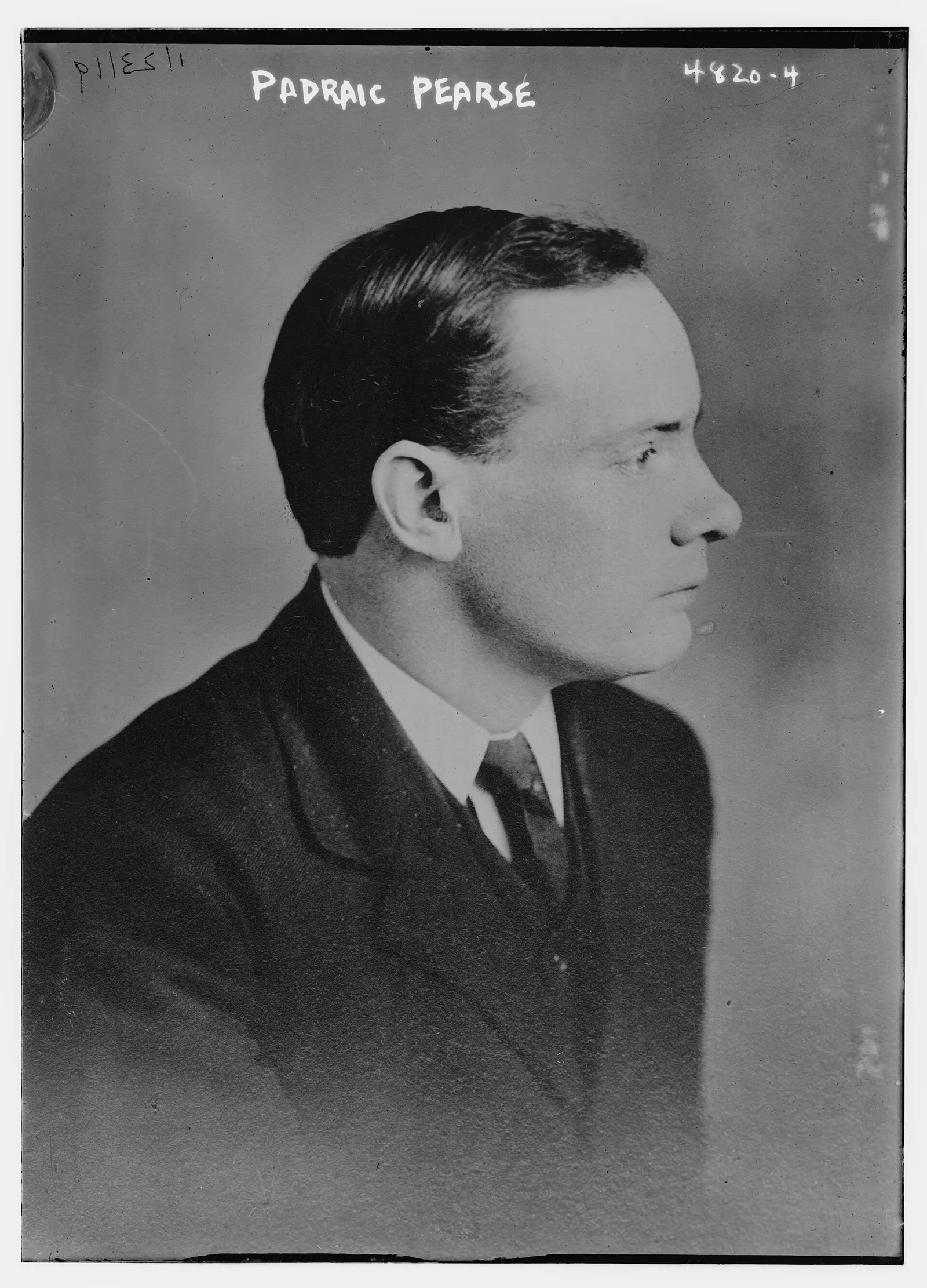
Llywelyn spoke to survivors, and the one who sticks out most in her mind, who impressed her most, was a very elderly man who was the 14-year-old boy who in the book bends over James Connolly's stretcher as he is being carried out of the General Post Office. "Children were involved. Inspired by Padraic Pearse, the boys from St. Enda's, the school Pearse founded, came in and holed up in the Imperial Hotel. These were children too young to fight, yet they did."
The central character of the book is Ned Halloran, who is 15 when the story opens in 1912. He was a passenger on the Titanic and, having survived the sinking, becomes a student at St. Enda's. Laughingly, Llywelyn said, "Pure coincidence. I had no idea that this Titanic phenomenon was going to happen. But it was important to tell the story through St. Enda's.
"Ned is a totally fictional composite of a lot of people I talked to and the journals I read of the boys who had gone to St. Enda's. Because he is 15 at the beginning of the book, I tried to give him the kind of fragmented, moody, changing, up one minute down the next, personality that a teenage boy would have. He is not a clearly defined character, in a way. He is in a state of change. Ned is becoming, and as we go through the book we can watch him becoming something very different than what he started out to be because this event influenced him."
A good bit of Llywelyn's writing is geared to young people because she considers it so important to get young people involved in history. She wants young people to see that history is the most exciting of subjects, that right at this moment we are living history, that history is made by people who are larger than life.
Her books "Strongbow" and "Brian Boru" were published in Ireland for children 8-12 years old and won awards in Ireland and Britain as children's books. When these books were sent to her American agent with an inquiry whether there might be an American market for them, he replied that they could not be sold as children's work, that they would have to be sold in the adult market. "This tells you something about the difference between Irish and American education," said Llywelyn.
When Llywelyn gets an idea for a book, the way she approaches and develops it depends upon where in time the story takes place. With "1916," for example, she started with the hard facts by reading and rereading all the written material she could find. If the events she is to write of took place in an earlier time, she starts with the archaeology, the physical bones. Whichever way she goes about it, once she has a good grasp of what happened, she then goes to the site and spends a lot of time getting the feel of the place so that she can describe where the events actually occurred. She wants the reader to walk with her; to experience what she hears, smells, touches - enough to give a sense of place because a sense of place, especially in Irish material, is so important.
For "1916," Llywelyn spent a great deal of time at St. Enda's. They let her up into the attics, where she saw the projects Pearse had created with his students - things they had actually done - so that she could really feel how it was for them. "Sometimes critics will argue with me about the kind of books I write because what they don't realize is that I am telling it as it was then, and that does not always meet with current perceptions. Our perceptions about the past are very often very badly skewed."
Llywelyn said that the screen rights to "Lion of Ireland" and "Pride of Lions" have been optioned by William O'Brien, and it looks like "Lion" will finally make it to the big screen. She hopes to see this epic story of Brian Boru made in Ireland with an Irish cast. "Bard," "Last Prince of Ireland" and "Grania" have also been optioned for future production, and even though "1916" will not be officially published until April 13, there is already interest in optioning the screen rights.
Llywelyn's legions of fans will be happy to know that because "1916" has generated so much excitement, her publisher has asked her to write two more books as sequels to "1916." Although the contract for the books allows three years for the writing of each, the second in the series can be expected in about two years because a lot of the research was completed while researching "1916." "I am going to do '1921,' the war of independence - not 1922, but 1921 - which will also include the civil war because I want to try to unravel a very confused situation and use the novel, which is basically a simplistic form. I want to tell it in a way that people who do not have history degrees can read it and understand what happened because it gets much more complicated than '1916' was. The third book of the series will be '1949,' which is when Ireland became a republic. "I want to show the birth of the republic. We got there. It took us a while, but we got there."
The trilogy that became five
Larkin caught her at a hinge. "1916" came out from Forge in 1998, and the two sequels she described over lunch arrived close to the schedule she gave: "1921" in 2001 and "1949" in 2003. She did not stop at three. "1972" followed in 2005 and "1999" in 2008, carrying the story through the Troubles and into the peace years.
The places she researched can still be visited. St. Enda's, Pearse's school, opened at Cullenswood House in Ranelagh in 1908 and moved to the Hermitage in Rathfarnham in 1910. Fifteen former pupils took part in the Rising. The school closed for good in 1935, and the Hermitage is now the Pearse Museum. The attics she climbed into belong to that building.
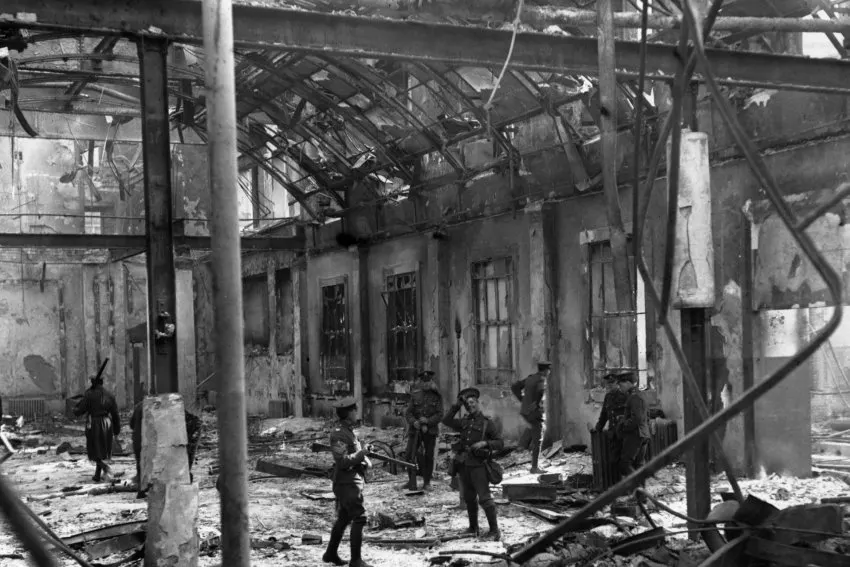
The Rising itself ran from Easter Monday, 24 April, to Pearse's surrender on 29 April 1916. Wikipedia's count is 485 dead: 260 civilians, 143 British military and police, and 82 rebels, including the sixteen leaders executed afterwards. When Llywelyn talks about "revisionist history" she was writing into a live argument over how Ireland should remember those six days. That argument outlasted this interview by a long way.
On the screen projects: she mentions options on Lion of Ireland, Pride of Lions, Bard and others, and early interest in 1916. We have not found a released film of any of them.
Questions readers ask
Who is Ned Halloran in Morgan Llywelyn's 1916?
Ned Halloran is the fictional hero of 1916: A Novel of the Irish Rebellion, published in 1998. He is fifteen when the story opens in 1912, survives the sinking of the Titanic, loses his parents and becomes a pupil at Patrick Pearse's school, St. Enda's. Llywelyn told this magazine he was a composite drawn from survivors she interviewed and journals kept by St. Enda's boys.
Is Morgan Llywelyn's 1916 historically accurate?
Llywelyn built the novel history first. She told Thomas Larkin she kept the real events unchanged and used fictional characters only to fill gaps the record leaves open. The book is heavily endnoted, and she drew on private papers and journals held by descendants of participants. The Rising itself ran from 24 to 29 April 1916 and left 485 people dead.
Did students from St. Enda's fight in the Easter Rising?
They did. Fifteen former pupils of St. Enda's, the Irish-language school Patrick Pearse founded in 1908, took part in the 1916 Rising. The school had moved from Cullenswood House in Ranelagh to the Hermitage in Rathfarnham in 1910, and it closed for good in 1935. The Hermitage now houses the Pearse Museum.
What comes after 1916 by Morgan Llywelyn?
The sequel is 1921: The War for Independence, published in 2001. In 1998 she told this magazine it would also take in the Civil War. 1949: The Irish Republic followed in 2003, and she later extended the run with 1972 in 2005 and 1999 in 2008, five novels in all.